

Jet Bead is in Jet.
Carbon Date. 1520BC. Middle Bronze Age Carbon Dates
Report: human bone; from a Bronze Age grave which also contained six sheet bronze beads, 13 jet buttons, a jet toggle, and a necklace of 180 jet beads; depth c 0.46m below the surface prior to April 1970; no rootlets were present in the grave.
ID: 16125, C14 ID: HAR 1282 Date BP: 3520 +/- 70, Start Date BP: 3590, End BP: 3450
Abstract: Garton Slack; 1975-76
Reference Name: Jordan, D, Haddon-Reece, D, Bayliss, A 1994 'Radiocarbon dates: from samples funded by English Heritage and dated before 1981', London: English Heritage
Council for British Archaeology (2012) Archaeological Site Index to Radiocarbon Dates from Great Britain and Ireland [data-set]. York: Archaeology Data Service [distributor] https://doi.org/10.5284/1017767
Carbon Date. 1370BC. Late Bronze Age Carbon Dates
Report: Charcoal from layer B abutting F1 and within F2 at Crawley Edge Cairn A, Stanhope, Weardale, Co Durham, England. Comment (subm): Date tends to agree with tubular jet beads and Collared Urn from site.
ID: 2251, C14 ID: HAR-3322 Date BP: 3370 +/- 80, Start Date BP: 3290, End BP: 3450
OS Letter: NZ, OS East: 0, OS North: 397
Archaeologist Name: R Young 1976-7
Reference Name: Durham Archaeol J, 8, 1992, 27-49 esp. 39
Council for British Archaeology (2012) Archaeological Site Index to Radiocarbon Dates from Great Britain and Ireland [data-set]. York: Archaeology Data Service [distributor] https://doi.org/10.5284/1017767
Carbon Date. 1350BC. Late Bronze Age Carbon Dates
Report: Charcoal from base of largest internal pit, which also yielded small shale or jet bead at Carneddau Ring Bank, Carno, Powys, Wales.
ID: 1818, C14 ID: CAR-1261 Date BP: 3350 +/- 70, Start Date BP: 3280, End BP: 3420
OS Letter: SN, OS East: 993, OS North: 998
Archaeologist Name: Bob Silvester (Clwyd-Powys Archaeological Trust)
Reference Name: Archaeol Wales, 31, 1991, 26
Council for British Archaeology (2012) Archaeological Site Index to Radiocarbon Dates from Great Britain and Ireland [data-set]. York: Archaeology Data Service [distributor] https://doi.org/10.5284/1017767
Carbon Date. 1350BC. Late Bronze Age Carbon Dates
Report: Charcoal from surface of natural mineral soil beneath cairn at Crawley Edge Cairn A, Stanhope, Weardale, Co Durham, England. Comment (subm): Date tends to agree with tubular jet beads and Collared Urn from site.
ID: 2252, C14 ID: HAR-3323 Date BP: 3350 +/- 90, Start Date BP: 3260, End BP: 3440
OS Letter: NZ, OS East: 0, OS North: 397
Archaeologist Name: R Young 1976-7
Reference Name: Durham Archaeol J, 8, 1992, 27-49 esp. 39
Council for British Archaeology (2012) Archaeological Site Index to Radiocarbon Dates from Great Britain and Ireland [data-set]. York: Archaeology Data Service [distributor] https://doi.org/10.5284/1017767
Carbon Date. 1045. Late Medieval
Report: Charcoal resting on floor of packed pebbles in front of cave mouth (assoc. with ball or thistlehead pin, jet bead, jet armlet fragments etc), at Jonathan's Cave, East Wemyss, Fife, Scotland.
ID: 1491, C14 ID: GU-1369 Date BP: 955 +/- 70, Start Date BP: 885, End BP: 1025
OS Letter: NT, OS East: 345, OS North: 972
Archaeologist Name: E W MacKie
Reference Name: Glasgow Archaeol J, 13, 1986, 74-7
Council for British Archaeology (2012) Archaeological Site Index to Radiocarbon Dates from Great Britain and Ireland [data-set]. York: Archaeology Data Service [distributor] https://doi.org/10.5284/1017767
Colt Hoare 1812. No. 171 [and Normanton Barrow 171 G36h-p [Map]] denotes a group of various tumuli of the largest of which produced a rude urn, some jet beads, and different sizes; a brass pin. In another, which had been opened before, we found the fragments of a large urn, and a piece of granite similar to one found in a barrow at Upton Lovel. Nearly all the smaller barrows in this group contained simple interments of burned bones.
Colt Hoare 1812. No. 26 [Winterbourne Stoke Barrow 26 G9 [Map]] is a fine bowl-shaped barrow, 97 fret in diameter, and nine feet and a half in elevation. Mr. Cunnington attempted to open it in the year 1804, but missed the interment, when, as it turned out, he was within one foot of it. Fortune now favoured our researches, and discovered to us in an oblong cist, a skeleton lying from north to south, within a shallow case of wood, of a boat-like form. Round its neck were found a great variety of amber and jet beads, a lance head, and pin of brass, with a little urn of a very neat form, which was broken to pieces.

Colt Hoare 1812. No. 156 [Normanton Barrow 156 G7 [Map]] is a fine bell-shaped barrow, 102 feet in base diameter, and 10 feet in elevation above the plain. It contained within a very shallow cist, the remains of a skeleton, whose head was placed towards the west, and a deposit of the most various elegant little trinkets; the most remarkable of which are two gold beads, engraved of their original size in Tumuli Plate XXV. No. 7, 8. The first is of an oblong form, large, and ornamented with circular rings; the other is much less, and of a globular; they appear to have been formed by first making a wooden bead, and then covering it with two thin plates of gold, which were overlapped in the centre, and made fast by indentation; for in none of these golden articles have we ever distinguished any marks of solder, or any other mode of fastening than by indentation. The large bead is perforated lengthways, the smaller one in two places on one side. Besides these beads of gold. there were several trinkets of jet, amber, &c. viz. a flat: piece of amber, No, 9; two other pieces, the one plain, the other marked with transverselines, both perforated; also two round beads of amber; a jet bead of a globular form, but much compressed, No. 10; another with convoluted stripes, No. 1; an article of jet, singular in its shape, No. 12; and some curious beads of stone, one of which, No. 13, seems to be the joint of a petrified echinus [sea urchin]. Besides the above articles, the most remarkable of which are engraved in Tumuli Plate XXV. we found another beautiful little grape cup, similar to those before described in Tumuli Plates XI. and XXIV. in high preservation. There was also a drinking cup placed at the feet of the skeleton, which was unfortunately broken, but afterwards repaired.
Ten Years' Digging. On the 5th of July we resumed the examination of the barrow at Nether Low [Map], and found at the west side about five yards from the centre, four interments, three of which were placed in angle of a shallow depression in the rock, of irregular form. The most important of these was the skeleton of a middle aged man, lying contracted in the western angle, having beneath the head, and in contact with the skull, a beautiful leaf-shaped dagger of white flint, 4½ inches long, with the narrower half curiously serrated. A few inches from this unique weapon, was a plain but neat spear head of white flint. In a joint of the rock at a right angle with this interment, was a slender skeleton, probably of a female in the prime of life, accompanied by a prism-shaped piece of white flint, a piece of hematite, a boar's tusk, and a large globular bead of jet; the last found close to the neck.
The third skeleton was that of a much younger subject, and lay on the rock a little nearer the centre; it was not provided with implements, but between it and the others was a single piece of a calcined human skull. They were all about 4 feet from the top of the barrow.
Another skeleton was discovered about two feet from the surface, in a cist covered by a large flat stone and constructed across the joint of rock occupied by the female skeleton; it was accompanied by stags' horns of large size, and an arrow point of grey flint; and appeared to be the body of a person 17 or 18 years old.
In another cutting, near the outside, we found the remains of an infant, and a very neat instrument of white flint of uncertain use.

Anne Boleyn. Her Life as told by Lancelot de Carle's 1536 Letter.
In 1536, two weeks after the execution of Anne Boleyn, her brother George and four others, Lancelot du Carle, wrote an extraordinary letter that described Anne's life, and her trial and execution, to which he was a witness. This book presents a new translation of that letter, with additional material from other contemporary sources such as Letters, Hall's and Wriothesley's Chronicles, the pamphlets of Wynkyn the Worde, the Memorial of George Constantyne, the Portuguese Letter and the Baga de Secrets, all of which are provided in Appendices.
Available at Amazon in eBook and Paperback format.
Ten Years' Digging. On the 5th of June [1850], we opened a barrow [Hill Head Barrow [Map]] on the Hill Head, an eminence in the neighbourhood of the last. The mound is about twelve yards across, and presents the appearance of having been much reduced, the height being nowhere more than eighteen inches. The centre had been disturbed with the effect of displacing the skeletons of three or four persons and some calcined bones; the earth around did not appear to have been moved, as masses of rats' bones occupied their original level. Notwithstanding the unfavourable condition of the barrow, we collected 81 jet ornaments, composing a handsome necklace that had accompanied one of the skeletons, they comprise 53 cylindrical, and 11 flat beads, 12 conical studs, and five out of the six dividing plates requisite to form the decoration: the plates are plain, and the centre pair are perforated for eight beads to go between. It is likely that many more of the very small flat beads would have been found if the tumulus had not been before disturbed; those that were found being collected with much trouble from an area of many feet, instead of lying near the head of their owner.
Ten Years' Digging. On the same afternoon, we began an examination of a large mutilated flat-topped barrow [Hay Top Barrow [Map]], twenty yards diameter and four feet high, on the summit of a hill called Hay Top, overlooking the manufacturing colony of Cressbrook. The mound is piled upon a naturally elevated rock, so as not to present more than two feet of accumulated material in the middle, where we began to dig, finding remains of many individuals, from infants to adults of large stature (an imperfect femur, broken off below the neck, measuring near nineteen inches), but all were in disorder except one skeleton, which appeared to lie on its left side in the centre; it was, however, so much surrounded by other bones as to be rather difficult to identify, and, from the same confusion, we cannot positively assign all the following articles to it, though there is scarcely a doubt that the flints and bone ornament were buried with it: - The objects referred to, are ten jet beads of the three common shapes, several flints, including three thick arrow points, and a curious bone ornament, with a hole for suspension round the neck, where it was found, not unlike a seal with a rectangular face. The skeleton, from the slenderness of the bones, was judged to be that of a female. We casually found pieces of two vessels, a polecat's skull, and many bones of the water-vole.

Ten Years' Digging. About the middle of the excavation, in the rock, were two rather small human crania, placed side by side, near a drinking-cup 7¼ inches high, ornamented with a lozengy pattern. Upon the crown of one of the skulls was a neatly chipped instrument of grey flint, and it is singular that no trace either of the lower jaws or of any other parts of the skeletons could be seen, though no dis-arrangement had ever taken place in this part of the mound, and it is certain that the crania alone had been buried there. At a little distance from them were the skeleton of a child, and one cylindrical jet bead. These discoveries, with the occurrence of numerous broken bones, both human and animal in the upper parts of the trenches, terminated the labours of the day. A portion of the west side of the mound intervening between the cuttings being reserved for the next day's examination, when it was cut out to the level of the rock, disclosing a grave about a yard square, sunk about three feet lower. Inside this excavation was a very neat rectangular cist, 2 feet long and 18 inches wide, formed of four flat slabs of limestone, filled with limestone, gravel, and rats' bones, which being very carefully removed, allowed us to see the skeleton of a child, doubled up, with the head to the south, and a most beautiful little vase, 4⅜ inches high, completely covered with a minute chevron pattern, lying obliquely in contact with the pelvis of the child, which had become thrust into it by the pressure of the grave; the depth at which this deposit lay was about five feet from the surface of the mound. The skeleton of the child is arranged in a glass case at Lomberdale House [Map], and from the abnormal shape of the head, it is probable that death was occasioned by hydrocephalus. Many burnt bones, and disjointed bones, as before, were found in the course of the day. The plan of this interesting barrow will illustrate the foregoing account.
Proceedings of the Society of Antiquaries 1896 Dec 17 Thirkel Low. On July 24th, Mr. Salt and his son resumed the digging, primarily with a view to finding the missing skull. They continued the trench to within two feet of the north-east margin of the barrow. Nothing noteworthy was met with until about 3 feet from this margin, when a high-level unburnt interment was discovered at about a depth of 9 inches from the surface. The skeleton, as might be expected from being so near the surface, was much decayed, broken, and disarranged, so that nothing could be made out as to its original attitude. With these remains were found the following: several fragments of a hand-made vessel of the ordinary 'food-vase' type, about 8 or 9 inches in diameter at the mouth, and its upper part decorated with chevrons and diagonal parallel lines, produced by the impression of a twisted rush or thong: a small disc-like jet bead, about 1/16 inch in thickness, and ¼ inch in diameter; an irregular fragment of flint of no determinable use; a rudely formed horse-shoe shaped scraper of chert; and a portion of an iron ox or horse-shoe. This shoe probably did not exceed inch in thickness in its original condition, and was fastened with clout nails (of which one remained), the large heads of which compensated in some measure for the deficiency in the thickness, besides helping to 'rough' the tread.
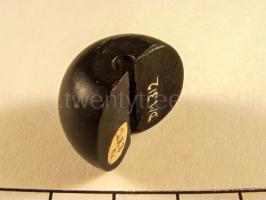
Wiltshire Museum. DZSWS:STHEAD.223a. 1 globular jet bead (split in half) found near the neck of a secondary (?) inhumation in saucer barrow Durrington G14 [Map], excavated by William Cunnington.
Broomrigg Stone Circle C [Map]. Historic England: A circle of 14 stones which enclose an internal area measuring approximately 16m east-west by 13m north-south. Limited excavation of the circle by Hodgson in 1948-9 found a burial cairn in the south west quadrant of the circle which covered a deep pit containing a stone cist composed of sandstone slabs. A short distance to the east a smaller disturbed cist was found. In the cairn's south east quadrant remains of several cremation burials were found together with urns and a number of grave goods including jet beads, a button and a bronze knife or awl. The excavator concluded that a small stone circle of 4.3m in diameter and represented by the remaining stones in the south west quadrant was the earliest construction here. A pit was dug in the centre, and an interment placed in a cist within; a cairn was then raised over the grave. At a later date the stone circle was demolished, apart from the south west arc, which was incorporated into the present surviving larger circle. More interments were then placed within this later circle. At the time of the excavation there was an outlying stone 14.5m south east of the circle's centre.