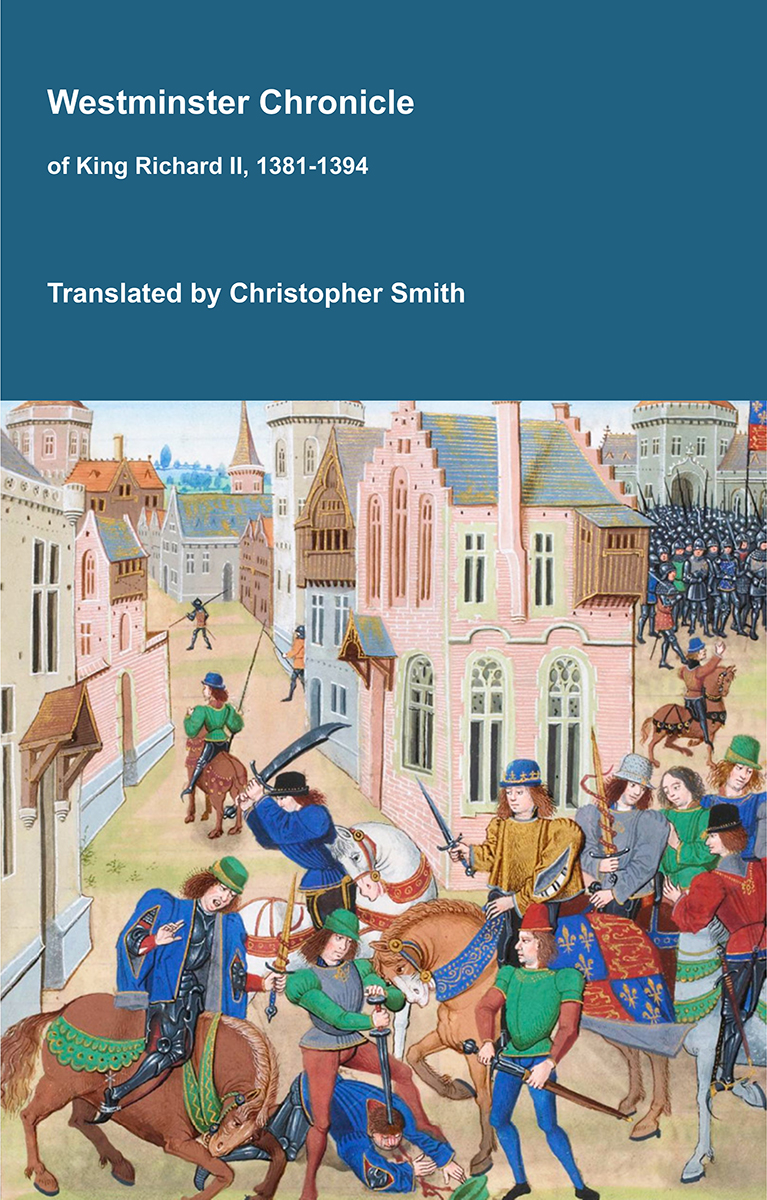
Westminster Chronicle of King Richard II, 1381-1394
The Westminster Chronicle is one of the most vivid and important narrative sources for the reign of Richard II. Written by an anonymous chronicler closely connected with Westminster Abbey, it covers the years 1381 to 1394, from the Peasants’ Revolt to the political tensions, court ceremonies, diplomatic negotiations, royal progresses, and public crises of Richard’s later reign. Rich in detail the chronicle records major events such as the conflicts between the King and Lords Appellant, King and the City of London, negotiations with France and Scotland, the death and funeral of Queen Anne of Bohemia, the illness of Charles VI of France, and the changing fortunes of leading nobles including John of Gaunt, Thomas of Gloucester, Robert de Vere, and the Earl of Arundel. The Chronicle offers readers a remarkable window into late fourteenth-century England, combining political observation, courtly spectacle, urban drama, ecclesiastical affairs, and moral judgement. It is an essential source for anyone interested in medieval monarchy, London, Westminster, and the troubled reign of Richard II.
Available at Amazon in eBook and Paperback format.
Effigy of Isabel d'Angouleme, Queen of King John is in Monumental Effigies of Great Britain.
ISABEL D'ANGOULESME was the third and last wife of King John. She was daughter and inheritrix of Aymer Earl of Angoulesme. Her mother was Alice, daughter of Peter Lord of Courtenay, fifth son of Louis le Gros. She was married to King John in the first year of his reign, and crowned his queen on the 8th of October. She had issue by him, Henry (afterwards Henry III.); Richard Earl of Cornwall and King of the Romans; Joan, married to Alexander the Second, King of the Scots; Eleanor, married to William Mareschal the younger, Earl of Pembroke; then to Simon de Montfort, the celebrated Earl of Leicester, who was slain at the battle of Evesham; and lastly, Isabel, who became the sixth and last wife of Frederick the Second, Emperor of Germany.
Surviving King John, she married Hugh Brun, Earl of Marche, and Lord of Lusignan and Valence, in Poitou. By him she had several children, some of whom were much advanced by Henry the Third, their half-brother, as William de Valence, created Earl of Pembroke; and Athelmar, raised to the Bishopric of Winchester. On the death of the Earl of Marche she took the veil at the monastery of Fontevraud [Map], and was at first unceremoniously interred in the churchyard of that place; her body was however taken up by order of her son, Henry the Third, and the effigy which is delineated placed over her remains.
Details. Plate 1. The camise, fermail, patterns on the border of the tunic and girdle. Plate II. Pattern of the border of the mantle.
