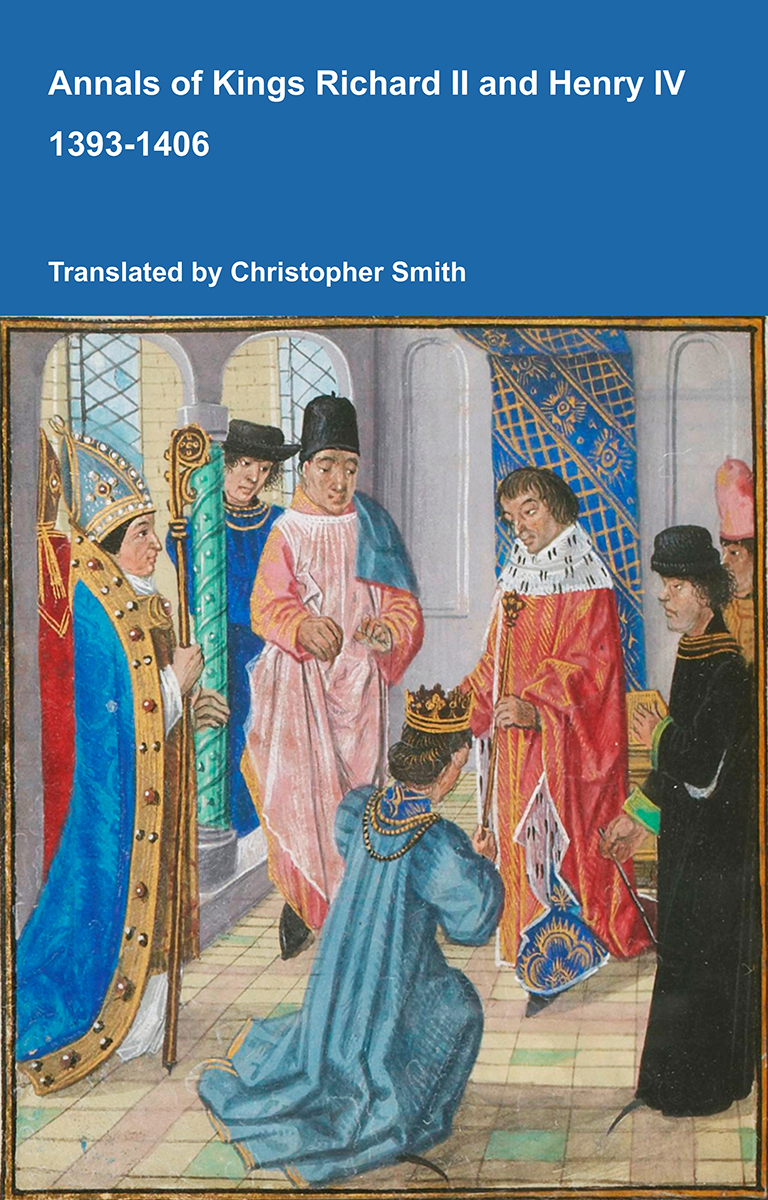
Annals of Kings Richard II and Henry IV 1393-1406

The Annals of Kings Richard II and Henry IV offers a vivid contemporary account of one of the most turbulent periods in late medieval England. Covering the reigns of Richard II and Henry IV, the chronicle records royal ceremonies, political conflict, rebellion, war, taxation, religious controversy, executions, popular unrest and remarkable portents. Its pages include a detailed description of Richard II’s coronation, the fall and deposition of the king, Henry IV’s seizure of the throne, the Percy rebellion, the execution of Archbishop Richard Scrope, the campaigns of Owain Glyndŵr, and England’s relations with Scotland, France, Portugal and Scandinavia. Alongside affairs of state, the annalist preserves reports of miracles, eclipses, prophecies, supernatural events and the experiences of ordinary townspeople, clergy, soldiers and travellers. Written from a monastic perspective, the work combines political observation with moral judgement, presenting victories and disasters as evidence of divine favour or punishment. At once a historical record and a reflection of medieval belief, the Annals provides an invaluable window into the challenges, ceremonies and conflicts of England at the turn of the fifteenth century.

Available at Amazon in eBook and Paperback format.

Effigy of Robert Ros

Effigy of Robert Ros is in Monumental Effigies of Great Britain.

[Robert Ros] WAS descended from the noble family of Ros or Roos, of Hamlake. His father Everard died when he was thirteen years of age, and he had livery of his lands from the wardship of the Crown in the second year of the reign of Richard I. on payment of a hne of one thousand marks; which shows that his possessions must have been very large.

He was one of the Barons who leagued together to obtain the Great and the Forest Charter from John; and when that King had signed them at Runnemede, he was one of the chief persons who undertook to constrain him to observe thema He married Isabella, the daughter of William the Lion, King of Scotland, by whom he had two sons, William and Robert. He gave the first his castle of Helmesley [Map], with the patronage of the monasteries of Kirkham, Rievaulx [Map], and Warden, to the other his castle of Werke and a barony in Scotland, held by knight's service of his brother-in-law. Of both the above-mentioned castles he was the founder. He confirmed to the Templars his manor of Ribstone, with other possessions, assumed the habit of their order, died in 1231, and was buried in the Temple church [Map]. The effigy of Ros is cross-legged, and his hands raised in the act of prayer; the hood of his hauberk is thrown back to show his visage. His sword depends from a belt adorned with broad studs; his surcoat reaches to his heels, which are armed with the pryck spur, and rest on a lion. On his shield are three water bougets, which were the bearing of Ros, Argent, in a held Gules. This figure, like that of Robert de Vere, is of a period subsequent to that of the decease of the person whom it is said to represent.