

The Illustrated London News 1867 is in The Illustrated London News.
APPALLING ACCIDENT IN REGENT'S PARK.
On Tuesday afternoon [15th January 1867] an accident involving a serious loss of life occurred through the breaking of the ice on the ornamental water in Regent's Park. The scene of the terrible event was that portion of the lake extending along the side of the pleasure-ground in front of Sussex-place, and is about 300 yards in length by 130 in breadth. At the east and west ends are small islands, and on the north side there is a third small island midway between the other two, and opposite the end of the low park which bounds that side of the water.
On this part of the lake, which is the broadest, several thousand persons had been skating during the forenoon without any accident taking place, although the ice was looked upon by the experienced icemen on duty as very unsafe, from its being principally snow ice. About half-past three o'clock in the afternoon there were near the same spot about 500 skaters, among whom were many ladies, there being at the same time on the banks from 2000 to 3000 spectators. The excitement and fun were at their highest. Select circles were surrounding the more skilled skaters, men of all ages and classes were darting across in each direction, the park was resounding with sounds of merriment and life, when, without warning, the scene was terribly changed. The entire expanse of ice, covering nearly an acre of water, gave way according to some, exploded according to others, and was agitated as if by an earthquake according to others. The fatal cracks are described as shooting with sharp reports in every conceivable direction, and with such rapidity that it seemed as if the giving way was simultaneous in each direction. Within a minute the whole sheet of the ice over the full width of the lake gave way, and split up into fragments of a few yards square. A general rush was made for the banks, Unfortunately, this broke up the soft ice into still smaller pieces. Numbers of persons fell through the crevices into the water, which is, at this part 12ft. deep. About 200 persons were struggling in the water, and screaming for help. A few, with great presence of mind, threw themselves flat upon the surface of the pieces of ice and were thus instrumental in saving the lives of many of those in the water, as well as preserving their own until assistance came to them.
Several ladies and gentlemen who were standing at different points have endeavoured to convey the scene that was photographed upon their minds when it first burst upon them. As may be expected, words, neither written nor spoken, can adequately portray the horror of the moment. In some directions splashes only indicated were a human being had disappeared; here and there a head would emerge, revealing the agonised features of one who clutched at the broken, slippery ice and again sank; men were seen leaping from block to block, falling at length upon a piece large enough to sustain them for a moment, but small enough to tilt over before they had secured a place of refuge. Nearer the banks, in the shallow water, men and women floundered about with terror-stricken children in their arms; a few, by their own exertions, reached safety after being immersed in the centre of the space for a long time; and, disturbing the already troubled waters on every hand, could be seen the up-thrown arms of men and boys struggling face to face with death. These were the prominent features of the picture the eye took in at one hurried sweep. The screams of those struggling and sinking in the water, and the shouts of the people on the banks, added to the horror of the scene.
Most of the icemen did all that it was possible to do under the circumstances, and three of them narrowly escaped drowning, having, when in the water helping the people out, been seized by others drowning and pulled under the ice. Several of the park-keepers and spectators rendered great aid, and more than one hundred persons within a few minutes of the accident were got on shore, the great number of whom were so much exhausted that they had to be taken to the Humane Society's tent and placed under medical treatment. While this was going on, several persons who were in the water in the middle of the lake, and whom it was impossible for the icemen to reach, the ladd ers and boats being rendered almost useless owing to the state of the ice, were seen to sink back exhausted, evidently benumbed with cold, after vainly endeavouring to support themselves by clutching at the rotten ice, which crumbled away in their grasp.
Many instances of gallantry and of coolness took place.
One man, at the most imminent risk, plunged in and brought several children safely out.
It is also related that a gentleman who fell so that his head and chest rested on a large block of ice, while his feet were in the water, lay smoking his pipe for a long time while the boats were farther out picking up as fast as possible those in a worse position. He began, however, to realise his position, and, removing his pipe from his mouth, he called out, "Fifty pounds to anyone who will fetch me out!" Several abortive attempts were made to reach him with ropes, poles, and ladders. A man, with the aid of a ladder, reached a small piece of sound ice, and endeavoured to throw a rope to him, but it fell short. He then managed to push the ladder on to a piece of ice farther out, and, standing on the former, he again threw the rope. In doing so he fell, and, in clinging to the ladder, he hurt himself and was drawn ashore. A gentleman then got into an escape fitted up with barrels at the end. When pushed ont as far as possible, he got into the water, and endeavoured to push the escape along, but he did not succeed. Eventually, a man stripped to his shirt and trousers, and, a rope having been fixed to his waist, he desperately fought his way through the ice, and, seizing the skater round the body, they were both dragged to land amid tremendous cheers.
Mr. Moore, who received a medal two years ago for saving people under similar circumstances, was very active, and saved several persons.
A man, apparently a mechanic, was shrieking for help about fifty yards out, when his cries attracted the attention of a gentleman in the crowd. Without a moment's hesitation he sprang into the water, battered a passage through the ice with his naked fist, and made for the now sinking man, who immediately threw his arms round his neck and locked him in a perilous embrace. To the horror of those who were watching the incident, both disappeared for the instant, but they ultimately returned safe, amidst the plaudits of the bystanders. The gentleman, giving his companion into the charge of several willing persons, disappeared before any one could speak to him.
The pleasure-boats ordinarily let out by Mr. Searle, were brought into requisition, and one of these, directed by Mr. Archer, the superintendent, was instrumental in saving many lives. From his first expedition amongst the broken ice Archer returned with ten men in hig, for this time veritable life-boat. Again and again he pushed forward, and up to the very last he was seen at work. It was a terrible work for all-police, society's men, park-keepers, and private individuals, many of whom ran into great risks in their well-meant endeavours to give aid. As every boat pushed off there were as many volunteers to man her as would have swamped her, and as every boat moved or was blocked there arose cheers from the spectators, and redoubled cries from those whose lives depended on the work. The most noteworthy and touching of these incidents was that of a father holding his two children, a boy and a girl, and who had held them all the long thirty minutes of the acting of this terrible scene. He stood up to his waist in the water, hemmed in by large masses of ice, holding his boy on one shoulder and the girl under the other arm. At length a boat made its way to him, and he and his children were brought ashore amid the acclamations of the crowd and some tears of mingled grief and joy.
Most praiseworthy measures were taken to resuscitate the insensible, revive the faint, and help the weak. The inhabitants of the neighbouring terraces-Sussex-terrace especially-sent out an abundant supply of stimulants and clothing. The Humane Society's tent was much too small to accommodate those who required the attention of the three surgeons present. Amongst the crowd, by a most fortunate circumstance, were Mr. and Mrs. Douglas, the master and matron of Marylebone workhouse, and their presence of mind and energy cannot be too highly appreciated. The former immediately sent for police, blankets, and brandy, and the latter hastened to the workhouse, to prepare for the reception of the injured. The result of this praiseworthy promptitude was that surgeons and their remedies were ready before the first patient arrived. Indeed, the whole resources of the establishment were at the disposal of those who needed them. Fifteen men and boys, in various stages of exhaustion, arrived there in cabs, and were subjected to proper treatment. While some of the patients were apparently lifeless others were in a state of delirium, crying out for help, and suffering over again the agonies of immersion. Four or five young men recovered quickly and were sent home, amongst them an iceman named Sheridan, who had been nearly drowned.
THE SEARCH FOR BODIES.
The true magnitude of the catastrophe has not yet been fully ascertained.
With the dawn of Wednesday came fresh horrors. All who could be saved had, of course, been saved the night before; but nightfall interrupted the operations. It was hoped, rather than expected, that the number of ten — consisting of eight lying at the Marylebone Workhouse and two at St. Mary's Hospital, Paddington —might represent the weight of the calamity. But a few hours' labour at the scene of the accident showed that the measure of the loss had been more truly taken at the time of the occurrence. Body after body was carried down by the police till, at three o'clock, the number was more than thirty. Many of these were well and even fashionably dressed young men, with watches and sums of money in their pockets. Some were mere boys. Of those belonging to the better classes nearly all had skates upon their feet. The countenances of those taken out of the water on Tuesday were not greatly discomposed, nor were their clothes dirtied; but in the case of those brought to the surface on Wednesday, not only did their clothes show traces of the mud at the bottom of the lake, but their features wore a harder and more painful expression. In many cases, also, the skin was purpled, or almost blackened, as if with frost bites.
To stand in or near the deadhouse was more trying than to witness the actual arrivals; for a loud scream was invariably the announcement that some unhappy father, mother, sister, or wife had found the object of their search.
It was (says the Times correspondent) a relief to quit this house of woe, even for the spot where the search was being prosecuted. At first it seemed, from the aspect of the place, in the last degree improbable that such an accident could have occurred. The ice was frozen hard and thick — so obstinate, in fact, was its resistance that fifteen, sometimes twenty minutes', hard work was requisite with too's suitable for the purpose before a narrow passage could be made allowing a boat to advance its own length. Seven boats, punts, or skiffs were engaged during the day at the portion of the lake where it was believed that the majority had fallen in; and it was as much as the men in them could do to make and keep sufficient openings clear for the purpose of using the drags. Along the edges of the lake others co-operated by cutting and breaking pieces of ice as far out as they could reach, or by floating away fragments from the tracks and narrow canals left by the passage of the boats. Looking closely at the surface, traces of the previous day's catastrophe were discernible. Great flaws and scars in the surface, knit together by fresh ice, indicated, like badly-healed wounds, that there must have been some violent disruption of the surface, and the ice itself preserved some records of its own treachery in the hats and oranges, and in one part a lady's muff, which, once afloat, were now congealed with the solid mass.
Up to nine or ten o'clock, with the exception of the police, Humane Society men, and park-keepers, the inclosure was left to its legitimate occupants, the outside public taking its stand on the elevated ridge at the north-east side of the lake. After that hour, however, the mass of people outside the railings, becoming excited by the fact that bodies were being found in such numbers, clambered over the barriers.
Between one and two o'clock on every side of the lake there was a wall of human faces and figures, in some places six, in others twenty, deep. Many of these were watching with an interest only too real the progress of the search, but the vast majority unmistakably belonged to the class for which "rough" has become the accepted designation. The air seems to carry to this class, as it does to birds of particular habits, the scent of blood. A dreadful accident happens one day, and the next there they are in thousands gazing upon the victims. It is only fair towards the men themselves to say that, as a rule, they seemed touched and softened by the magnitude and character of the calamity, and that comparatively few remarks unworthy of the place or of the scene were indulged in. But there they were, following the instincts of their tribe. In the face of a biting wind, and occasionally of thin drifts of snow, they kept their ground for hours, watching with an interest that never slackened that solemn quarrying of the ice with hatchet, pickaxe, stone-hammer, and mallet, and the still more dreadful feeling along the bottom for something that, when it was found, came up stark and stiff. As often as one of these shapeless masses, more like trunks of trees than anything else, rose to the side of the boat, and was tenderly lifted in, that ghastly sound, which is not a sob, nor a gasp, nor a groan, nor a yell, but a compound of all four, the cry of the British mob, went up into the air. Many times, too many times, this cry was heard during the day. Strong men and little boys-the artisan, the itinerant fruit-vender, and the poor little blue-coat boy-were fished up one after the other by those awful hooks. As soon as they were landed they were laid upon the grass to be identified; if not recognised within a certain time, or, indeed, whether or not, they were carried off on stretchers to be added to the lamentable total at the Marylebone Workhouse. At half-past seven o'clock in the evening twenty-three bodies formed the result of Wednesday's operations.
The dragging for the bodies of the drowned was resumed at an early hour on Thursday morring. That several yet remain under water no one doubts, but the process of recovery is necessarily a slow one. Notwithstanding the severity of the weather, the bank was once more lined with spectators, and when a body was recovered they crowded eagerly together for the purpose of catching a glimpse of the ghastly corpse. About ten o'clock two bodies were recovered, one being that of a lad fourteen years of age, named David North, who lived at 55, Wellstead-street, Somers Town-a locality which has contributed a large quota to the list of the dead; the other is that of a working man, about thirty years of age; it lies in the deadhouse of St. Marylebone Workhouse, and had not been identified at the time we went to press with our country edition. The clothes worn are a dun-coloured pea-jacket, dark tweed trousers, white socks, and elastic-sided boots. Ia one of the pockets were found two letters, one from Prospect-place, Bury St. Edmunds, written by females of the names of Browning and Reeve. The teeth are compressed and the hands clenched. About two o'clock two other bodies (unidentified) were pulled out. They were found deposited at some depth under the mud.
Jean de Waurin's Chronicle of England Volume 6 Books 3-6: The Wars of the Roses
Jean de Waurin was a French Chronicler, from the Artois region, who was born around 1400, and died around 1474. Waurin’s Chronicle of England, Volume 6, covering the period 1450 to 1471, from which we have selected and translated Chapters relating to the Wars of the Roses, provides a vivid, original, contemporary description of key events some of which he witnessed first-hand, some of which he was told by the key people involved with whom Waurin had a personal relationship.
Available at Amazon in eBook and Paperback format.
One incident is worth recording. A large Newfoundland black dog, which accompanied its master on the ice and managed to get back on the shore, has since Tuesday afternoon never quitted the ground, nor have the police been able to drive it away. Sergeant Neal, 9 D, has on three occasions brought food for it, but the dog has refused it.
OPENING OF THE INQUEST.
The inquest upon the bodies of the deceased persons was opened by Dr. Lankester, the Coroner for Central Middlesex, on Wednesday evening, at the board-room of the Marylebone Workhouse. The inquiry was opened thus early in order that the necessary identification should be proceeded with and the bodies delivered up to the friends. The doors of the workhouse were surrounded by crowds of people, many of whom besought admittance on the plea that relatives and friends were missing, and the distress of some of the applicants was most painful. The jury having been sworn, the following identifications were taken on oath:-
Donald Macintyre, 8, Highbury-crescent, Islington, was identified by Captain Moriarty, of her Majesty's ship Fox. He was twenty-six years of age, and was a silkmercer.
William Smith, 6, Margaret-street, Cavendish-square, was identified as a gasfitter, twenty-six years of age.
Thomas Harvey, jun., 38, Springfield-place, Leeds, residing with friends, 56, Torrington square, was described as seventeen years of age, and a student at University College Hospital.
Charles Jukes, 8, Dorset-buildings, New-street-mews, Dorset-square, was stated by his father to be nine years of age.
H. Woodhouse, of Bedford House, Tavistock-square, was identified by the Rev. Arthur W. Archer as his nephew. Deceased was sixteen years of age and the son of a colonial broker.
James Crawley, 28, Sherborne-street, Blandford-square, was identified by his father. He was a coach-joiner, aged twenty-two, and single.
C. E. Luckman, 2, Mountpleasant, Barnsbury, was identified by his father, and described as a Manchester warehouseman, aged twenty-four, and single.
R. Born, 60, Hampstead-road, was described by his brother as thirteen years of age, the son of a publican.
James Griffin, 20, Lincoln-court, Drury-lane, was identified by his father. He was described as twenty-eight years of age, and an orange-vender.
William Parkinson, 10, Phoenix-place, Somers Town, was identified by his father. Deceased was eighteen years of age, and an artisan.
John Bryant, 8, Church-lane, St. Giles's, was identified by his brother, who described deceased as twenty-two years of age, and a costermonger.
John Spencer Woods, 73, Chiswell-street, Finsbury, was described as eighteen years of age, and an upholsterer.
Richard Haarnack, 10, Charlotte-street, Fitzroy-square, was identified by his father, and described as ten years of age.
John Thomas Whately, 25, Gower-place, Euston-square, fourteen years of age, was described as a Bluecoat-school boy.
Edward Thurley, 17, Hanover-terrace, was described by his brother-in-law as a butler, thirty-four years of age, married.
Henry Hardiman, 16, Maredon-street, Euston-road, was identified by his mother, and it was stated by her that he was seventeen on the day of his death.
Thomas Harries, 156, Camden-road-villas, Camden Town, was identified by his brother, and described as a single gentleman, twenty-nine years of age.
Robert Edwin Scott, 52, Harrington-street, was identified, and described as a clerk, married, and twenty-nine years of age.
Arthur Reginald Stevens, 91, Charlotte-street, Fitzroy-square, was identified as the son of Lieutenant-Colonel Stevens, of the Indian Army, and sixteen years of age.
Charles William Wake, 4, Stanhope-street, Hampstead-road, was described as a law student, aged twenty.
Joseph Waite, 5, Mecklenburg-street, was described as about twenty-two or twenty-three years of age, a clerk, and single.
James Mitchell, 25, Munster-square, was identified by a fellow-workman, who described deceased as twenty-six years of age, an organ-builder, and single.
Charles Smith, Cumberland-mews, was shown to be the son of a coachman, and thirteen years of age.
John Edward Claridge, 47, Union-street, Somers Town, was described as fourteen years of age.
John Vincent, at Mr. Burrows's, 2, Richmond-grove, Richmond-road, Barnsbury, was shown to be ten years of age.
George Rhodes, 40, Charles-street, Portland Town, was identified as a painter and decorator, twenty or twenty-one years of age.
John Broadbridge, 15, Little Exeter-street, Lisson-grove, was identified by the parents, and described as ten years of age.
William Davies, 70, Mornington-road, aged twenty-two, medical student.
The two last-mentioned were brought in from St. Mary's Hospital.
The above persons only were sworn to, and the following are the names of those whose bodies have yet to be claimed :-Henry Gambell, 32, Leighton- road, Kentish Town; T. Justice, Unsworth-mews; - Sheldwick, Maldon- road; and Edward Pullman, 53, Buckingham-road, Kingsland.
The only other body remaining in the Marylebone Workhouse has been identified as that of Mr. Thomas Wilson Spencer, of Keighley, Yorkshire, who had been staying at the Inns of Court Hotel, and who had a half of a first-class return ticket to Bradford in his pocket when he lost his life.
During the proceedings only two or three observations were made apart from the identification. The father of one of the deceased persons complained that the ice was purposely broken round some parts of the lake, and to this he attributed the accident. The body of the deceased Davies was identified by the son of Dr. Hardwicke, the deputy coroner. This witness stated that he was on the ice with deceased, and, having a presentiment that the ice would break, he walked to the land.
The inquest was formally adjourned until Saturday evening, for the further identification of the bodies lying in the deadhouse, and of any more which may be recovered.
It is proposed to open the inquiry on Monday into the cause of the accident.
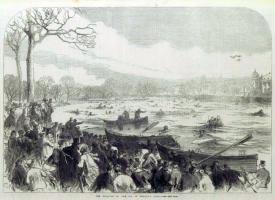
[26th January 1867] THE DISASTER ON THE ICE IN REGENT'S PARK. In our last publication we gave an account of the dreadful accident in Regent's Park on Tuesday week, when the ice of the lake or ornamental water, on which several hundred persons were skating or sliding, broke down so suddenly and unexpectedly that a great number of them were plunged into the water, by which more than forty were unhappily drowned. From a sketch made very soon afterwards by an eye-witness of the accident, we have prepared the Illustration engraved on the preceding page. The point of view is the bank opposite Sus-ex-terrace, looking across the broad part of the lake, with the largest island and the lawn belonging to a private honse called "The Holme" extending to the left-hand side. The scene was most distressing for many minutes after the breaking of the ice: a multitude of people, amongst whom were several women and children, were struggling in the water, and trying to save themselves by holding the pieces of ice, and most of them screaming in despair. Of those on shore, a few were able to give prompt assistance to the nearest sufferers and help them to scramble to land; but many were struck with horror and could do nothing but utter cries of lamentation. The icemen of the Royal Humane Society and the park-keepers, aided by some of the spectators, lost not a moment in bringing all their ropes, poles, ladders, and boats to the place, and endeavouring to rescre those who still remained above water, as is shown in our Engraving. Several remarkable incidents in the escape of those more fortunate persons were related last week. The total number of those who sank to rise no more proves considerably greater than was at first supposed, forty dead bodies having been recovered up to Saturday evening, when the adjourned inquest was resumed by Dr. Lankester, the Coroner, at the Marylebone Workhouse.