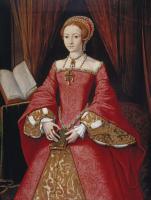
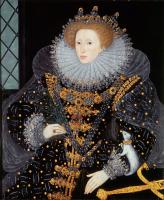
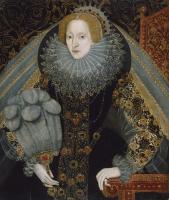
About six at night she made signs for the archbishop1 and her chaplains to come to her, at which time I went in with them, and sat upon my knees full of tears to see that heavy sight. Her Majesty lay upon her back, with one hand in the bed, and the other without. The bishop kneeled down by her, and examined her first of her faith ; and she so punctually answered all his several questions, by lifting up her eyes, and holding up her hand, as it was a comfort to all the beholders. Then the good man told her plainly what she was, and what she was to come to ; and though she had been long a great Queen here upon earth, yet shortly she was to yield an account of her stewardship to the King of kings. After this he began to pray, and all that were by did answer him. After he had continued long in prayer, till the old man's knees were weary, he blessed her, and meant to rise and leave her. The Queen made a sign with her hand. My sister Scroop2 knowing her meaning, told the bishop the Queen desired he would pray still. He did so for a long half hour after, and then thought to leave her. The second time she made sign to have him continue in prayer. He did so for half an hour more, with earnest cries to God for her soul's health, which he uttered with that fervency of spirit, as the Queen, to all our sight, much rejoiced thereat, and gave testimony to us all of her Christian and comfortable end. By this time it grew late, and every one departed, all but her women that attended her.
This that I heard with my ears, and did see with my eyes, I thought it my duty to set down, and to affirm it for a truth, upon the faith of a Christian ; because I know there have been many false lies reported of the end and death of that good lady.
I went to my lodging, and left word with one in the cofferer's chamber to call me, if that night it was thought she would die, and gave the porter an angel to let me in at any time when I called. Between one and two of the clock on Thursday morning, he that I left in the cofferer's chamber, brought me word the Queen was dead3.
Note 1. Archbishop John Whitgift [aged 73]. He was highly esteemed by Queen Elizabeth for his sense, learning, and piety. The Queen, who was particularly wary what concessions she made, and to whom she granted them, allowed Archbishop Whitgift, in the year 1579, (then Bishop of Worcester,) the power of bestowing the prebends of his church on such persons as he thought fit, which disposal before this time had not been in the nomination of the Bishop, but of the crown ; nor did she now give away the right of such disposal to him, and his successors, but only as a particular favour to himself during his continuance in that see. And in the year 1580, the nomination of justices of the peace for Worcestershire and Warwickshire was left to his discretion. Such a confidence did the Queen repose in the wisdom and integrity of this Bishop. — See the Lives of the Archbishops.
Note 2. Philadelphia, Lady Scroop, second daughter of Henry Cary, Lord Hunsdon.
Note 3. She died March 24 [1603], soon after the archbishop had left her, about three o'clock in the morning.
Click to read more ...