All About History Books on Amazon

The True Chronicles of Jean le Bel Volume 1 Chapters 1-60 1307-1342

The True Chronicles of Jean le Bel offer one of the most vivid and immediate accounts of 14th-century Europe, written by a knight who lived through the events he describes, and experienced some of them first hand. Covering the early decades of the Hundred Years’ War, this remarkable chronicle follows the campaigns of Edward III of England, the politics of France and the Low Countries, and the shifting alliances that shaped medieval warfare. Unlike later historians, Jean le Bel writes with a strong sense of eyewitness authenticity, drawing on personal experience and the testimony of fellow soldiers. His narrative captures not only battles and sieges, but also the realities of military life, diplomacy, and the ideals of chivalry that governed noble society. A key source for Jean Froissart, Le Bel’s chronicle stands on its own as a compelling and insightful work, at once historical record and literary achievement. This translation builds on the 1905 edition published in French by Jules Viard, adding extensive translations from other sources Rymer's Fœdera, the Chronicles of Adam Murimuth, William Nangis, Walter of Guisborough, a Bourgeois of Valenciennes, Geoffrey le Baker of Swinbroke and Richard Lescot to enrich the original text and Viard's notes.

Available at Amazon in eBook and Paperback format.

Archaeologia Volume 3 Section XXIX

Archaeologia Volume 3 Section XXIX is in Archaeologia Volume 3.

Discoveries in a Barrow [Winster Barrow [Map]] in Derbyshire. Communicated by Mr. Mander, of Bakewell, in the said County. Read at the Society of Antiquaries, March 17, 1768.

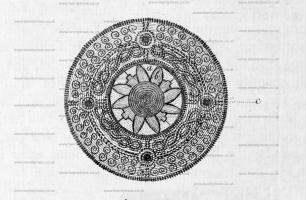
Upon the commons of Winster [Map], a village within the King's great manor de Alto Pecco, which were lately inclosed, are divers barrows, or tumuli, chiefly of stone, and among the rest one of earth, which the inhabitants account the more singular. This being lately opened, there were found in it two glass vessels, between eight and ten inches in height, with wide circular mouths, and a little bulge in the middle, and containing about a pint of water, of a light greenish colour, and exceeding limpid. With these was also found a silver collar or bracelet, about an inch broad, joining at the ends in dovetail fashion, and studded with human heads, and other small ornaments, secured by rivets, which might occasionally be detached. Also an ornament of the size and fashion above [below] represented, composed chiefly of filligree work, of gold or silver gilt, and set with garnets, or red glass. The inward part (a) is raised above the rest, and suppofed to be gold. The partitions, marked (b), were filled with red glass or garnets; as were the four spots marked (c). The rest was filligree, or chain-work. The large sstone which filled the socket in the centre is wanting. To the back of this ornament is affixed a plate of silver, secured by four rivets, lying under the four circular stones in the border. There were also several square and round beads, of various colours, of glass and earth, and some small remains of brass, like clasps and hinges, and pieces of wood, as of a little box, in which the ornaments had been deposited.