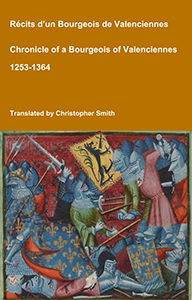
Chronicle of a Bourgeois of Valenciennes
Récits d’un bourgeois de Valenciennes aka The Chronicle of a Bourgeois of Valenciennes is a vivid 14th-century vernacular chronicle written by an anonymous urban chronicler from Valenciennes in the County of Hainaut. It survives in a manuscript that describes local and regional history from about 1253 to 1366, blending chronology, narrative episodes, and eyewitness-style accounts of political, military, and social events in medieval France, Flanders, and the Low Countries. The work begins with a chronological framework of events affecting Valenciennes and its region under rulers such as King Philip VI of France and the shifting allegiances of local nobility. It includes accounts of conflicts, sieges, diplomatic manoeuvres, and the impact of broader struggles like the Hundred Years’ War on urban life in Hainaut. Written from the perspective of a burgher (bourgeois) rather than a monastery or royal court, the chronicle offers a rare lay viewpoint on high politics and warfare, reflecting how merchants, townspeople, and civic institutions experienced the turbulence of the 13th and 14th centuries. Its narrative style combines straightforward reporting of events with moral and civic observations, making it a valuable source for readers interested in medieval urban society, regional politics, and the lived experience of war and governance in pre-modern Europe.
Available at Amazon in eBook and Paperback format.
The History of Scotland by Robert Lindsay of Pitscottie is in Tudor Books.
For the Englishmen, believing that the Scots fled, pursued them so fast, that they were all out of breath. The first battle, led by Sir Bryan Latoun and Sir Robert Bowis had, in the midst of the battle, a thousand spears; and, on their right wing, five hundred hagbutters, and on their left, five hundred bows. Sir Ralph Ivers led the great battle, containing a thousand spears, thousand hagbutters, and as many bows. The Scots, at the beginning, had only three hundred men with the governor, and two hundred with the earl of Angus. The English hasted them to preveen the flight of the Scots, thinking, by one encounter, to put an end to the war. But they, lighting on the ambush of the Scots, all wearied, and out of breath, albeit they were disicouraged, yet, contemning the fewness of their number, set upon them. The Scots had providently gotten the advantage both of the wind and sun (being both in the south-west) so that the sun-beams and smoke of the powder took all fight from the English, besides, the Scottish-mens spears were an ell longer than the English; whereby the English were born down before they could reach at the Scots; who, encountring them most violently, beat back the vanguard upon the great battle; and fo, disordering both, put them to flight, killing their two leaders, Sir Ralph Ivers and Sir Bryan Latoun, and a great number of gentlemen and common soldiers, to the number of five hundred; with the loss of two Scottishmen, slain rakelesly by their own artillery. There were taken a thousand, whereof eighty were gentlemen. The governor, at night, returning to his standard, kneeled down, and gave solemn thanks: to God for the unexpected victory; the like whereof hath scarcely been read of, that so small-a number discomfited so great a host, and so well appointed. The chief of the captives were, Mr. Howard [aged 20] the queen's uncle, Mr. Hutchinson mayor of York, the lord Bowis, Sir John Withrington, many of the Herons and Sellies, and other gentlemen of the borders, and knights of great esteem. This battle was foughten in Teviotdale, at Ancram-muir, the ninth of March, one thousand five hundred and forty-five2.
Note 1. George Howard, brother of Queen Catherine Howard of England.
Note 2. The battle was fought on 27th February 1545.