Chester Archaeological and History Society 1856 Page 48 is in Chester Archaeological and History Society 1856.
Denbigh Castle by William Ayrton.
The Goblin Tower [Map]. Denbigh Castle.
One of the most amusing, if not always the most instructive, provinces of the Archaeologist, has ever been the etymology of names,—both of things, people, and places; and perhaps in no country is there such a field for tracing real or fancied derivations as in Wales, where almost every hill, valley, river or ruin, possesses a title referable to either a British, Saxon, or sometimes a Roman origin.
Denbigh is certainly no exception to this rule; but from the mass of conflicting opinions as to the origin 6f its name, we may select that of Archdeacon Newcome, who in his History of Denbigh says, "The first syllable of the name is without doubt Dinas, a city; and perhaps the last is a proper name." Walters' Dictionary makes it Dinas buck, i.e the desirable city.
While searching the Welsh language for the etymology of the word, it has been remarked by our Historic Secretary, Mr. Wynne Ffoulkes, that the name of Denbigh is nowhere to be found as the title of the place before the Conquest. Previous to that time the inhabitants of the neighbourhood are mentioned in every authentic record as " the men of Rhos Rhyfoniog;" so that Denbigh is, in all probability, a name of English origin. Henry Lacy, first Lord of Denbigh, was Earl of Lincoln, and possessed, among others, a manor in Yorkshire called Deneby, which name, he (Mr. Ffoulkes) thinks may probably have been bestowed by the Earl on his new possession in Wales.
It appears doubtful whether any Castle (in the present sense of the term) preceded the ruin now under notice. That the site was, long before this time, an important fortified post we have abuudant evidence, but that it possessed anything we should recognize as a complete garrisoned town and Castle is not so clear.
Continues ...
1606. Plan of Denbigh Castle and Town Walls [Map] from Speed's Theatre of Great Britain.
Plan of Denbigh Castle from a Survey by James Harrison.
Goblin Tower [Map] at Denbigh Castle.
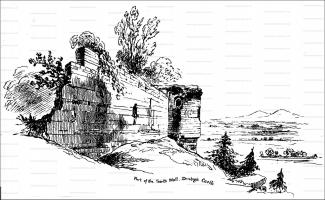
Part of the South Wall of Denbigh Castle [looking toward the Treasure House Tower [Map]]
Adam Murimuth's Continuation and Robert of Avesbury’s 'The Wonderful Deeds of King Edward III'
This volume brings together two of the most important contemporary chronicles for the reign of Edward III and the opening phases of the Hundred Years’ War. Written in Latin by English clerical observers, these texts provide a vivid and authoritative window into the political, diplomatic, and military history of fourteenth-century England and its continental ambitions. Adam Murimuth Continuatio's Chronicarum continues an earlier chronicle into the mid-fourteenth century, offering concise but valuable notices on royal policy, foreign relations, and ecclesiastical affairs. Its annalistic structure makes it especially useful for establishing chronology and tracing the development of events year by year. Complementing it, Robert of Avesbury’s De gestis mirabilibus regis Edwardi tertii is a rich documentary chronicle preserving letters, treaties, and official records alongside narrative passages. It is an indispensable source for understanding Edward III’s claim to the French crown, the conduct of war, and the mechanisms of medieval diplomacy. Together, these works offer scholars, students, and enthusiasts a reliable and unembellished account of a transformative period in English and European history. Essential for anyone interested in medieval chronicles, the Hundred Years’ War, or the reign of Edward III.
Available at Amazon in eBook and Paperback format.
Burgess Gate [Map] at Denbigh Castle.