Bron - y - Garth, Port Madoc, 16th November, 1850.
Dear Sir,
In consequence of the desire you expressed for views and measurements of Ystumcegid, when we visited it together last August, I again repaired to the spot, and I now have the pleasure to forward you the result of my operations and inqui ries. This cromlech, or in Welsh coetan, is situated about half a mile from the left bank of the river Dwyfawr, which winds considerably in this part of its course, and may probably have given rise to the name Ystumcegid or Ystumcuddiedig, meaning the windings of the hidden or concealed. The house which originally stood on this property is reported to have been the residence of Prince Owen Gwynneth in the eleventh century; but, having been burnt down during the wars of Owen Glendower, the present farm - house was erected shortly afterwards.
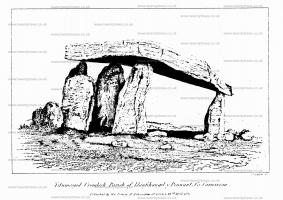
The ground rises towards the cromlech on three sides; it is placed at the edge of a field, with walls of loose stones built up to it. Round about are low undulating hills much covered with large boulders of a sort of greenish trap rock; and in the distance is a view of Cardigan Bay. Three of the pillars or upright supports of the cromlech are of this trap rock; the fourth supporting stone, as well as the slab forming the top, are composed of a hard, grey stratified rock, which was probably obtained from the hills in the immediate neighbourhood, as many pieces or frag ments of this stone, as well as of the trap rock, are used in the construction of the adjoining walls. The top or roofing stone, usually termed " table stone, " is nearly flat, and in shape resembles a boy's paper kite, the sharp end pointing nearly due west. The accompanying sketch, marked No. 4, is a plan of this stone drawn to a scale of half an inch to a foot; it measures eleven feet in the broadest part, fifteen feet in its greatest length, and forty feet eight inches in circumference. The thick ness of the stone varies from fourteen inches to eighteen inches, being greatest at the broad or eastern end; it averages sixteen inches; and I compute its weight to be about fourteen tons. It is placed at an angle gently inclined from east to west, and has five slight marks or grooves on the surface, running also east and west, but which appear to be caused by natural joints in the stone. The height of the three upright stones or pillars at the eastern end is about six feet one inch each, mea sured from the surface of the ground; and that of the one at the west end four feet three inches. They all appear to have their ends or foundation sunk to some depth in the soil; and have not the least appearance of ever having been shaped or dressed with any tool, but are very irregular, with rough edges, and their surface is overgrown with lichens and moss stains. I send herewith three views of this cromlech, taken by myself on the spot; that marked No. 1 is from the north side, No. 2 is from the west end, and No. 3 from the east end. In order to give a more perfect and complete idea of its form, I have left out of these views the boundary walls of the field, which, as already stated, are now built up to the cromlech at both ends.
I can hear of no tradition in this neighbourhood with respect to this crom lech. There are several others in this part of Carnarvonshire, of which I have seen three, but this is by far the largest.
That they are sepulchral structures may perhaps be inferred from the well-known practice during the earlier ages in North Wales, of burying beneath mounds of stones, cairns, or tumuli; and the ready supply of slabs and large stones in all the localities where the cromlechs are placed may naturally have suggested their con struction. That there were many ancient Britons buried in this neighbourhood may be gathered from the frequent occurrence of barrows on the tops of the adja cent mountains; and from the circumstance that in the adjoining farms of Llwyn - y Mafon - isaf and Bach - y - Saint very ancient sepulchral urns made of clay have been dug up, as I am informed by Mr. Ellis Owen, of Cefn-y-Meusydd, who discovered one himself in the spring of 1849. This urn contained ashes and a small bronze knife. It was unfortunately much broken; but a description of it has been sent by Mr. Owen to Mr. Albert Way.
I am, dear Sir,
Yours, & c.
N. N. Solly.

Click to read more ...