The Deeds of the Dukes of Normandy

The Gesta Normannorum Ducum [The Deeds of the Dukes of Normandy] is a landmark medieval chronicle tracing the rise and fall of the Norman dynasty from its early roots through the pivotal events surrounding the Norman Conquest of England. Originally penned in Latin by the monk William of Jumièges shortly before 1060 and later expanded at the behest of William the Conqueror, the work chronicles the deeds, politics, battles, and leadership of the Norman dukes, especially William’s own claim to the English throne. The narrative combines earlier historical sources with firsthand information and oral testimony to present an authoritative account of Normandy’s transformation from a Viking settlement into one of medieval Europe’s most powerful realms. William’s history emphasizes the legitimacy, military prowess, and governance of the Norman line, framing their expansion, including the conquest of England, as both divinely sanctioned and noble in purpose. Later chroniclers such as Orderic Vitalis and Robert of Torigni continued the history, extending the coverage into the 12th century, providing broader context on ducal rule and its impact. Today this classic work remains a foundational source for understanding Norman identity, medieval statesmanship, and the historical forces that reshaped England and Western Europe between 800AD and 1100AD.

Available at Amazon in eBook and Paperback format.

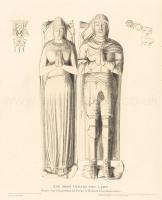
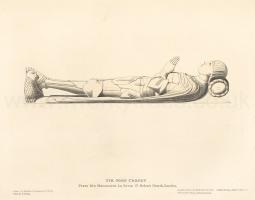
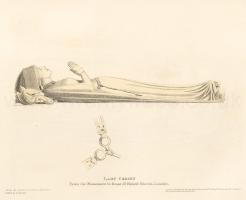
Effigy of Sir John Crosby and his Lady Agnes

Effigy of Sir John Crosby and his Lady Agnes is in Monumental Effigies of Great Britain.

This is a rare exception to the characters delineated in this work, consisting chiefly of royal personages, potent feudatories of the crown, or renowned military leaders. Sir John Crosby was an eminent grocer and wool-merchant of the city of London. He accumulated a large fortune by commercial pursuits, in the reigns of Henry the Sixth and Edward the Fourth. A current tradition, arising perhaps from the passion of the vulgar for the marvellous, was, that he was a foundling, and derived his name from his being taken up near one of those public crosses so common formerly in our highways: hence he was called "Cross-by." Stow rejects the story as fabulousa, and thinks he might be the son of one John Crosby, a servant of Henry the Fourth, to whom he granted in 1406 the wardship of Joan, the daughter and heiress of John Jordaine, a wealthy fishmonger. Crosby might have married his ward, and thus established himself as a person of consequence in the city. Sir John Crosby, whose effigy is here delineated, was an Alderman of London, and one of the Sheriffs of that city in 1470. In 1471 he met Edward the Fourth on his entry into the city, and was knighted. In the following he was a Commissioner for treating with the Hanse Towns, relative to some differences in which the Duke of Burgundy was concerned.

Note a. "Survey of London," edit. 1631, p. 332.

He erected for himself a magnificent house near the priory church of Great St. Helen's, Bishopsgatea. It was the loftiest structure in the city in his day. Some apartments of this building are still standing, the chief of which is its great hall, with its exquisitely carved oaken roof and embowered oriel. The view of the general design of this elegant structure is impeded by its being divided in its height by floors, and formed into a warehouseb. Sir John Crosby died in 1475, and lies buried in the chapel of the Holy Ghost, in Great Helen's church, Bishopsgate, under an altar-tomb, on which is his own effigy, and that of his first wife, Agnes.

Note a. It was built on the site of certain tenements, and their appurtenances, demised to him in 1466, for the term of ninety-nine years, by Alice Ashted, Prioress, and the Convent of St. Helen's, for the annual rent of £11. 6s. 8d. being seventeen marks.

Note b. In these all-changing days, when every thing which is connected with our ancient historical existence seems marked for innovation or destruction, we have heard it rumoured that Crosby-place is to be pulled down. We trust, however, that the British Government, as in the case of the Hall at Eltham, will interfere to save it. The state of the nave of that fine old Christian Temple, St. Saviour's, Southwark, is sufficient disgrace for London and its suburbs in the intellectual nineteenth century.

He gave by his will 500 marks towards the repair of the church of Great St. Helen's, and large bequests to other ecclesiastical establishments in and near London. Stow says that his arms were extant in many parts of St. Helen's churcha. Weever has preserved the epitaph on his tomb, as followsb:

Orate pro animabus Johannis Crosby, Militis, Ald. atque tempore vite Majoris Staple ville Caleis, et Agnetis uxoris sue, ac Thome, Richardi, Johanni, Margarete, et Johanne, liberorum ejusdem Johannis Crosby, Militis; ille obiit 1475, et ilia 1466, quorum animabus propitietur Deus.

Details. Plate 1. 1. The collar and pendant of the Lady Crosby. 3. The collar and pendant, apparently an animal, perhaps a ram, of Sir John Crosby.

Note a. Sable, a chevron Ermine between three rams trippant.

Note b. Funeral Monuments, p. 421.