

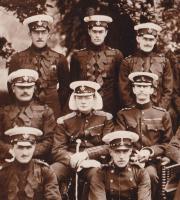
The Queen's Own Oxfordshire Hussars. Valentine Fleming (back row, far right) and Winston Churchill (centre).
On 17th February 1882 Valentine Fleming was born.
On 15th February 1906 Valentine Fleming [aged 23] and Evelyn "Eve" Sainte Croix Rose [aged 21] were married. His father settled a quarter of a million pounds on them.
In 1910 Valentine Fleming [aged 27] was elected MP Henley.
On 20th May 1917 Valentine Fleming [aged 35] was killed in action by German shellfire at Gillemont Farm, near Épehy, Somme, France. His squadron had been called to an exposed post in the British Expeditionary Force's frontline opposite the Hindenburg line, north of St. Quentin. During the early morning of 20th May, the Germans opened a heavy bombardment and Valentine was hit by a shell and killed instantly. News of the tragedy reached the family mere days before Ian's ninth birthday.
His wife Evelyn "Eve" Sainte Croix Rose [aged 32] inherited his large estate in trust on condition that she not remarry.
25th May 1917. An Appreciation 'W. S. C.' [Winston Churchill [aged 42]] writes of the death of Major Valentine Fleming [deceased], M.P., who, as announced in The Times on Wednesday, was killed in action: "This news will cause sorrow in Oxfordshire and in the House of Commons and wherever the member of the Henley Division was well known. Valentine Fleming was one of those younger Conservatives who easily and naturally combine loyalty to party ties with a broad liberal outlook upon affairs and a total absence of class prejudice. He was most earnest and sincere in his desire to make things better for the great body of the people, and had cleared his mind of all particularist tendencies. He was a man of thoughtful and tolerant opinions, which were not the less strongly or clearly held because they were not loudly or frequently asserted. He shared the hopes to which so many of his generation respond of a better, fairer, more efficient public life and Parliamentary system arising out of these trials. But events have pursued a different course. As a Yeomanry officer he always took the greatest pains to fit himself for military duties. There was scarcely an instructional course open before the war to the Territorial Forces of which he had not availed himself, and on mobilization there were few more competent civilian soldiers of his rank. The Oxfordshire Hussars were the first or almost the first Yeomanry regiment to come under the fire of the enemy, and in the first battle of Ypres acquitted themselves with credit. He had been nearly three years in France, as squadron leader or second in command, and had been twice mentioned in dispatches, before the shell which ended his life found him. From the beginning his letters showed the deep emotions which the devastation and carnage of the struggle aroused in his breast. But the strength and buoyancy of his nature were proofs against the sombre realizations of his mind. He never for a moment flagged or wearied or lost his spirits. Alert, methodical, resolute, untiring he did his work, whether perilous or dull, without the slightest sign of strain or stress to the end. 'We all of us,' writes a brother officer, 'were devoted to him. The loss to the regiment is indescribable. He was, as you know, absolutely our best officer, utterly fearless, full of resource, and perfectly magnificent with his men.' His passion in sport was deer stalking in his much-loved native Scotland. He rode well and sometimes brilliantly to hounds, and was always a gay and excellent companion. He had everything in the world to make him happy; a delightful home life, active interesting expanding business occupations, contented disposition, a lovable and charming personality. He had more. He had that foundation of spontaneous and almost unconscious self-suppression in the discharge of what he conceived to be his duty without which happiness, however full, is precarious and imperfect. That these qualities are not singular in this generation does not lessen the loss of those in whom they shine. As the war lengthens and intensifies and the extending lists appear, it seems as if one watched at night a well-loved city whose lights, which burn so bright, which burn so true, are extinguished in the distance in the darkness one by one."
On 27th July 1964 [his former wife] Evelyn "Eve" Sainte Croix Rose [aged 79] died.