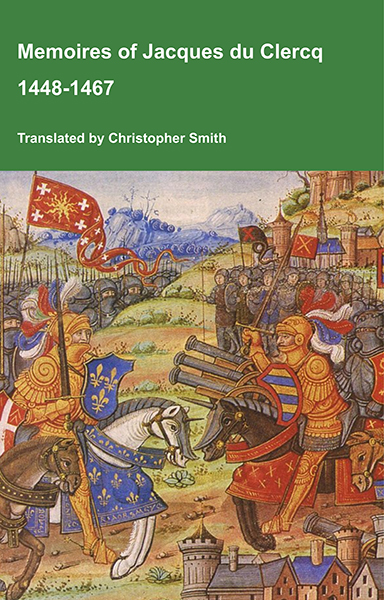
Memoires of Jacques du Clercq

This is a translation of the 'Memoires of Jacques du Clercq', published in 1823 in two volumes, edited by Frederic, Baron de Reissenberg. In his introduction Reissenberg writes: 'Jacques du Clercq tells us that he was born in 1424, and that he was a licentiate in law and a counsellor to Philip the Good, Duke of Burgundy, in the castellany of Douai, Lille, and Orchies. It appears that he established his residence at Arras. In 1446, he married the daughter of Baldwin de la Lacherie, a gentleman who lived in Lille. We read in the fifth book of his Memoirs that his father, also named Jacques du Clercq, had married a lady of the Le Camelin family, from Compiègne. His ancestors, always attached to the counts of Flanders, had constantly served them, whether in their councils or in their armies.' The Memoires cover a period of nineteen years beginning in in 1448, ending in in 1467. It appears that the author had intended to extend the Memoirs beyond that date; no doubt illness or death prevented him from carrying out this plan. As Reissenberg writes the 'merit of this work lies in the simplicity of its narrative, in its tone of good faith, and in a certain air of frankness which naturally wins the reader’s confidence.' Du Clercq ranges from events of national and international importance, including events of the Wars of the Roses in England, to simple, everyday local events such as marriages, robberies, murders, trials and deaths, including that of his own father in Book 5; one of his last entries.

Available at Amazon in eBook and Paperback format.

History of Enstone by J Jordan

History of Enstone by J Jordan is in Prehistory.

Paraochial History of Enstone

British And Roman Period 55 BC To AD 409. The great Roman emperor general and historian Julius Cæsar invaded Britain in the year 55 before the Christian era that is before the birth of Jesus Christ from whose birth we now reckon our years so that this is the year 1857 since He was born and is therefore called the year of our Lord or in Latin Anno Domini commonly written AD It is therefore now 1912 years since Britain was thus visited Some time however before this our country was known to the Romans by the name of Britannia but it was not discovered by them to be an island until the time when Agricola was governor and when he sailed round it The Romans continued to exercise dominion here for no less than 464 years that is from the year 55 BC till the year 409 AD It was during this period at least although very probably even before it that our most ancient monument the Enne Stan that is the Giant or Great Stone was erected for notwithstanding that that name is Saxon there can be no doubt of the monument so called being British or Romano British that is either founded in the most ancient times when Britons only knew and inhabited this island or during the period when the Romans reigned over the Britons and held them in subjection We can have little difficulty in conceiving what was the state and condition of this vicinity at that time It was like the uncleared forests of the United States of America or of Canada at this day or to come home to a nearer likeness still it was in much the same state as the yet disafforested remains of Wichwood now are. But with the exception of the surface of the earth and the single monument whence the parish now derives its name of Enstone no monument or memorial survives to tell us of the past and to point out to us where our British progenitors dwelt or lived. All that we know further is that in our immediate neighbourhood similar monuments to this have been erected and remain as the Hawk stone [Map], or Hoar stone, at Dean the stone [Hoar Stone, Steeple Barton [Map]] at Barton and the very extensive and interesting British relics at Rollright commonly called the Rollright stones [Map]. It was at this period also that the tumuli to be found at Charlford must have been formed unless indeed they are to be regarded as of older date

Click to read more ...