

Baronet Prideaux is in Baronetcies of England Alphabetically.
On 17th July 1622 Edmund Prideaux 1st Baronet [aged 68] was created 1st Baronet Prideaux of Netherton in Devon. Mary Reynell Lady Prideaux [aged 37] by marriage Lady Prideaux of Netherton in Devon.
On 28th March 1628 Edmund Prideaux 1st Baronet [aged 74] died. His son Peter [aged 32] succeeded 2nd Baronet Prideaux of Netherton in Devon. Susan Poulet Lady Prideaux [aged 28] by marriage Lady Prideaux of Netherton in Devon.
In 1682 Peter Prideaux 2nd Baronet [aged 86] died. His son Peter [aged 56] succeeded 3rd Baronet Prideaux of Netherton in Devon.
Around 1685 Peter Prideaux 3rd Baronet [aged 59] died. His son Edmund [aged 16] succeeded 4th Baronet Prideaux of Netherton in Devon.
After 1719 Edmund Prideaux 4th Baronet [deceased] died. His son Edmund [aged 33] succeeded 5th Baronet Prideaux of Netherton in Devon.
Around 28th February 1729 Edmund Prideaux 5th Baronet [aged 43] died. His brother John [aged 33] succeeded 6th Baronet Prideaux of Netherton in Devon. Anne Vaughan Lady Prideaux [aged 32] by marriage Lady Prideaux of Netherton in Devon.
On 24th August 1776 John Prideaux 6th Baronet [aged 81] died. His grandson John [aged 28] succeeded 7th Baronet Prideaux of Netherton in Devon.
Around 4th March 1826 John Wilmot Prideaux 7th Baronet [aged 78] died. His son John [aged 34] succeeded 8th Baronet Prideaux of Netherton in Devon.
On 13th May 1833 John Wilmot Prideaux 8th Baronet [aged 42] died. His brother Edmund [aged 40] succeeded 9th Baronet Prideaux of Netherton in Devon.
On 11th February 1875 Edmund Saunderson Prideaux 9th Baronet [aged 82] died. Baronet Prideaux of Netherton in Devon extinct.
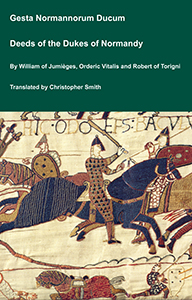
The Deeds of the Dukes of Normandy
The Gesta Normannorum Ducum [The Deeds of the Dukes of Normandy] is a landmark medieval chronicle tracing the rise and fall of the Norman dynasty from its early roots through the pivotal events surrounding the Norman Conquest of England. Originally penned in Latin by the monk William of Jumièges shortly before 1060 and later expanded at the behest of William the Conqueror, the work chronicles the deeds, politics, battles, and leadership of the Norman dukes, especially William’s own claim to the English throne. The narrative combines earlier historical sources with firsthand information and oral testimony to present an authoritative account of Normandy’s transformation from a Viking settlement into one of medieval Europe’s most powerful realms. William’s history emphasizes the legitimacy, military prowess, and governance of the Norman line, framing their expansion, including the conquest of England, as both divinely sanctioned and noble in purpose. Later chroniclers such as Orderic Vitalis and Robert of Torigni continued the history, extending the coverage into the 12th century, providing broader context on ducal rule and its impact. Today this classic work remains a foundational source for understanding Norman identity, medieval statesmanship, and the historical forces that reshaped England and Western Europe between 800AD and 1100AD.
Available at Amazon in eBook and Paperback format.
On 31st May 1658 Edmund Prideaux 1st Baronet was created 1st Baronet Prideaux of Forde Abbey in Dorset.
On 19th August 1659 Edmund Prideaux 1st Baronet died. His son Edmund [aged 25] succeeded 2nd Baronet Prideaux of Forde Abbey in Dorset.
Around May 1660, at the Restoration of the Charles II, the Baronetcy Baronet Prideaux of Forde Abbey in Dorset held by Edmund Prideaux 2nd Baronet [aged 26] was considered extinct since it was created during the Commonwealth.