The True Chronicles of Jean le Bel Volume 2 Chapters 61-109 1342-1361
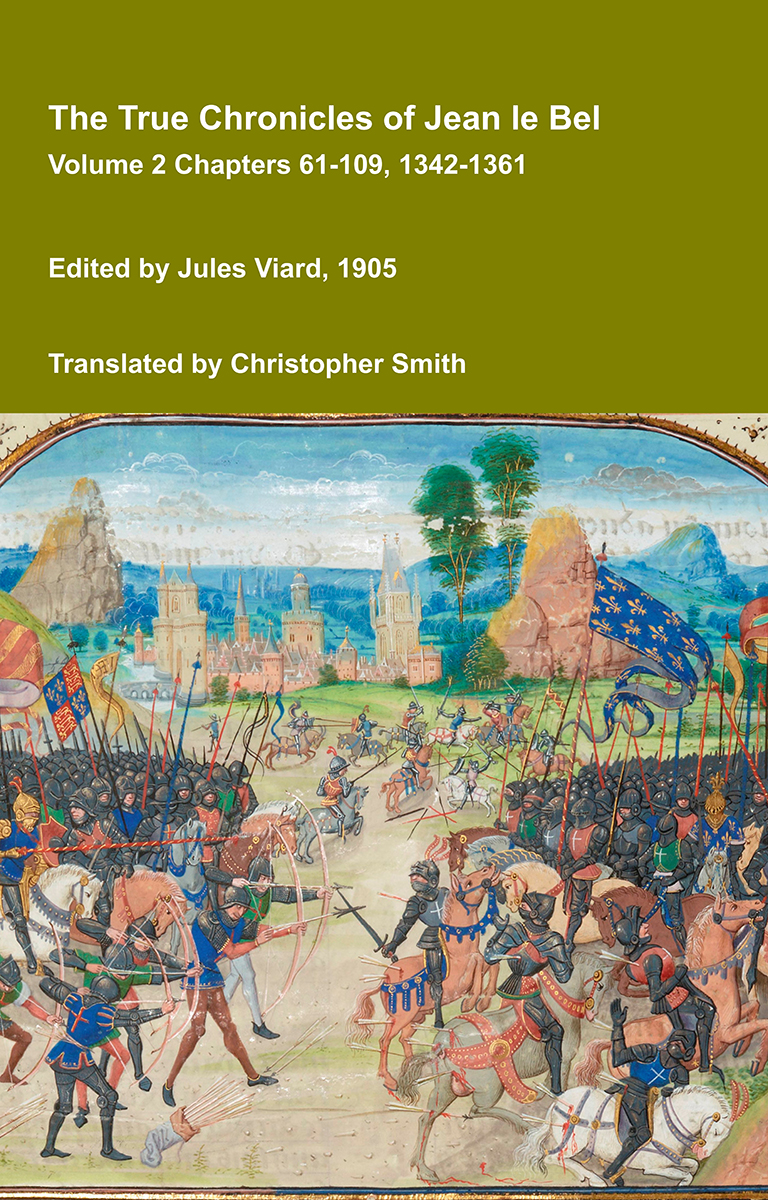
The Chronicle of Jean le Bel, Volume 2 continues one of the most important fourteenth-century accounts of the early Hundred Years’ War. Written by the Liège chronicler Jean le Bel, this vivid narrative follows the fortunes of Edward III, Jean II of France, the Black Prince, the great nobles of France and England, and the soldiers, captains and companies who shaped the conflict. This volume covers some of the most dramatic events of the period, including the battles of Crécy and Poitiers, the siege and capture of Calais, the captivity of King John, the rise of the Jacquerie, the turmoil in Paris under Étienne Marcel and Charles of Navarre, the devastation caused by the free companies, Edward III’s great campaign of 1359–1360, and the negotiations leading to the Treaty of Brétigny. Jean le Bel’s chronicle is especially valuable for its lively detail, its interest in chivalry, warfare, politics and reputation, and its influence on later chroniclers, most famously Froissart. This English translation presents the text in clear, readable British English while preserving the force and character of the original narrative. The translation includes extensive notes to help the reader better understand Jean le Bel's text. Volume 2 also includes translated appendices drawn from royal and administrative records, many from the English Record Office, which illuminate Edward III’s campaigns in Brittany, the siege and occupation of Calais, naval preparations, military finance, appointments, safe conducts and related affairs.
Available at Amazon in eBook and Paperback format.
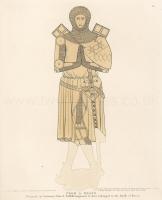
Effigy of a Bacon in Gorleston Church, Suffolk is in Monumental Effigies of Great Britain.
THIS interesting figure exhibits a good example of those extraordinary appendages to armour called ailettes. Weever makes, taking them for escutcheonsa, a shrewd conjecture that they were intended to indicate the rank of Knight Banneret, being of the narrow oblong form to which the pennon of the Knight was reduced when he was raised to that honourable grade. This distinction was only conferred on the held of battle. Froissart gives us a lively idea of the ceremony employed, where he describes the making Sir John Chandos a Banneret by the Black Prince on the held at Navarete, or Vittoria. "The Spaniards seeing the English had halted did the same, in order of battle. Then each man tightened his armour, and made ready for instant combat. Sir John Chandos advanced in front of the battalions with his banner uncased in his hand. He presented it to the Prince, saying, 'My Lord, here is my banner; I present it to you that I may display it in whatever manner shall he most agreeable to you; for, thanks to God, I have now sufficient lands to enable me so to do, and maintain the rank which it ought to hold.' The Prince (Don Pedro being present) took the banner in his hand, which was blazoned with a sharp stake Gules on a held Argent, after having cut olf the tail to make it square, he displayed it, and returning it to him by the handle, said, 'Sir John, I return you your banner. God give you honour and strength to preserve it.' Upon this Sir John left the Prince, went hack to his men with the banner in his hand, and said to them, 'Gentlemen, behold my banner and yours; you will guard it, therefore, as becomes you.' His companions, taking the banner, replied with much cheerfulness, that if it pleased God and St. George they would defend it well, and act worthily of it. .... The banner was put into the hands of a worthy English Squire, called William Allestry, who bore it with honour that day, and loyally acquitted himself in the serviceb."
Note a. Fun. Monutn. p.847. edit. 1631.
Note b. Johnes's Froissart, voi. HI. p. 304. 8vo edit.
Image taken from a Brass.