

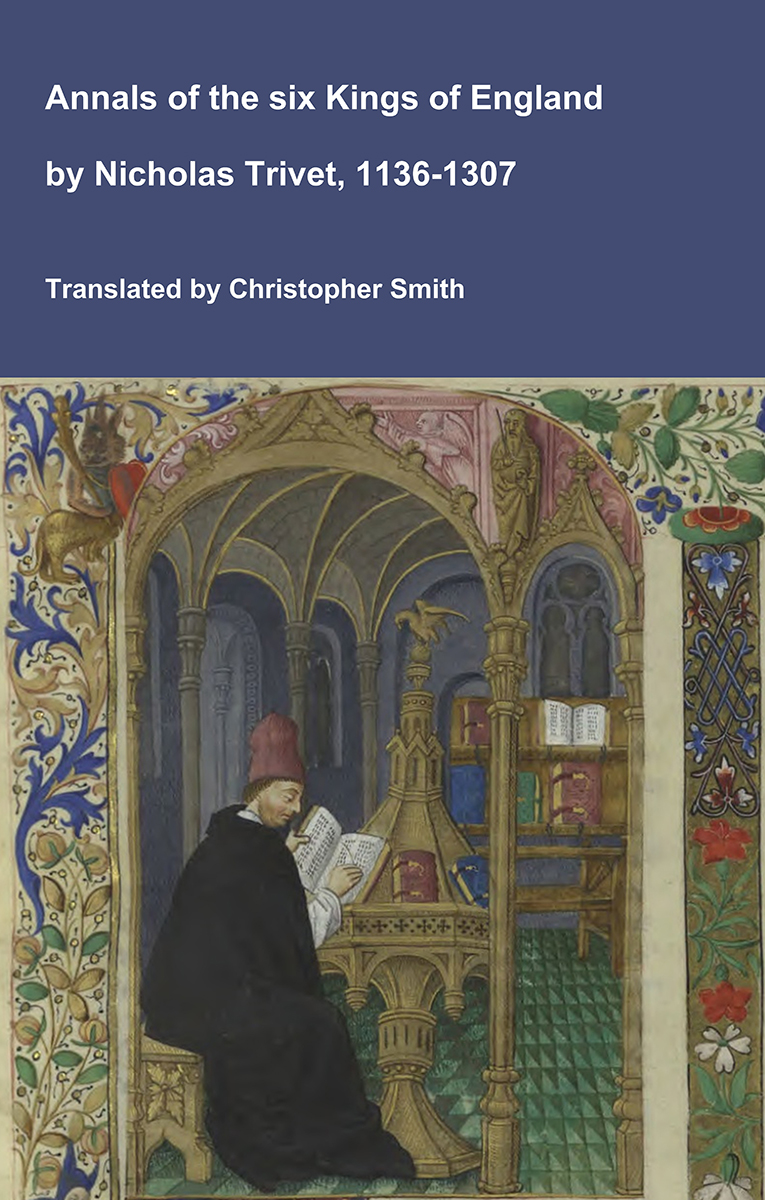
Annals of the six Kings of England by Nicholas Trivet
Translation of the Annals of the Six Kings of England by that traces the rise and rule of the Angevin aka Plantagenet dynasty from the mid-12th to early 14th century. Written by the Dominican scholar Nicholas Trivet, the work offers a vivid account of English history from the reign of King Stephen through to the death of King Edward I, blending political narrative with moral reflection. Covering the reigns of six monarchs—from Stephen to Edward I—the chronicle explores royal authority, rebellion, war, and the shifting balance between crown, church, and nobility. Trivet provides detailed insight into defining moments such as baronial conflicts, Anglo-French rivalry, and the consolidation of royal power under Edward I, whose reign he describes with particular immediacy. The Annals combines careful year-by-year reporting with thoughtful interpretation, presenting history not merely as a sequence of events but as a moral and political lesson. Ideal for readers interested in medieval history, kingship, and the origins of the English state, this chronicle remains a valuable and accessible window into the turbulent world of the Plantagenet kings.
Available at Amazon in eBook and Paperback format.
Effigy of Hugh de Northwold, Bishop of Ely is in Monumental Effigies of Great Britain.

HUGH DE NORTHWOLD, Abbot of St. Edmundsbury, was consecrated Bishop of Ely in the year 1229 (14 Henry III.) He was a munificent restorer of his Cathedral Church, which he almost rebuilt from the foundation at the cost of upwards of five thousand pounds, a princely sum for the time in which he flourished. In the dark days of Christianity the pastors of the church exhibited noble ideas of the honour due to the Deity in the piles devoted to his worship, and a corresponding munificence in contributing to their construction. The rebuilding Ely Cathedral [Map] by Northwold occupied seventeen years, and he consecrated the new church in the presence of Henry III [aged 46] and Prince Edward [aged 14], whom he entertained (keeping at the same time "the hall," or open house to all comers) in his palace at Ely. The last mentioned edifice he also entirely rebuilt, and covered with a distinction of the most costly buildings in the middle age. He departed this life on the 9th of August 1254, thankful to Providence for having been allowed to see the completion of his cathedral, where he was interred in the middle of the presbytery. On the removal of the choir the situation of his effigy was changed, and it now lies on the altar tomb of Barnet, who died Bishop of Ely 1373. The niche which canopies the figure of Northwold is in the richest style of sculpture, the pillars are composed of interlacing foliage in scroll work, intermixed with heads of ecclesiastics and birds. At the top of the canopy are fragments of two angels. The sides are adorned with niches containing figures: these do not appear in the etching. The Bishop treads on a dragon and a lion, under both of which images the power of Satan is indicated in Holy Writ. The entablature at the foot of the tomb, delineated in the plate, represents the martyrdom of St. Edmund, King of the East Angles, who was shot to death with arrows by the Danes, A. D. 870. This piece of sculpture of course alludes to Northwold, as Abbot of Saint Edmundsbury.