This is a translation of the 'Memoires of Jacques du Clercq', published in 1823 in two volumes, edited by Frederic, Baron de Reissenberg. In his introduction Reissenberg writes: 'Jacques du Clercq tells us that he was born in 1424, and that he was a licentiate in law and a counsellor to Philip the Good, Duke of Burgundy, in the castellany of Douai, Lille, and Orchies. It appears that he established his residence at Arras. In 1446, he married the daughter of Baldwin de la Lacherie, a gentleman who lived in Lille. We read in the fifth book of his Memoirs that his father, also named Jacques du Clercq, had married a lady of the Le Camelin family, from Compiègne. His ancestors, always attached to the counts of Flanders, had constantly served them, whether in their councils or in their armies.' The Memoires cover a period of nineteen years beginning in in 1448, ending in in 1467. It appears that the author had intended to extend the Memoirs beyond that date; no doubt illness or death prevented him from carrying out this plan. As Reissenberg writes the 'merit of this work lies in the simplicity of its narrative, in its tone of good faith, and in a certain air of frankness which naturally wins the reader’s confidence.' Du Clercq ranges from events of national and international importance, including events of the Wars of the Roses in England, to simple, everyday local events such as marriages, robberies, murders, trials and deaths, including that of his own father in Book 5; one of his last entries.
Available at Amazon in eBook and Paperback format.
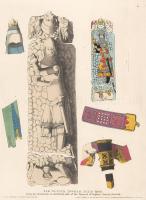
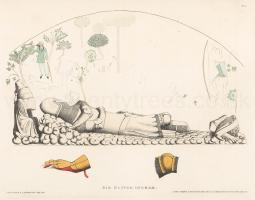
Effigy of Sir Oliver de Ightham is in Monumental Effigies of Great Britain.
Oliver Ightham.
This effigy is placed under an arch on the north side of the church of Ingham in Norfolk. Oliver was the son and heir of Sir John Ingham, whose ancestors were seated at Ingham as early as the middle of the twelfth century.
The first historical notice that we End of Sir Oliver Ingham is that in the year 1325, the nineteenth of the reign of Edward the Second, he was by the heir apparent, as Duke of Aquitaine, constituted Seneschal of Guienne. He is characterized at this period as a young, lusty, and valiant soldier. He collected an army of mercenary troops, Spaniards, Arragonese, and Gascons, invaded the territory of Angenois, retained contrary to treaty by the French king, and reduced it to the dominion of the English. He was one of those persons to whom, in the early part of the following reign, the king's writ was directed to apprehend Mortimer Earl of Marche.
In 1340 we find him in the execution of the office of Seneschal, commanding at Bordeaux, where he was suddenly surprised by the appearance of a large army of French before the walls. He had scarcely six thousand men within the town to repel this assault; his only resource was his military genius and presence of mind. He ordered the citizens, who were well affected to the English, to follow their usual occupations, and directed that the banner of France should be displayed on the walls and citadel. The French fell into the snare, thought the place had been abandoned by their enemy, entered it, and laying aside their arms, fell to rifling the houses of the English. At this juncture Ingham sallied forth from the castle at the head of his men, fell impetuously on the French, and put them to the rout with great slaughter; nearly the whole were slain or made prisoners, and their leader, Gaston Count de Laille, with great difficulty escaped.
The valiant Seneschala died at Bordeaux in 1344, and was buried in the church of his family demesne at Ingham. His heirs were a daughter, Joan, married to Roger le Strange, Lord of Knockyn; and a grand-daughter Mary, by Elizabeth his eldest daughter, and her husband Sir John Curzon. The tomb of Sir Oliver is on the north side of the chancel of Ingham church. Weever in his time describes it thus:—"Under a fair tomb of freestone, very curiously wrought, lieth the body of Sir Oliver Ingham, with his resemblance in his coat-armour, his belt, gilt spurs, and the blew garter about his leg; his crest, the owl out of the ivy bush, with a crowne on the head thereof; he being a great traveller lyeth upon a rocke, beholding the sunne and moone and starres, all very lively set forth in mettall, beholding the face of the earth. About the tomb twenty-four mournersb."
Note a. Among other appointments of honour and trust, we find him serving in Pariiament, Governor of Ellesmere and Guildford Castles, Custos and Justice of Chester.
Note b. Fun. Monuments, edit. 1631, p. 817.
Some points of this description agree very well with the effigy as represented in the plates; while others supply us with particulars which the injuries of time would have otherwise eRaced. The crest on the helmet is broken off; so is the right leg: there is no garter on the left. Weevet mistook the fillet of the genouilliere for a garter. Sir Oliver was not a knight of that order. In the painting which remains on the back ground of the figure, we do not observe the planets as mentioned by Weever. A forest is represented, in which wild animals and beasts of prey are roaming at large; in one corner an archer clothed in
"Cote and hood of green,"
winds his bugle; in the other his companion is seen bending his bow. This would seem to indicate the extensive forests of the duchy of Aquitaine, over which Ingham was Seneschal, or his addiction to the chase. He reposes on the rock, or rather a bed of pebbles, mentioned by Weever, not improbably indicative of his martial hardihooda; an idea that has not escaped Shakspeare:
--- "The tyrant custom
Has made the flinty and steel couch of war
My thrice-driven bed of down."
Details. Plate 1. Helmet with the mantelet. Portion of the mantelet enlarged. Figure as originally painted. The surcoat bears. Party per pale Or and Vert, a cross moline Gules. Belt and clasp. Scabbard, mountings with portions of the belt attached. Plate II. Painting at the back of the tomb; genouillieres or knee-pieces; cuisses with studs; some links of the lower part of the hauberk.
Note a. Another conjecture is that when an effigy is thus placed, it represents the knight as shipwrecked, and thrown upon "the beached verge of the salt flood." We believe that examples of figures of this kind are rare; in this work only one other occurs, that of Sir Roger de Kerdeston. If the purpose of the sculptor had been to represent Ingham as shipwrecked we should have expected a back ground of marine objects. Those painted on the tomb before us are, on the contrary, altogether terrene. The attitudes of Ingham and Kerdeston are very similar, each appears as if roused from his rude bed of slumber, and laying his hand on the hilt of his sword.