

Henrici Quinti, Angliæ Regis, Gesta, is a first-hand account of the Agincourt Campaign, and subsequent events to his death in 1422. The author of the first part was a Chaplain in King Henry's retinue who was present from King Henry's departure at Southampton in 1415, at the siege of Harfleur, the battle of Agincourt, and the celebrations on King Henry's return to London. The second part, by another writer, relates the events that took place including the negotiations at Troye, Henry's marriage and his death in 1422.
Available at Amazon in eBook and Paperback format.
In 1510 Bishop John White was born to Robert White at Farnham, Surrey [Map]. He was educated at Winchester College, Winchester and New College, Oxford University.
In 1551 Bishop John White [aged 41] was appointed Archdeacon of Taunton.
On 1st April 1554 the Lord Chancellor Bishop Edmund "Bloody" Bonner of London [aged 54], assisted by Bishop Stephen Gardiner [aged 71], Bishop Nicholas Ridley [aged 54] and Bishop Cuthbert Tunstall [aged 80], consecrated seven bishops at Southwark Cathedral [Map]:
Bishop George Cotes was consecrated Bishop of Chester.
Bishop Gilbert Bourne was consecrated Bishop of Bath and Wells.
Bishop James Brooks [aged 41] was consecrated Bishop of Gloucester.
Bishop Maurice Griffiths [aged 47] was consecrated Bishop of Rochester.
Bishop Henry Morgan was consecrated Bishop of St David's.
Bishop John White [aged 44] was consecrated Bishop of Lincoln.
Bishop Robert Parfew aka Warton was consecrated Bishop of Hereford.
Henry Machyn's Diary. 1st April 1554. [The first day of April my lord chancellor [aged 54] did consecrate six new bishops at St. Mary Overy's [Map], before the high altar; and a goodly mass was said. And when all] was done thay yede unto my lord ch[ancellor's,] for ther was as grett a dener as youe ha[ve seen.] Thes be the bysshopes names that wher consecrated, [doctor] Whyt [aged 44], warden of Wynchastur, the bysshope of Ly[ncoln]; doctur Borne, bysshope of Bathe; doctur Morgan, bishop of sant Davys; doctur Brokes [aged 41], bysshope of Gloss [ter]; doctur Cottes, bysshope of Westtchastur; bysshope of sant Asse changyd to be bysshope of Arfford; master [Griffith] [aged 47] parsun of sant Magnus bysshope of Rochastur.
Henry Machyn's Diary. 18th November 1554. The xviij day of November dyd pryche at Powlles crosse [Map] the nuw bysshope of Lynckolne, doctur White [aged 44], late the warden of Wynchaster.
The sam day was consecratyd nuw [bishops], on bysshope of Brystow [aged 59], and a-nodur byshope of Lycheffeld and Coventre [aged 50].
Henry Machyn's Diary. 14th November 1555. The xiiij day of November be-gane the knyll for the most ryght reverent father in God my lord chaunseler of England, doctur Sthevyn Gardener [deceased], byshope of Wynchastur, and of the preve consell with kyng Henry the viijth and unto quen Mare quen of England [aged 39]; and with a hersse of iiij branchys, with gylt candyllstykes, and ij whytt branchys and iij dosen of stayffes-torchys, and all the qwyre hangyd with blake and armes, and a durge songe; and the morow masse of requiem, and alle bysshoppes and lordes and knyghtes and gentyllmen; and my lord bysshope Bonar [aged 55] of London did syng masse of requiem, and doctur Whyt [aged 45] bysshope of Lynkolne dyd pryche at the sam masse; and after all they whent to his plasse to dener.
Note. P. 97. Funeral of lord chancellor Gardiner. The ceremonial of this is preserved in the Coll. Arm. I. 11. 121–124, and a second copy in pp. 127–133.—Machyn's extraordinary word "inowlle" is converted by Strype into "jewels:" and in my marginal note I have suggested "enamel." Both explanations are wrong: as no doubt our painter meant that the banners were painted with images of saints in oil and "with fine gold."
In 1556 Bishop John White [aged 46] was appointed Bishop of Winchester.

Henry Machyn's Diary. 14th February 1556. The xxiiij day of Feybruary was the obsequies of the most reverentt father in God, Sthevyn Gardener, docthur and bysshope of Wynchastur, prelett of the gartter, and latte chansseler of England, and on of the preve consell unto Kyng Henry the viij and unto quen Mare [aged 39], tyll he ded; and so the after-none be-gane the knyll at sant Mare Overes [Map] with ryngyng, and after be-gane the durge; with a palle of cloth of gold, and with ij whytt branchys, and ij dosen of stayffe-torchys bornyng, and iiij grett tapurs; and my lord Montyguw [aged 27] the cheyffe mornar, and my lord bysshope of Lynkolne [aged 46] and ser Robart Rochaster [aged 62], comtroller, and with dyvers odur in blake, and mony blake gownes and cotes; and the morow masse of requeem and offeryng done, be-gane the sarmon; and so masse done, and so to dener to my lord Montyguw('s); and at ys gatt the corse was putt in-to a wagon with iiij welles, all covered with blake, and ower the corsse ys pyctur mad with ys myter on ys hed, with ys and ys armes, and v gentyll men bayryng ys v banars in gownes and hods, then ij harolds in ther cote armur, master Garter and Ruge-crosse; then cam the men rydyng, carehyng of torchys a lx bornyng, at bowt the corsse all the way; and then cam the mornars in gownes and cotes, to the nombur unto ij C. a-for and be-hynd, and so at sant Gorges cam prestes and clarkes with crosse and sensyng, and ther thay had a grett torche gyffyn them, and so to ever parryche tyll they cam to Wynchaster, and had money as money as cam to mett them, and durge and masse at evere logyng.
Henry Machyn's Diary. 25th March 1556. The xxv day of Marche was owre Lady day, the Annunsyasyon, at Bow chyrche in London was hangyd with cloth of gold, and with ryche hares [arras] and cossens for the commyng of my lord cardenall Polle [aged 56]; ther dyd the bysshope of Vosseter dyd synge he masse mytyred; and ther wher dyver bysshopes, as the bysshope of Ely [aged 50], bysshope of London [aged 56], and bysshope of Lynkkolne [aged 46], and the yerle of Penbroke [aged 55], and ser Edward Hastynges [aged 35], the master of horsse, and dyvers odur nobuls, and after masse done to my lord (unfinished).


Henry Machyn's Diary. 15th April 1556. The xv day of Aprell was electyd at Grenwyche bysshope of Wynchastur master doctur Whyt [aged 46], byshope of Lynckolne; and doctur Westun [aged 41], dene of Westmynster, to be bysshope of Lynckolne; and the dene of Durram to be bysshope of Karlelle.
Henry Machyn's Diary. 23rd April 1557. The xxiij day of Aprell was sant Gorge('s) day [the King's [aged 29]] grace whent a pressessyon in ys robes of the garter; lord Talbott [aged 29] bare the sword a-for the Kyng, and master (blank) bare the rod; and doctur (blank) bare the boke of the record; and the bysshope of Wynchaster [aged 47] ware ys myter, and song masse that day; and x knyghtes of the Garter be-syd the Kyng; and secretere Peter ware a robe of cremesun velvett with the Garter; and after the Kyng and odur lordes and knyghtes of the garter whent to evyngsong; and ther was the duke of Muskovea was in chapell at evyngsong, and after he whent and toke ys barge and whent to London, and after wher iij knyghtes of the garter chossen, furst my lord F(itz)uater [aged 32], my lord Gray of Wylton [aged 48], and ser Robart Rochaster [aged 63]; thes iij wher mad of the order.


Henry Machyn's Diary. 23rd April 1557. The xxiij day of Aprell was sant George('s) day [the King's [aged 29]] grace whent a pressessyon at Whyt-halle [through the hall] and rond abowt the court hard by the halle; and so [certain of] the knyghts of the garter as they whent in ther [robes] of the garter; the bysshope of Wynchaster [aged 47] dyd exsecute the masse with ys myter; the furst as they whe[nt the lord] Montyguw [aged 28], my lord admerall [aged 47], ser Antony Sely[ger, the] lord Cobham [aged 60], the lord Darce [aged 60], ser Thomas Chenne, [the lord] Pagett [aged 51], the lord of Penbroke [aged 56], the lord of Arundel [aged 45], [the] lord tressorer [aged 74], and secretore Peter in a robe of cremesun velvett with the garter brodered on ys shuder, and [one bare] a rod of blake, and a docthur bare a boke; and [then went all] the harodes, and then my lord Talbott [aged 29] bare the sword, then sergant(s) of armes, and the Kyng('s) grace [came next], and Quen('s) [aged 41] grace lokyng owt of a wyndow [beside] the cowrt on the garden syde.
Henry Machyn's Diary. 22nd May 1557. The xxij day of May was bered master Doge .... gren cloth at sant Martens in the feld [Map] be-syd Charyng-crose, with ij whytt branchys and .... and ij dosen of skochyons and dyver mornars.
23rd May 1557. The xxiij day of May dyd pryche the bysshope of Wynchaster doctur Whytt [aged 47] at sant Mare Overes [Map] in Sowthwarke, and ther was a heretyke ther for to here the sermon.
Henry Machyn's Diary. 30th January 1558. The Sonday the xxx day of January dyd pryche at Powlles Crosse [Map] the byshope of Wynchester [aged 48], and mad a goodly sermon.
Henry Machyn's Diary. 6th February 1558. The vj day of Feybruarij dyd pryche at Powlles Crosse [Map] the byshope of Westchaster [aged 48]; and ther wher at ys sermon xvj bysshopes, and my lord mayre and the althermen, and mony juges, and ther he declaryd that of Wedynsday next to go on generall prossessyon and pray to God.
Henry Machyn's Diary. 14th December 1558. The xiiij day of Desember [was] the quen('s) [deceased] masse; and [all the lords] and lades, knyghtes and gentyll women, dyd offer. [And there was] a man of armes and horse offered; and her cotarmur, and sword, and targett, and baner of armes, and iij [standards]; and all the haroldes abowt her; and ther my lord bysshope of Wynchester [aged 48] mad the sermon; and ther was offered cloth of gold and welvet, holle pesses, and odur thynges. [After the] masse all done, her grace was cared up [to the chapel [Map]] the kyng Henry the vij byldyd, with bysshopes [mitred;] and all the offesers whent to the grayffe [grave], and after [they] brake ther stayffes, and cast them in-to the grayffe; in the mayn tyme the pepull pluckt [down] the cloth, evere man a pesse that cold caycth [catch] [it,] rond a-bowt the cherche, and the armes. And after[wards,] my lord bysshope of Yorke [aged 57], after her grace was [buried,] he declaryd an colasyon [collation], and as sone as he had made an end, all the trumpetes bluw a blast, and so the cheyff morners and the lords and knyghtes, and the bysshopes, with [the] abbott [aged 43], whent in-to the abbay to dener, and all the offesers of the quen('s) cott [court].


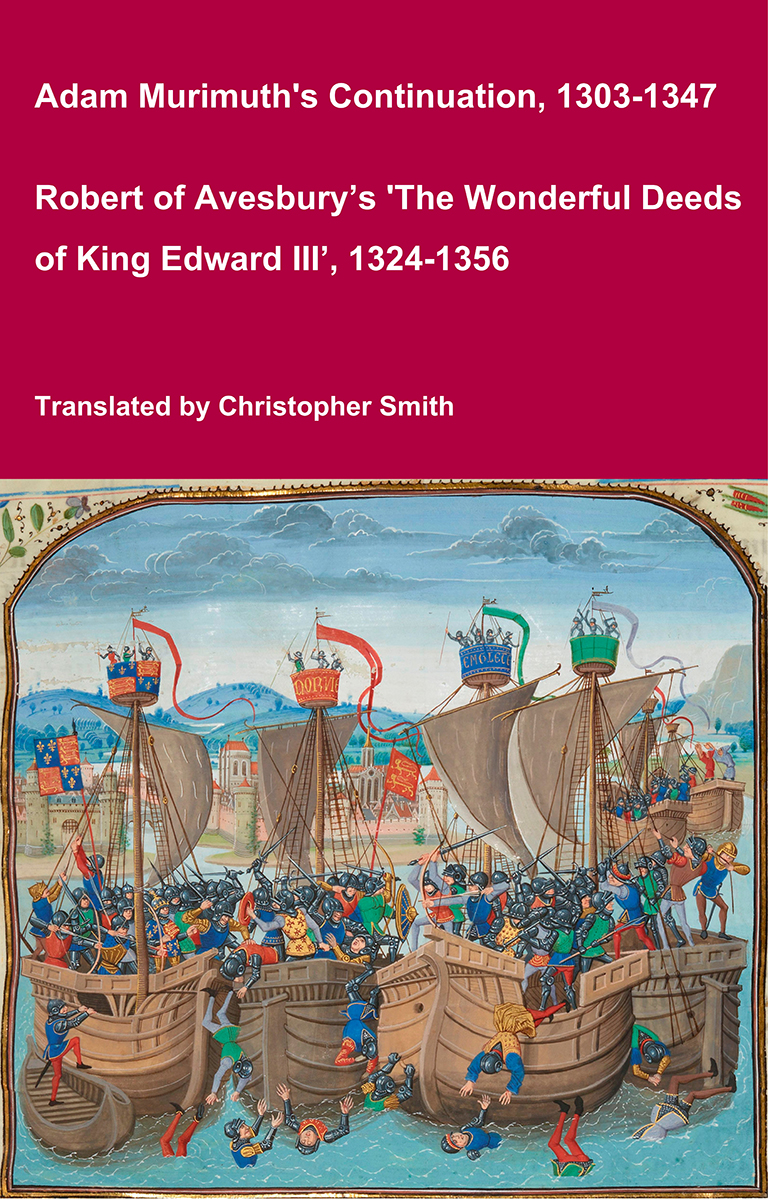
Adam Murimuth's Continuation and Robert of Avesbury’s 'The Wonderful Deeds of King Edward III'
This volume brings together two of the most important contemporary chronicles for the reign of Edward III and the opening phases of the Hundred Years’ War. Written in Latin by English clerical observers, these texts provide a vivid and authoritative window into the political, diplomatic, and military history of fourteenth-century England and its continental ambitions. Adam Murimuth Continuatio's Chronicarum continues an earlier chronicle into the mid-fourteenth century, offering concise but valuable notices on royal policy, foreign relations, and ecclesiastical affairs. Its annalistic structure makes it especially useful for establishing chronology and tracing the development of events year by year. Complementing it, Robert of Avesbury’s De gestis mirabilibus regis Edwardi tertii is a rich documentary chronicle preserving letters, treaties, and official records alongside narrative passages. It is an indispensable source for understanding Edward III’s claim to the French crown, the conduct of war, and the mechanisms of medieval diplomacy. Together, these works offer scholars, students, and enthusiasts a reliable and unembellished account of a transformative period in English and European history. Essential for anyone interested in medieval chronicles, the Hundred Years’ War, or the reign of Edward III.
Available at Amazon in eBook and Paperback format.
In 1559 Bishop John White [aged 49] was deprived of his see of Bishop of Winchester and imprisoned.
Henry Machyn's Diary. 3rd April 1559. The iij day of Aprell the bysshopes and the nuw prychers mett at the abbay a-for my lord keper of the brod seylle, and dyvers of the consell, and ther to gyff a answer of the matter; the sam nyght, my lord bysshope of Wynchester [aged 49] and my lord of Lynkolne [aged 44] was send to the towre of London [Map] by the gard by water, to the Old Swane, and to Belynsgatt after.

Henry Machyn's Diary. 25th May 1559. The thursday the xxv day of May master John Whyt altherman and grocer ys chyld was cristened in lytyll sant Barthelmuw be-syd sant Antonys; thes wher the god-fathers' names, my lord marques of Wynchester [aged 76] now lord tresorer of England, and my lord byshope of Wynchester docthur Whytt [aged 49], and the god-moder my lade Laxtun, lat the wyffe of ser Wylliam Laxtun latt mare of London and grocer; and after ther was waferers [wafers] and epocras grett plente; and after they whent home to the plasse, with the chyld nam(ed) John Whytt; the wyche wyff was master Raff Grenway altherman and grocer of London wyff.
Henry Machyn's Diary. 26th June 1559. The sam day was deprevyd of ther bysshoprykes the bysshope of Wynchestur [aged 49] and the bysshope of Lynckolne [aged 44] at master Hawse the kyng('s) shreyff in Mynsyon lane, and the bysshope of Wynchester to the Towre [Map] agayne, and the bysshope of Lynckolne delevered a-way.
Note. P. 201. Bishops deprived. Mr. Bruce has given a list of the deprived bishops, founded upon documents in Rymer's Fœdera, in Hayward's Annals of Q. Eliz. p. 27.
Henry Machyn's Diary. 7th July 1559. The vij day of July, was sant Thomas of Cantebere day, my good lord of Wynchastur doctur Whytt [aged 49] came owt of the Towre [Map], with the leyftenantt ser Edward Warner [aged 48], by vj [6] in mornyng, and so to my lord keper of the brod selle, and from thens unto master Whyt, John, [possibly Thomas] altherman, and ther he lys.
On 12th January 1560 Bishop John White [aged 50] died.
Henry Machyn's Diary. 12th January 1560. The xij day of January ded good master docthur Whyt [aged 50], latt byshope of Wynchestur, in Hamshyre, at ser Thomas Whytes plasse, the wyche ded of a aguw; and he gayff myche to ys servandes.
Henry Machyn's Diary. 15th January 1560. The xv day of January was cared to be bered master doctor Whyt [deceased], late byshope of Wynchester, unto Wynchester [Map], and bered ther.
Note. P. 224. Funeral of the late bishop of Winchester. John White, warden of Winchester college, consecrated bishop of Lincoln 1554 (see p. 58), translated to Winchester 1556, deprived 1559. He was brother to alderman sir John White, to whose house he had been allowed to repair on coming out of the Tower (see p. 203), this being an instance (to which there are many parallels) of two brothers bearing the same Christian name. Sir Thomas White, of South Warnborough, Hampshire, was his brother-in-law, for, though not nearly related in paternal descent, there had been two marriages which connected the families, sir Thomas White having married Agnes sister to the bishop and sir John, and sir John having married for his first wife Sibell sister of sir Thomas White. See the Collectanea Topogr. et Geneal. vol. vii. p. 212.