

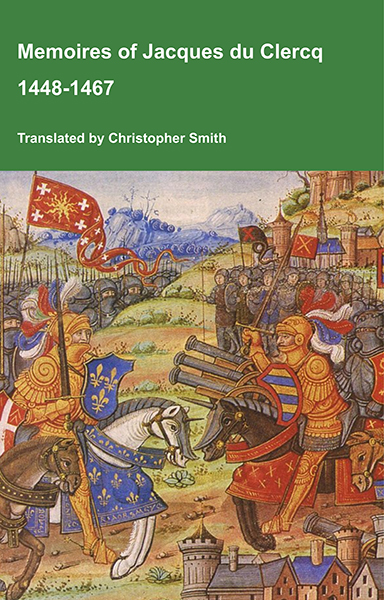
This is a translation of the 'Memoires of Jacques du Clercq', published in 1823 in two volumes, edited by Frederic, Baron de Reissenberg. In his introduction Reissenberg writes: 'Jacques du Clercq tells us that he was born in 1424, and that he was a licentiate in law and a counsellor to Philip the Good, Duke of Burgundy, in the castellany of Douai, Lille, and Orchies. It appears that he established his residence at Arras. In 1446, he married the daughter of Baldwin de la Lacherie, a gentleman who lived in Lille. We read in the fifth book of his Memoirs that his father, also named Jacques du Clercq, had married a lady of the Le Camelin family, from Compiègne. His ancestors, always attached to the counts of Flanders, had constantly served them, whether in their councils or in their armies.' The Memoires cover a period of nineteen years beginning in in 1448, ending in in 1467. It appears that the author had intended to extend the Memoirs beyond that date; no doubt illness or death prevented him from carrying out this plan. As Reissenberg writes the 'merit of this work lies in the simplicity of its narrative, in its tone of good faith, and in a certain air of frankness which naturally wins the reader’s confidence.' Du Clercq ranges from events of national and international importance, including events of the Wars of the Roses in England, to simple, everyday local events such as marriages, robberies, murders, trials and deaths, including that of his own father in Book 5; one of his last entries.
Available at Amazon in eBook and Paperback format.
Around 1500 Bishop Nicholas Ridley was born.
In 1547 Bishop Nicholas Ridley [aged 47] was elected Bishop of Rochester.

Wriothesley's Chronicle [1508-1562]. The 29th daie of June [1547] there was a solempne obsequie kept in Poules [Map] [for] the French Kinge Frances latelie departed, where was a sumptuous herse made, and the quire and the bodie of the church hanged with blacke and sett with schuchions of the armes of France, and tow hundreth torch bearers having new blacke gownes and hoodes with badges of the armes of France on their sholders, the Archbishop of Canterbery [aged 57] begining the derige in his pontificalibus, the Archbishop of Yorke [aged 65] and other 8 bishopps and suffragans being also in their pontificalibus, six erles and lordes of the Kinges Majestie being the cheife mourners, the Emperours Embassadour, and the French Kinges Embassadoure, and the Secretarie of Venice in their blacke mourning gownes being also there present at the same, the major and aldermen with tow hundred citizens in their best lyveries with their hoodes on their sholders present at the same also; and on the morrow also at the requiem masse, which the Archbishopp of Canterberie songe in his pontificalibus, with the other bishopps in their pontificalibus also; and there preached at the said masse the Bishop of Rochester [aged 70] [Note. Possibly Bishop Nicholas Ridley [aged 47] who became Bishop of Rochester in 1547], who greatlie commended in his sermon the said French King departed, for setting fourth of the Bible and New Testament in the French tonge to be reade of all his subjectes; also all the parish churches in London kept a solempne obett with knill, the bells ringing, and a herse with tow great tapers, in everie parish church.
Wriothesley's Chronicle [1508-1562]. The fourth daie of November, 1547, the Kinges Majestie [aged 10] beganne his High Court of Parliament at his cittie of Westminster, his Edward the Majestic ryding from his pallace of Westminster to the church of Saint Peter [Map] in his perliament robes, with all his Lordes Spirituall and Temporall riding in their robes also; and afore the masse of the Holic Ghost there was a sermon made before the King by Doctor Ridley, Bishopp of Rochester [aged 47]; and after that the masse beganne, Gloria in eacelsis, the Creede, Sanctus, Benedictus, and the Agnus were all songen in Englishe; the masse ended, his Majestie with his Lordes went into the Perliament Chamber, where my Lord Chauncelor [aged 50] made a grete proposition for the assembly of the said Parliament, and, that donne, the King putt of his robes, and went to his pallace at Westminster by water. Sir John Baker, knight, Chauncelor of the Tenthes, was chosen Speaker of the Commens Howse for the said Perliament.


Diary of Edward VI. 3rd April 1550. Nicholas Ridley [aged 50], befor of Rochester, made bishop of London, and received his othe.1
Thomas Thirlby [aged 44], befor of Whestmuster2, made bishop of Norwich, and received his othe.
Note 1. "Item the xijth day of Aprill, he that was byshoppe of Rochester, Nicolas Rydley, was stallyd [bishop of London] by one of the byshoppe of Ely('s) chaplynes." (Chronicle of the Grey Friars of London, where several curious notices will be found of the changes which the new bishop soon made in his church and diocese.) The letters patent of Ridley's translation are printed by Rymer, xv. 222.
Note 2. Dr. Thirlby's resignation of the bishopric of "Westminster, dated 80th March, is printed in Rymer, xv. 219, from the Close roU, 4 Edw. VT. p. 1, m. 11; and at p. 221 are letters patent dated 1 April, translating him to the bishopric of Norwich, which was then vacant "by the free resignation of William (Rugge, alias Repps) late bishop" thereof. Bishop Rugge died on the 21st Sept. following.

Diary of Edward VI. 2nd May 1550. Jhon (Joan) Bocher, otherwis Jhon (Joan) of Kent1, was burnt for holding that Christ was not incarnat of the Virgin Mary, being condemned the yere befor, but kept in hope of conversion; and the 30 of April the bishop of London [aged 50] and the bishop of Elie2 were to perswad her. But she withstode them, and reviled the preacher [aged 40] that preached at her death.3
The first paiment was paied at Cales [Map], and received by sir Thomas (Maurice) Dennis [aged 42] and mr. Sharington [aged 55].
Note 1. Joan Bocher, alias Knell, was a martyr for religious opinions, whose story is not related by John Foxe: but that historian mentions her incidentally in his account of the King's character, illustrating his meek nature by the following anecdote: "Hee alwaies spared and favoured the life of man: as in a certain dissertation of his once appeared, had with master Cheeke in favoring the life of heretickes: in so much that when Joane Butcher should have been burned, all the counsel could not moove him to put-to his hand, but were faine to get doctour Cranmer to perswade with him, and yet neither coulde hee with much labour induce the King so to doe, saying, What, my lord, will yee have me send her quick to the devill in her error? So that doctour Cranmer himselfe confessed that hee had never so much to doe in all his life, as to cause the King to put-to his hand, saying that he would laie aU the charge thereof upon Cranmer before God." This story, apocryphal at the best, has been considered so far to the discredit of Cranmer [aged 60] that his friends have been anxious to vindicate him. Mr. Bruce, in the Works of Roger Hutchinson, edited for the Parker Society, 1842, Preface, p. iv., has shewn that the King would not be required to sign any document on the occasion, the warrant of the council being sufficient. For the particulars of Joan Bocher and her heresy see Wilkins, Concilia, iv. 43; the General Index to the Works of the Parker Society, 1855, p. 124; also the General Index to the Works of Strype, Oxford edition. The religious insurrection in Kent, which the King has just mentioned under the date of the 26th April, was perhaps the proximate cause of her suffering; for it was on the 27th that the council issued their warrant to the lord chancellor [aged 53] to make out a writ to the sheriffs of London for her execution. (Council Book.)
Note 2. Ridley and Goodrich.
Note 3. "There preached before her, or she dyed, Scory; and she said to hym he lyed lyke a knave, &c." Chronicle of the Grey Friars of London, p. 66. The preacher was John Scory, afterwards bishop of Hereford in the reign of Elizabeth.
Diary of Edward VI. 11th July 1550. The bishop of London [aged 50], the secretary Petre [aged 45], mr. Cicel, and Goderik, wer commaundid to make certein articles according to the lawis, and put them in the submission.2
Note 2. See "the copy of the last articles sent to the bishop of Winchester," in Foxe (edit. Cattley), vi. 82.
Diary of Edward VI. 14th July 1550. The bishop of Winchestir [aged 67] did deny the articles that the bishop of London [aged 50] and the other had made.3
Note 3. See the report of the master of the horses and master secretary Petre [aged 45] in Foxe (edit. Cattley), iv. 84; in p. 75, Gardiner's own account of the interview in his answer to the 14th article subsequently objected against him; and also, in p. 116, his farther account in paragraph Ixxiv. of his justificatory narrative.
Diary of Edward VI. 20th March 1551. The bis(hops) of Canterbury [aged 61], London [aged 51], Rochester [either Bishop John Ponet [aged 37] or Bishop John Scory [aged 41]], did conclude, to give licence to sinne was sinne; to suffre and winke at it2 for a time might be borne, so al hast possible might bee used.
Note 2. i. e. the mass, not sin in general. Sir John Hayward chose to read the passage in the latter sense, for which Strype calls him to account in his note, Kennett, ii. 315.
On 2nd August 1551 John Veron was ordained as Deacon by Bishop Nicholas Ridley [aged 51] at Fulham Palace.
William of Worcester's Chronicle of England
William of Worcester, born around 1415, and died around 1482 was secretary to John Fastolf, the renowned soldier of the Hundred Years War, during which time he collected documents, letters, and wrote a record of events. Following their return to England in 1440 William was witness to major events. Twice in his chronicle he uses the first person: 1. when writing about the murder of Thomas, 7th Baron Scales, in 1460, he writes '… and I saw him lying naked in the cemetery near the porch of the church of St. Mary Overie in Southwark …' and 2. describing King Edward IV's entry into London in 1461 he writes '… proclaimed that all the people themselves were to recognize and acknowledge Edward as king. I was present and heard this, and immediately went down with them into the city'. William’s Chronicle is rich in detail. It is the source of much information about the Wars of the Roses, including the term 'Diabolical Marriage' to describe the marriage of Queen Elizabeth Woodville’s brother John’s marriage to Katherine, Dowager Duchess of Norfolk, he aged twenty, she sixty-five or more, and the story about a paper crown being placed in mockery on the severed head of Richard, 3rd Duke of York.
Available at Amazon in eBook and Paperback format.
On 28 or 29th September 1551 Robert Crowley [aged 34] was ordained by Bishop Nicholas Ridley [aged 51].
Henry Machyn's Diary. 26th July 1553. The xxvj day of July cam unto the Towre my lord marqwes of Northamton [aged 41], by and my lord Robart Dudley [aged 21], and the bysshop of London [aged 53], and ser Recherd Corbett; and after cam in to the Towre my lord cheyffe justes Chamley [aged 58], the lord Montyguw [aged 68], at v of the cloke at nyght.
Note. The lord Montague. The person intended by this designation was sir Edward Montague, who was lord chief justice of the common pleas, as sir Roger Cholmley was of the king's bench. The new queen appointed sir Richard Morgan and sir Thomas Bromley in their places.


Chronicle of Queen Jane and Two Years of Queen Mary 1553. 14th September 1553. Note, about this daye, or the day before, my lady of Warwike [aged 15] had licence to come to hir husbande [aged 26]; at the same tyme my lady Taylebushe [aged 31], nowe my lorde Ambrose wif, had lycence to come to my lorde Ambrose [aged 23]; and he and my lorde Harry had the liberty of the leades over Cole Harbert. Likewise had the lorde Herry and the lord Guilforde the liberty of the leades on Beacham's tower; likewise had mr. Yorke the liberty of the leades on the Bell tower; the said tyme had my lorde marques and the erle of Huntingdon libertye to come to the chappell to masse a' dayes; like liberty had doctour Rydley [aged 53], lat bushop of London.
Henry Machyn's Diary. 8th March 1554. The viij day of Marche cam owt of the Towre of London [Map] the archbysshope of Canturbere Crenmer [aged 64], and bysshope of London was Rydley [aged 54], and master Lathemer [aged 67] condam, [i. e. quondam (bishop of Worcester).] and so to Brenfford and ther ser John Wylliam reseyvyd them, and so to Oxfford.
On 1st April 1554 the Lord Chancellor Bishop Edmund "Bloody" Bonner of London [aged 54], assisted by Bishop Stephen Gardiner [aged 71], Bishop Nicholas Ridley [aged 54] and Bishop Cuthbert Tunstall [aged 80], consecrated seven bishops at Southwark Cathedral [Map]:
Bishop George Cotes was consecrated Bishop of Chester.
Bishop Gilbert Bourne was consecrated Bishop of Bath and Wells.
Bishop James Brooks [aged 41] was consecrated Bishop of Gloucester.
Bishop Maurice Griffiths [aged 47] was consecrated Bishop of Rochester.
Bishop Henry Morgan was consecrated Bishop of St David's.
Bishop John White [aged 44] was consecrated Bishop of Lincoln.
Bishop Robert Parfew aka Warton was consecrated Bishop of Hereford.
Wriothesley's Chronicle [1508-1562]. 1st April 1554. The first day of Aprill was consecrated at St. Marye Overies churche [Map] in Southwerke vi new Bishopps after the olde sorte, the Lord Chauncellor [aged 54] and Bishop of Winchester [aged 71] singinge the masse, the Bishop of London [aged 54] and the Bishop of Durham [aged 80] assistinge him.
Chronicle of Greyfriars. 9th April 1554. Item the ix. day of Aprille began the opposycions at Oxford by Thomas Creme [aged 64]1 sometyme byshoppe of Cantorbery, Nicolas Rydley [aged 54] sometyme byshoppe of London, and Hugh Latemer [aged 67], agayne the lerdemen2 of both the universytes; and there the sayd iij. persons was condempnyd as erytykes [heretics], and soo remaynyd there in presone a longe tyme.
Note 1. Thomas Cranmer.
Note 2. learned men.
On 16th October 1555 Bishop Hugh Latimer [aged 68] and Bishop Nicholas Ridley [aged 55] were burned at the stake at Oxford, Oxfordshire [Map]. Archbishop Thomas Cranmer [aged 66], who would be executed in March the following year, was forced to watch.
Henry Machyn's Diary. 16th October 1555. [The same day were burnt at Oxford for heresy doctor Latimer [aged 68], late bishop of Worcester, and doctor Ridley [aged 55],] late bysshope of London; [they were some] tyme grett prychers as ever was; and at ther bornyng dyd pryche doctur Smyth, sum-tyme the master of Vetyngtun colege (blank).