

Henrici Quinti, Angliæ Regis, Gesta, is a first-hand account of the Agincourt Campaign, and subsequent events to his death in 1422. The author of the first part was a Chaplain in King Henry's retinue who was present from King Henry's departure at Southampton in 1415, at the siege of Harfleur, the battle of Agincourt, and the celebrations on King Henry's return to London. The second part, by another writer, relates the events that took place including the negotiations at Troye, Henry's marriage and his death in 1422.
Available at Amazon in eBook and Paperback format.
On 23rd January 1865 Constance MacDonald "Connie" Gilchrist Countess Orkney was born to David Gilchrist in Agar Town, London.

1872 to 1874. James Abbott McNeill Whistler [aged 37]. "Blue Girl". Model Connie Gilchrist [aged 6].
In 1873 Constance MacDonald "Connie" Gilchrist Countess Orkney [aged 7] performed at the Drury Lane Theatre playing the Prince of Mushrooms in a play entitled, Jack in the Box.

Around 1873. James Abbott McNeill Whistler [aged 38]. "Harmony in Yellow and Gold". Model Connie Gilchrist [aged 7] performing her skipping rope stage act.

1875. Frederick Leighton 1st Baron Leighton [aged 44]. "Little Fatima". Model Connie Gilchrist [aged 9].

1876. Frederick Leighton 1st Baron Leighton [aged 45]. "The Daphnephoria". The model for all five girls centre Connie Gilchrist [aged 10].

Around 1876. Frederick Leighton 1st Baron Leighton [aged 45]. "Study: At a Reading Desk". Model Connie Gilchrist [aged 10].

Frederick Leighton Biography. 1877. Frederick Leighton 1st Baron Leighton [aged 46]. "The Music Lesson". Model originally Connie Gilchrist [aged 11] who was replaced by Isabella Helena "Lena" Pullen [aged 4]. See The Life, Letters and Work of Frederic Leighton.

Around 1878. Bassano Ltd. Photograph of Constance MacDonald "Connie" Gilchrist Countess Orkney [aged 12].
Before 1882 George Henry Lowther 4th Earl Lonsdale [aged 26] purchased a house for Connie Gilchrist [aged 16] and other girls of the Gaiety Theatre.
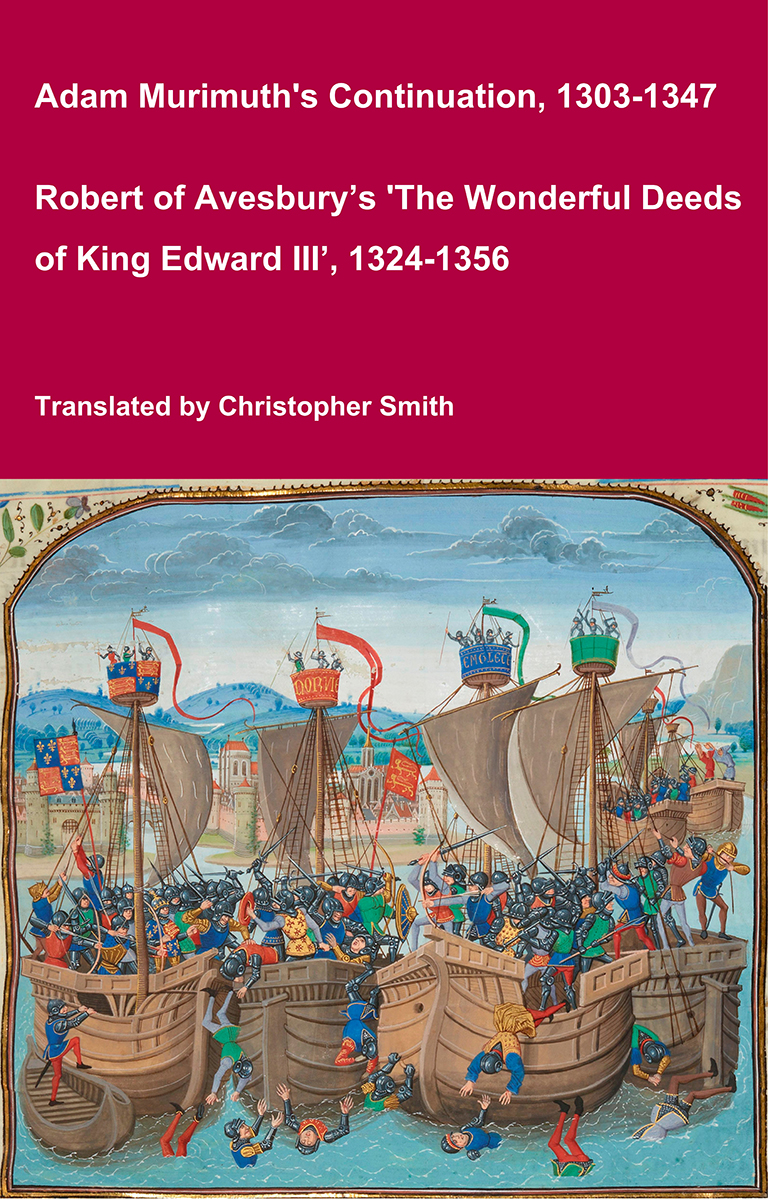
Adam Murimuth's Continuation and Robert of Avesbury’s 'The Wonderful Deeds of King Edward III'
This volume brings together two of the most important contemporary chronicles for the reign of Edward III and the opening phases of the Hundred Years’ War. Written in Latin by English clerical observers, these texts provide a vivid and authoritative window into the political, diplomatic, and military history of fourteenth-century England and its continental ambitions. Adam Murimuth Continuatio's Chronicarum continues an earlier chronicle into the mid-fourteenth century, offering concise but valuable notices on royal policy, foreign relations, and ecclesiastical affairs. Its annalistic structure makes it especially useful for establishing chronology and tracing the development of events year by year. Complementing it, Robert of Avesbury’s De gestis mirabilibus regis Edwardi tertii is a rich documentary chronicle preserving letters, treaties, and official records alongside narrative passages. It is an indispensable source for understanding Edward III’s claim to the French crown, the conduct of war, and the mechanisms of medieval diplomacy. Together, these works offer scholars, students, and enthusiasts a reliable and unembellished account of a transformative period in English and European history. Essential for anyone interested in medieval chronicles, the Hundred Years’ War, or the reign of Edward III.
Available at Amazon in eBook and Paperback format.

On 8th February 1882 George Henry Lowther 4th Earl Lonsdale [aged 26] died at a house in London he had purchased for Connie Gilchrist [aged 17] and other girls of the Gaiety Theatre. He bequeathed the house, and a sizeable legacy, to Gilchrist. His brother Hugh [aged 25] succeeded 5th Earl Lonsdale, 6th Viscount Lowther, 6th Baron Lowther. Grace Cecilie Gordon Countess Lonsdale [aged 27] by marriage Countess Lonsdale.
On 21st October 1889 George FitzMaurice 6th Earl of Orkney [aged 62] died. [her future husband] Edmond Fitzmaurice 7th Earl of Orkney [aged 22] succeeded 7th Earl Orkney.
On 19th July 1892 Edmond Fitzmaurice 7th Earl of Orkney [aged 25] and Constance MacDonald "Connie" Gilchrist Countess Orkney [aged 27] were married.
On 9th May 1946 Constance MacDonald "Connie" Gilchrist Countess Orkney [aged 81] died at his her Tythe House, Stewkley.
On 21st August 1951 [her former husband] Edmond Fitzmaurice 7th Earl of Orkney [aged 84] died.
Frederick Leighton Biography. Meanwhile four of these beautiful children became useful to him as models. From the second daughter [Edith Ellen Pullen], who afterwards married an artist, Leighton painted "Memories," reproduced here; from the third, Hetty, he painted "Simœtha the Sorceress" and "Farewell"; but it was the youngest, Lina, quite a small child, who delighted him most, and who had a rare, refined charm which must have captivated any child-lover. She took the place of little Connie Gilchrist of the "Cleobouline," the "Music Lesson," and other of the earlier paintings, in the later pictures. She sat for "Sister's Kiss," "The Light of the Harem," "Letty," the sleeping group in "Cymon and Iphigenia," "Kittens," in the friezes "The Dance" and "Music," and "A little girl with golden hair and pale blue eyes" -
"Yellow and pale as ripened corn
Which Autumn's kiss frees—grain from sheath
Such was her hair, while her eyes beneath,
Showed Spring's faint violets freshly born."
Robert Browning.