

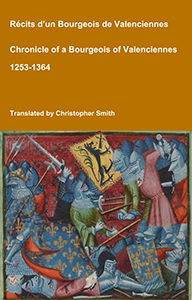
Chronicle of a Bourgeois of Valenciennes
Récits d’un bourgeois de Valenciennes aka The Chronicle of a Bourgeois of Valenciennes is a vivid 14th-century vernacular chronicle written by an anonymous urban chronicler from Valenciennes in the County of Hainaut. It survives in a manuscript that describes local and regional history from about 1253 to 1366, blending chronology, narrative episodes, and eyewitness-style accounts of political, military, and social events in medieval France, Flanders, and the Low Countries. The work begins with a chronological framework of events affecting Valenciennes and its region under rulers such as King Philip VI of France and the shifting allegiances of local nobility. It includes accounts of conflicts, sieges, diplomatic manoeuvres, and the impact of broader struggles like the Hundred Years’ War on urban life in Hainaut. Written from the perspective of a burgher (bourgeois) rather than a monastery or royal court, the chronicle offers a rare lay viewpoint on high politics and warfare, reflecting how merchants, townspeople, and civic institutions experienced the turbulence of the 13th and 14th centuries. Its narrative style combines straightforward reporting of events with moral and civic observations, making it a valuable source for readers interested in medieval urban society, regional politics, and the lived experience of war and governance in pre-modern Europe.
Available at Amazon in eBook and Paperback format.
Paternal Family Tree: Chaucer
Around 1343 Geoffrey Chaucer was born.
Before 1367 Geoffrey Chaucer [aged 23] and Philippa Roet [aged 20] were married at St Mary de Castro Leicester, Leicestershire [Map].
In or before 1367 Hugh Swynford and [his sister-in-law] Katherine Swynford aka Roet Duchess Lancaster [aged 16] were married.
Around 1367 [his son] Thomas Chaucer was born to Geoffrey Chaucer [aged 24] and [his wife] Philippa Roet [aged 21]. He married before 1404 Maud Burghesh and had issue.
In June 1368 Lionel of Antwerp 1st Duke of Clarence [aged 29] and Violante Visconti [aged 14] were married in the Church of Santa Maria Maggiore, Milan [Map]. The wedding festivities were lavish and ostentatious. The banquet, held outside, included 30 courses of meat and fish presented fully gilded. Between the courses the guests were given gifts such as suits of armour, bolts of cloth, war horses, arms, and hunting dogs. Among the guests were Geoffrey Chaucer [aged 25], Petrarch, Jean Froissart and John Hawkwood [aged 48]. He the son of King Edward III of England [aged 55] and Philippa of Hainaut Queen Consort England [aged 57]. They were fourth cousin once removed.
Around 1387 [his wife] Philippa Roet [aged 41] died.
In September 1389 the Scrope vs Grosvenor Case was brought to the Court of Chivalry. Up to that time two families, Scrope and Grosvenor, had been using the armorial  Scrope Arms: Azure, a bend or.
Several hundred witnesses were called including John of Gaunt 1st Duke Lancaster [aged 49], Geoffrey Chaucer [aged 46] and John Savile of Shelley and Golcar [aged 64].
On 3rd September 1386 Owain ap Gruffudd "Glyndŵr" Mathrafal Prince Powys [aged 27] gave evidence at the Church of John the Baptist, Chester [Map].
The Court decided in favour of Scrope.
Neither party was happy with the decision so King Richard II [aged 22] was called upon to give his personal verdict.
On 27th May 1390 he confirmed that Grosvenor could not bear the undifferenced arms.
As a consequence of the case the Grosvenor has for many years used the name Bendor for horses and nicknames.


On 25th October 1400 Geoffrey Chaucer [aged 57] died. He was buried at Poets Corner Westminster Abbey [Map].
John Evelyn's Diary. 9th June 1654. Dined at Marlborough [Map], which having been lately fired, was now new built. At one end of this town, we saw my Lord Seymour's [aged 64] house, but nothing observable save the Mount, to which we ascended by windings for near half a mile. It seems to have been cast up by hand. We passed by Colonel Popham's [aged 49], a noble seat, park, and river. Thence, to Newbury [Map], a considerable town, and Donnington, famous for its battle, siege, and castle, this last had been in the possession of old Geoffrey Chaucer. Then to Aldermaston, a house of Sir Humphrey Forster's, built à la moderne. Also, that exceedingly beautiful seat of my Lord Pembroke [aged 33], on the ascent of hill, flanked with wood, and regarding the river, and so, at night, to Cadenham, the mansion of Edward Hungerford [aged 21], Esq, uncle to my wife [aged 19], where we made some stay. The rest of the week we did nothing but feast and make good cheer, to welcome my wife.
Samuel Pepys' Diary. 14th June 1663. By and by in comes Sir J. Minnes [aged 64] and Sir W. Batten [aged 62], and so we sat talking. Among other things, Sir J. Minnes brought many fine expressions of Chaucer, which he doats on mightily, and without doubt he is a very fine poet1. Sir W. Pen [aged 42] continues lame of the gout, that he cannot rise from his chair. So after staying an hour with him, we went home and to supper, and so to prayers and bed.
Note 1. Pepys continued through life an admirer of Chaucer, and we have the authority of Dryden [aged 31] himself for saying that we owe his character of the Good Parson to Pepys's recommendation.


Jean de Waurin's Chronicle of England Volume 6 Books 3-6: The Wars of the Roses
Jean de Waurin was a French Chronicler, from the Artois region, who was born around 1400, and died around 1474. Waurin’s Chronicle of England, Volume 6, covering the period 1450 to 1471, from which we have selected and translated Chapters relating to the Wars of the Roses, provides a vivid, original, contemporary description of key events some of which he witnessed first-hand, some of which he was told by the key people involved with whom Waurin had a personal relationship.
Available at Amazon in eBook and Paperback format.

John Evelyn's Diary. 3rd August 1667. Went to Mr. Cowley's [deceased] funeral, whose corpse lay at Wallingford House, and was thence conveyed to Westminster Abbey [Map] in a hearse with six horses and all funeral decency, near a hundred coaches of noblemen and persons of quality following; among these, all the wits of the town, divers bishops and clergymen. He was interred next Geoffry Chaucer, and near Spenser. A goodly. Monument is since erected to his memory.
[his daughter] Elizabeth Chaucer was born to Geoffrey Chaucer and Philippa Roet.