

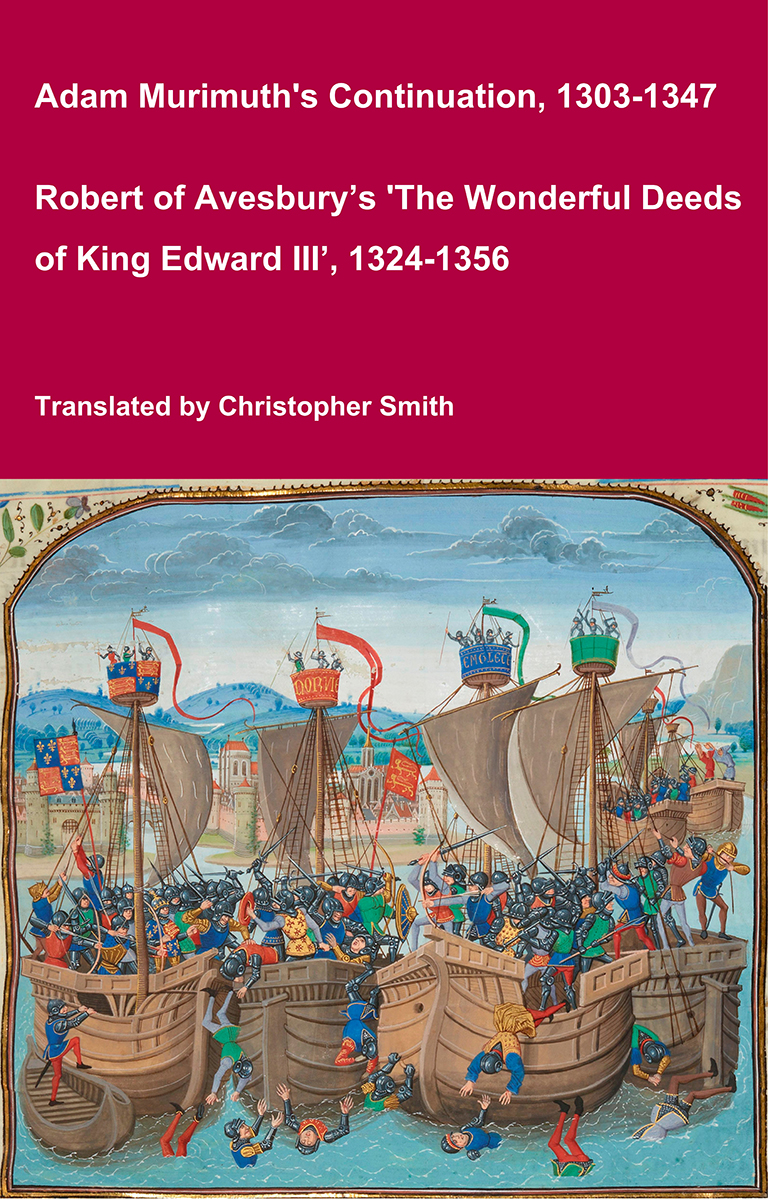
Adam Murimuth's Continuation and Robert of Avesbury’s 'The Wonderful Deeds of King Edward III'
This volume brings together two of the most important contemporary chronicles for the reign of Edward III and the opening phases of the Hundred Years’ War. Written in Latin by English clerical observers, these texts provide a vivid and authoritative window into the political, diplomatic, and military history of fourteenth-century England and its continental ambitions. Adam Murimuth Continuatio's Chronicarum continues an earlier chronicle into the mid-fourteenth century, offering concise but valuable notices on royal policy, foreign relations, and ecclesiastical affairs. Its annalistic structure makes it especially useful for establishing chronology and tracing the development of events year by year. Complementing it, Robert of Avesbury’s De gestis mirabilibus regis Edwardi tertii is a rich documentary chronicle preserving letters, treaties, and official records alongside narrative passages. It is an indispensable source for understanding Edward III’s claim to the French crown, the conduct of war, and the mechanisms of medieval diplomacy. Together, these works offer scholars, students, and enthusiasts a reliable and unembellished account of a transformative period in English and European history. Essential for anyone interested in medieval chronicles, the Hundred Years’ War, or the reign of Edward III.
Available at Amazon in eBook and Paperback format.
George Backhouse Witts is in Antiquaries.
In 1846 George Backhouse Witts was born to [his father] Reverend Edward Francis Witts at Winchcombe, Gloucestershire.
Transactions of the Bristol and Gloucestershire Archaeological Society Volume 9 1876. At the close of this address the journey was resumed, and Willersey Camp was next reached. It is the site of a British Camp, on property now belonging to Mr. R. N. Chadwick, who had obligingly given permission for its inspection, and also for the exploration of the barrow adjacent. Mr. George B. Witts (age 29) here acted as cicerone, and by his concise and graphic description of the remains gave his auditory clear ideas of their ancient form and uses. The camp, Mr. Witts stated, was 68 acres in extent, and after describing how it was originally constructed, pointed out the number of British camps which were visible from it. Amongst them were those as distant as Shenboro', Cleeve Hill (Cheltenham), Oxenton Hill, May Hill, Welshboro', Malvern, Bredon (2), Meon, Chastleton, and the Rollright stones [Map], to all which, with others, Mr. Witts directed attention. He also described the situation of the camp in relation to the Roman roads and its connection with Saintbury (Swains'-bury) camp. From the camp a short walk brought the party to the barrow [Willersey Barrow [Map]], which with praiseworthy zeal Mr. Witts had on the previous day, with a willing party of workers, partially excavated. The face of the outer wall of the barrow was exposed for some distance, also the walls of some of the chambers, though displaced probably by previous explorers. Here the bones of the ox were found, and also many fragments of human bones and of pottery, with some flint chips. After an explanation of the form and extent of the barrow, a hearty vote of thanks was given to Mr. Chadwick for his permission to explore the barrow, and to those who had so well done the work. The carriages were resumed, and on arriving at Kiftsgate Stone the President pointed it out to the party as their carriages arrived in succession at the spot, and thence they were conveyed to the summit of "Dover's Hill." From this hill is a most magnificent panorame, which was seen to great advantage, the atmosphere being just at that time particularly favorable for views of distant scenery. From the hill associated with the historic name of Mr. Dover, the great patron of the Coteswold games, the travellers proceeded to the picturesque town of Chipping Campden, where at the ancient hostelry of the Noel Arms the party alighted to lunch, to which they had been kindly invited by the President. Having partaken of the President's hospitality
In 1878 George Backhouse Witts (age 32) and Sybil Catharine Vavasour were married at Cheltenham, Gloucestershire.
Archaeological Handbook of the County of Gloucester by G B Witts (age 36), C.E. being an Explanatory Description of the Archaeological Map of Gloucestershire by the Same Author, On which are shown 113 Ancient Camps, 26 Roman Villas, 40 Long Barrows, 126 Round Barrows, and a large number of British and Roman Roads. 1883.
On 6th September 1912 George Backhouse Witts (age 66) died.
GrandFather: Francis Edward Witts
Father: Reverend Edward Francis Witts