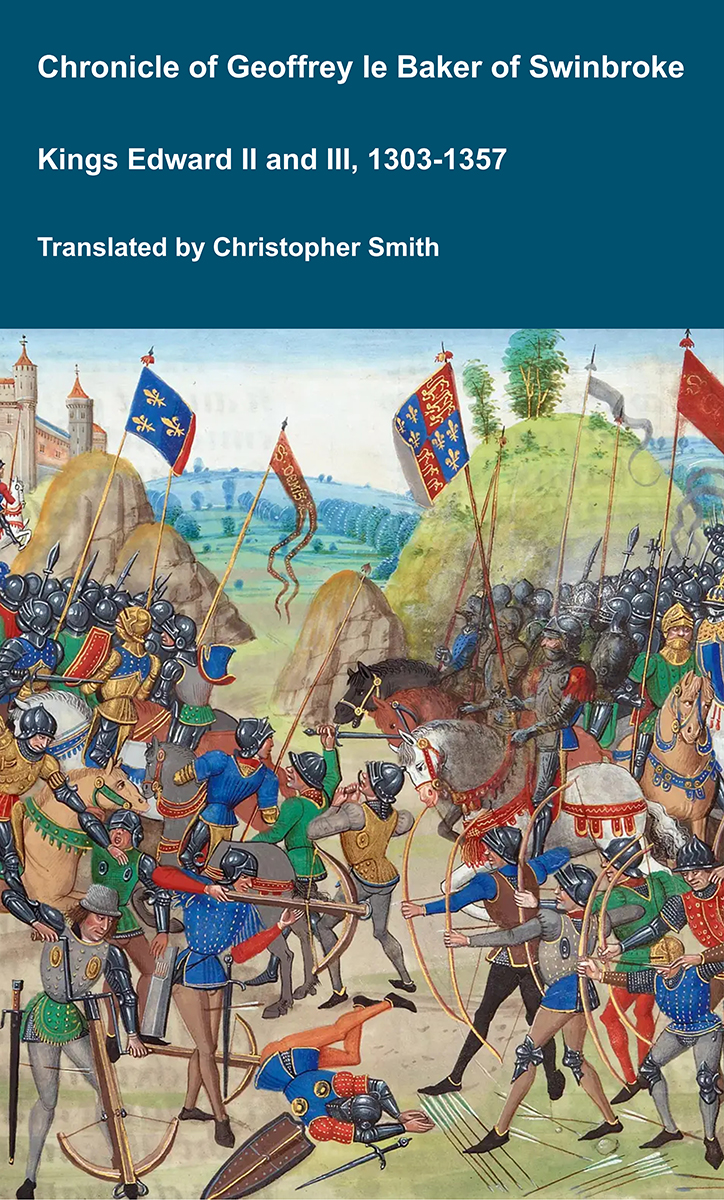
Chronicle of Geoffrey le Baker of Swinbroke
Baker was a secular clerk from Swinbroke, now Swinbrook, an Oxfordshire village two miles east of Burford. His Chronicle describes the events of the period 1303-1356: Gaveston, Bannockburn, Boroughbridge, the murder of King Edward II, the Scottish Wars, Sluys, Crécy, the Black Death, Winchelsea and Poitiers. To quote Herbert Bruce 'it possesses a vigorous and characteristic style, and its value for particular events between 1303 and 1356 has been recognised by its editor and by subsequent writers'. The book provides remarkable detail about the events it describes. Baker's text has been augmented with hundreds of notes, including extracts from other contemporary chronicles, such as the Annales Londonienses, Annales Paulini, Murimuth, Lanercost, Avesbury, Guisborough and Froissart to enrich the reader's understanding. The translation takes as its source the 'Chronicon Galfridi le Baker de Swynebroke' published in 1889, edited by Edward Maunde Thompson.
Available at Amazon in eBook and Paperback format.
Graves of George Frederick Bodley, flat, next to the large cross, and Reverend Frederick Andrews in the churchyard of St James' Church, Kinnersley [Map].
Reverend Frederick Andrews: In 1873 he was appointed Vicar of St James' Church, Kinnersley [Map]. In 1920 he died. He was buried in the churchyard of St James' Church, Kinnersley [Map].
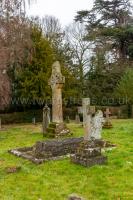
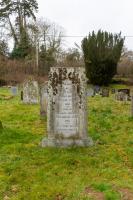
On 14th March 1827 George Frederick Bodley was born to William Hulme Bodley.
In 1872 George Frederick Bodley [aged 44] and Minna Reavely were married at Kinnersley Castle, Herefordshire [Map].
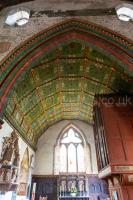
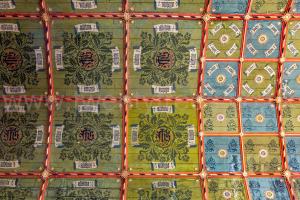
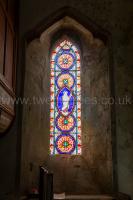
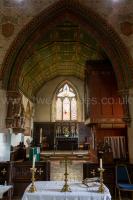
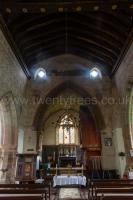
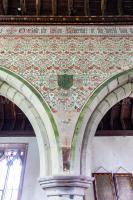
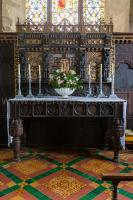
From 1873 the interior of St James' Church, Kinnersley [Map] was revised by George Frederick Bodley [aged 45] working with the Reverend Frederick Andrews. Reredos by George Frederick Bodley. Altar Jacobean.

1883. Lych Gate at St Oswald's Church, Blankney. By George Frederick Bodley [aged 55]. Inscription over the gate: 'ERECTED IN MEMORY OF FLORENCE CHAPLIN, 1883'.
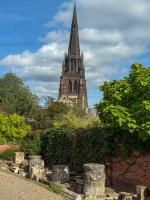
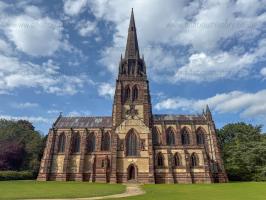
Clumber Chapel [Map] was commissioned by Henry Pelham-Clinton 7th Duke Newcastle-under-Lyne [aged 25] and designed by George Frederick Bodley [aged 62]. Built in Runcorn Sandstone and white Steetley Stone, the building is 42m long. The spire is 55m high. The oak screen that separates the Crossing from the Chancel is also designed by Bodley. The Chapel was dedicated by Bishop George Ridding [aged 61] on 23rd October 1889.
Henry Pelham-Clinton 7th Duke Newcastle-under-Lyne: On 28th September 1864 he was born to Henry Pelham Alexander Pelham-Clinton 6th Duke Newcastle-under-Lyne and Henrietta Adela Hope Duchess Newcastle under Lyne. On 22nd February 1879 Henry Pelham Alexander Pelham-Clinton 6th Duke Newcastle-under-Lyne died. His son Henry succeeded 7th Duke Newcastle under Lyme, 14th Earl Lincoln. On 30th May 1928 Henry Pelham-Clinton 7th Duke Newcastle-under-Lyne died. His brother Francis succeeded 8th Duke Newcastle under Lyme, 15th Earl Lincoln.
On 21st October 1907 George Frederick Bodley [aged 80] died at Water Eaton, Oxfordshire. He was buried in the churchyard of St James' Church, Kinnersley [Map].