


Chronicle of a Bourgeois of Valenciennes
Récits d’un bourgeois de Valenciennes aka The Chronicle of a Bourgeois of Valenciennes is a vivid 14th-century vernacular chronicle written by an anonymous urban chronicler from Valenciennes in the County of Hainaut. It survives in a manuscript that describes local and regional history from about 1253 to 1366, blending chronology, narrative episodes, and eyewitness-style accounts of political, military, and social events in medieval France, Flanders, and the Low Countries. The work begins with a chronological framework of events affecting Valenciennes and its region under rulers such as King Philip VI of France and the shifting allegiances of local nobility. It includes accounts of conflicts, sieges, diplomatic manoeuvres, and the impact of broader struggles like the Hundred Years’ War on urban life in Hainaut. Written from the perspective of a burgher (bourgeois) rather than a monastery or royal court, the chronicle offers a rare lay viewpoint on high politics and warfare, reflecting how merchants, townspeople, and civic institutions experienced the turbulence of the 13th and 14th centuries. Its narrative style combines straightforward reporting of events with moral and civic observations, making it a valuable source for readers interested in medieval urban society, regional politics, and the lived experience of war and governance in pre-modern Europe.
Available at Amazon in eBook and Paperback format.
In 1710. John James Baker. Known as "Whig Junto". From www.tate.org ... This is a portrait of a political group named the Whig Junto and a Black servant, whose identity is unknown. It is the only known portrait of the Junto, which was an ideologically close-knit group of political peers who formed the leadership of the Whig party in the late seventeenth and early eighteenth centuries. The members of the group are shown gathered together on a grand terrace, while a vista onto a garden is revealed by the Black servant, who holds back a heavy velvet curtain. The grand architectural setting is imagined, and is deliberately evocative of power and status. The picture was commissioned by Edward Russell, 1st Earl of Orford [aged 57], who stands on the right, as if welcoming the company. It is not known if Orford had a Black servant in his household or whether the individual was included to emphasise Orford's wealth and social standing. At the time, Britain was profiting heavily from the trade of enslaved people from West Africa. The presence of Black servants, many of whom were enslaved, in both aristocratic and merchant households had come to symbolise property and wealth. This reflected the dehumanising view of enslaved Black people held by the British elite.
The scene conjures one of the Junto's country house meetings where, in between parliamentary sessions, policy and party strategy were formulated. From left to right the sitters round the table can be identified as Charles Spencer, 3rd Earl of Sunderland [aged 34]; Thomas Wharton, 1st Marquess of Wharton [aged 61]; John Somers, 1st Baron Somers (1C 1697) [aged 58]; Charles Montagu, 1st Earl of Halifax [aged 48]; and William Cavendish, 2nd Duke of Devonshire [aged 38]. The lavish surroundings probably represent Orford's house, Chippenham, where Junto meetings sometimes took place. It was also ideally located for the nearby Newmarket horse races, which the members of the Junto frequently attended when parliament was not sitting.
The portrait is dated 1710, before the crushing electoral defeat of the Whigs in October of that year. It shows the political allies while in power, when Sunderland was Secretary of State, Wharton Lord Lieutenant of Ireland, Somers Lord President of the Privy Council, Devonshire Lord Steward and a member of the Privy Council, and Orford First Lord of the Admiralty. On the surface the portrait shows a relaxed gathering of fellow connoisseurs, seated round a table consulting antique medals and books of prints. Fittingly, Somers and Halifax sit at the centre of the company, holding a book and handling a medal respectively. Both were known collectors and antiquarians - Somers was one of the founders of the Whig Kit-Cat Club, a convivial drinking and dining club, but which also had a political propagandist agenda; he had also purchased the Resta collection of drawings from Italy in 1709. Halifax had a celebrated library and a collection of antique medals (sold in 1740), to which those being consulted presumably allude. Behind this exterior of cultural appreciation, however, the portrait advertises Whig policy in 1709-10, which supported the continuation of war against France in opposition to Tory calls for peace. The two visible prints are friezes from Trajan's column showing episodes from the Dacian wars, with the Roman army crossing the Danube. The viewer is invited to make parallels between the valour and victories of the Roman emperors and the current military greatness achieved for Britain by the Duke of Marlborough's campaigns. The globe, showing the Pacific, presumably alludes to Whig foreign policy ambitions beyond Europe. By defeating France in Europe, they aimed to gain commercial access to Spanish American trade routes. It reflects the competitive European colonial pursuit of new markets, including the selling of enslaved West African people to Spanish territories overseas.
John James Baker (or Backer, or Bakker) is thought to have been Flemish, from Antwerp. He was Godfrey Kneller's [aged 63] (1646-1723) long-time studio assistant and drapery painter, and this is his largest, most ambitious and complex work. The symbolic programme was presumably devised by Orford in discussion with Baker. The Duke of Devonshire was not a regular member of the Junto, although an increasingly important Whig peer, but his inclusion here is presumably because of his kinship relationship with Orford. The picture is thus a demonstration of Orford's private as well as professional networks, and also his pride and ambition. It would have been displayed at Chippenham in the newly appointed, fashionable interiors, alongside other works that Orford commissioned to advertise his public achievement and the private and professional networks that sustained his power and influence.

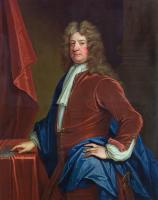


Before 1725. John James Baker. Portrait of Stephen Fox.
In 1725 John James Baker died.