


Anne Boleyn. Her Life as told by Lancelot de Carle's 1536 Letter.
In 1536, two weeks after the execution of Anne Boleyn, her brother George and four others, Lancelot du Carle, wrote an extraordinary letter that described Anne's life, and her trial and execution, to which he was a witness. This book presents a new translation of that letter, with additional material from other contemporary sources such as Letters, Hall's and Wriothesley's Chronicles, the pamphlets of Wynkyn the Worde, the Memorial of George Constantyne, the Portuguese Letter and the Baga de Secrets, all of which are provided in Appendices.
Available at Amazon in eBook and Paperback format.
Paternal Family Tree: Robartes
In 1606 John Robartes 1st Earl Radnor was born to [his father] John Robartes 1st Baron Robartes [aged 26] at Truro, Cornwall.
In 1616 John Robartes 1st Earl Radnor [aged 10] was knighted.
In 1620 John Robartes 1st Earl Radnor [aged 14] bought at Lanhydrock House.
In 1625 [his father] John Robartes 1st Baron Robartes [aged 45] was created 1st Baron Robartes of Truro in Cornwall. Purchased for £10,000, possibly under compulsion.
After 1625 John Robartes 1st Earl Radnor [aged 19] and Letitia Isabella Smythe Countess Radnor were married. She by marriage Baroness Robartes of Truro in Cornwall. The difference in their ages was 24 years.
In 1634 [his father] John Robartes 1st Baron Robartes [aged 54] died. His son John [aged 28] succeeded 2nd Baron Robartes of Truro in Cornwall, 2nd Baronet Robartes. [his future wife] Lucy Rich Baroness Robartes [aged 19] by marriage Baroness Robartes of Truro in Cornwall.
Before 7th February 1634 John Robartes 1st Earl Radnor [aged 28] and Lucy Rich Baroness Robartes [aged 19] were married. She the daughter of Robert Rich 2nd Earl Warwick [aged 46] and Frances Hatton Countess Warwick.
On 7th February 1634 [his son] Robert Robartes was born to John Robartes 1st Earl Radnor [aged 28] and [his wife] Lucy Rich Baroness Robartes [aged 19]. He married 1657 Sarah Bodvel and had issue.
In November 1635 [his son] Hender Robartes was born to John Robartes 1st Earl Radnor [aged 29] and [his wife] Lucy Rich Baroness Robartes [aged 20].
Abbot John Whethamstede’s Chronicle of the Abbey of St Albans
Abbot John Whethamstede's Register aka Chronicle of his second term at the Abbey of St Albans, 1451-1461, is a remarkable text that describes his first-hand experience of the beginning of the Wars of the Roses including the First and Second Battles of St Albans, 1455 and 1461, respectively, their cause, and their consequences, not least on the Abbey itself. His text also includes Loveday, Blore Heath, Northampton, the Act of Accord, Wakefield, and Towton, and ends with the Coronation of King Edward IV. In addition to the events of the Wars of the Roses, Abbot John, or his scribes who wrote the Chronicle, include details in the life of the Abbey such as charters, letters, land exchanges, visits by legates, and disputes, which provide a rich insight into the day-to-day life of the Abbey, and the challenges faced by its Abbot.
Available at Amazon in eBook and Paperback format.
In or after November 1635 [his former wife] Lucy Rich Baroness Robartes [deceased] died.
Around 1650 [his daughter] Letitia Robartes Countess Drogheda was born to John Robartes 1st Earl Radnor [aged 44] and [his wife] Letitia Isabella Smythe Countess Radnor [aged 20] at Lanhydrock, Bodmin. She married (1) 28th October 1669 her fourth cousin Charles Moore 2nd Earl Drogheda, son of Henry Moore 1st Earl Drogheda and Alice Spencer Countess Drogheda (2) 29th September 1679 William Wycherley.
Before 6th January 1650 [his son] Francis Robartes was born to John Robartes 1st Earl Radnor [aged 44] and [his wife] Letitia Isabella Smythe Countess Radnor [aged 20] at Lanhydrock, Bodmin. He married (1) before 2nd July 1680 Penelope Pole, daughter of Courtenay Pole 2nd Baronet and Urith Shapcote Lady Pole (2) before 3rd February 1718 his fourth cousin twice removed Anne Fitzgerald, daughter of Wentworth Fitzgerald 17th Earl of Kildare and Elizabeth Holles Countess Kildare, and had issue.
In 1657 Robert Robartes [aged 22] and Sarah Bodvel [aged 20] were married. He the son of John Robartes 1st Earl Radnor [aged 51] and Lucy Rich Baroness Robartes.
Samuel Pepys' Diary. 6th June 1660. My letters tell me, that Mr. Calamy1 had preached before the King in a surplice (this I heard afterwards to be false); that my Lord, Gen. Monk [aged 51], and three more Lords, are made Commissioners for the Treasury2; that my Lord had some great place conferred on him, and they say Master of the Wardrobe3; that the two Dukes [Duke of York and Duke of Gloucester.] do haunt the Park much, and that they were at a play, Madam Epicene,-["Epicene, or the Silent Woman", a comedy, by Ben Jonson.] the other day; that Sir. Ant. Cooper [aged 38], Mr. Hollis [aged 60], and Mr. Annesly [aged 45], & late President of the Council of State, are made Privy Councillors to the King. At night very busy sending Mr. Donne away to London, and wrote to my father for a coat to be made me against I come to London, which I think will not be long. At night Mr. Edward Montagu came on board and staid long up with my Lord. I to bed and about one in the morning,
Note 1. Edmund Calamy, D.D., the celebrated Nonconformist divine, born February, 1600, appointed Chaplain to Charles II., 1660. He refused the bishopric of Lichfield which was offered to him. Died October 29th, 1666.
Note 2. The names of the Commissioners were Sir Edward Hyde [aged 51], afterwards Earl of Clarendon, General Monk, Thomas, Earl of Southampton [aged 53], John, Lord Robartes [aged 54], Thomas, Lord Colepeper [aged 60], Sir Edward Montagu, with Sir Edward Nicholas [aged 67] and Sir William Morrice [aged 57] as principal Secretaries of State. The patents are dated June 19th, 1660.
Note 3. The duty of the Master of the Wardrobe was to provide "proper furniture for coronations, marriages, and funerals" of the sovereign and royal family, "cloaths of state, beds, hangings, and other necessaries for the houses of foreign ambassadors, cloaths of state for Lord Lieutenant of Ireland, Prince of Wales, and ambassadors abroad", as also to provide robes for Ministers of State, Knights of the Garter, &c. The last Master of the Wardrobe was Ralph, Duke of Montague [aged 21], who died 1709.


Samuel Pepys' Diary. 21st August 1660. This morning I went to White Hall with Sir W. Pen [aged 39] by water, who in our passage told me how he was bred up under Sir W. Batten [aged 59]. We went to Mr. Coventry's [aged 32] chamber, and consulted of drawing my papers of debts of the Navy against the afternoon for the Committee. So to the Admiralty, where W. Hewer [aged 18] and I did them, and after that he went to his Aunt's Blackburn (who has a kinswoman dead at her house to-day, and was to be buried to-night, by which means he staid very late out). I to Westminster Hall [Map], where I met Mr. Crew [aged 62] and dined with him, where there dined one Mr. Hickeman, an Oxford man, who spoke very much against the height of the now old clergy, for putting out many of the religious fellows of Colleges, and inveighing against them for their being drunk, which, if true, I am sorry to hear. After that towards Westminster, where I called on Mr. Pim, and there found my velvet coat (the first that ever I had) done, and a velvet mantle, which I took to the Privy Seal Office, and there locked them up, and went to the Queen's Court, and there, after much waiting, spoke with Colonel Birch [aged 44], who read my papers, and desired some addition, which done I returned to the Privy Seal, where little to do, and with Mr. Moore towards London, and in our way meeting Monsieur Eschar (Mr. Montagu's man), about the Savoy, he took us to the Brazennose Tavern, and there drank and so parted, and I home by coach, and there, it being post-night, I wrote to my Lord to give him notice that all things are well; that General Monk [aged 51] is made Lieutenant of Ireland, which my Lord Roberts [aged 54] (made Deputy) do not like of, to be Deputy to any man but the King himself. After that to bed.


Samuel Pepys' Diary. 22nd August 1660. Office, which done, Sir W. Pen [aged 39] took me into the garden, and there told me how Mr. Turner do intend to petition the Duke for an allowance extra as one of the Clerks of the Navy, which he desired me to join with him in the furthering of, which I promised to do so that it did not reflect upon me or to my damage to have any other added, as if I was not able to perform my place; which he did wholly disown to be any of his intention, but far from it. I took Mr. Hater home with me to dinner, with whom I did advise, who did give me the same counsel. After dinner he and I to the office about doing something more as to the debts of the Navy than I had done yesterday, and so to Whitehall to the Privy Seal, and having done there, with my father (who came to see me) to Westminster Hall [Map] and the Parliament House to look for Col. Birch [aged 44], but found him not. In the House, after the Committee was up, I met with Mr. G. Montagu [aged 38], and joyed him in his entrance (this being his 3d day) for Dover. Here he made me sit all alone in the House, none but he and I, half an hour, discoursing how things stand, and in short he told me how there was like to be many factions at Court between Marquis Ormond, General Monk [aged 51], and the Lord Roberts [aged 54], about the business of Ireland; as there is already between the two Houses about the Act of Indemnity; and in the House of Commons, between the Episcopalian and Presbyterian men. Hence to my father's [aged 59] (walking with Mr. Herring, the minister of St. Bride's), and took them to the Sun Tavern, where I found George, my old drawer, come again. From thence by water, landed them at Blackfriars, and so home and to bed.
Samuel Pepys' Diary. 7th August 1661. To horse again, and by degrees with much ado got to London, where I found all well at home and at my father's and my Lady's, but no news yet from my Lord where he is. At my Lady's (whither I went with Dean Fuller [aged 53], who came to my house to see me just as I was come home) I met with Mr. Moore, who told me at what a loss he was for me, for to-morrow is a Seal day at the Privy Seal, and it being my month, I am to wait upon my Lord Roberts [aged 55], Lord Privy Seal, at the Seal. Home and to bed.
Samuel Pepys' Diary. 21st October 1661. Early with Mr. Moore by coach to Chelsy, to my Lord Privy Seal's [aged 55], but have missed of coming time enough; and having taken up Mr. Pargiter, the goldsmith (who is the man of the world that I do most know and believe to be a cheating rogue), we drank our morning draft there together of cake and ale, and did make good sport of his losing so much by the King's [aged 31] coming in, he having bought much of Crown lands, of which, God forgive me! I am very glad.
Samuel Pepys' Diary. 23rd October 1661. To Whitehall, and there, to drink our morning, Sir W. Pen [aged 40] and I to a friend's lodging of his (Col. Pr. Swell), and at noon he and I dined together alone at the Legg in King Street, and so by coach to Chelsy to my Lord Privy Seal's [aged 55] about business of Sir William's, in which we had a fair admittance to talk with my Lord, and had his answer, and so back to the Opera, and there I saw again "Love and Honour", and a very good play it is.
Samuel Pepys' Diary. 12th December 1661. From thence to Westminster to my Lord's house to meet my Lord Privy Seal [aged 55], who appointed to seal there this afternoon, but by and by word is brought that he is come to Whitehall, and so we are fain to go thither to him, and there we staid to seal till it was so late that though I got leave to go away before he had done, yet the office was done before I could get thither, and so to Sir W. Pen's [aged 40], and there sat and talked and drank with him, and so home.
Jean de Waurin's Chronicle of England Volume 6 Books 3-6: The Wars of the Roses
Jean de Waurin was a French Chronicler, from the Artois region, who was born around 1400, and died around 1474. Waurin’s Chronicle of England, Volume 6, covering the period 1450 to 1471, from which we have selected and translated Chapters relating to the Wars of the Roses, provides a vivid, original, contemporary description of key events some of which he witnessed first-hand, some of which he was told by the key people involved with whom Waurin had a personal relationship.
Available at Amazon in eBook and Paperback format.
Samuel Pepys' Diary. 16th December 1661. Up by five o'clock this morning by candlelight (which I have not done for many a day), being called upon by one Mr. Bollen by appointment, who has business to be done with my Lord Privy Seal [aged 55] this morning, and so by coach, calling Mr. Moore at the Wardrobe, to Chelsy, and there did get my Lord to seal it.
Samuel Pepys' Diary. 17th December 1661. Up and to the Paynter's [aged 52] to see how he went forward in our picture. So back again to dinner at home, and then was sent for to the Privy Seal [aged 55], whither I was forced to go and stay so long and late that I was much vexed. At last we got all done, and then made haste to the office, where they were sat, and there we sat late, and so home to supper and to Selden, "Mare Clausum", and so to bed.

Samuel Pepys' Diary. 18th December 1661. At the office upon business extraordinary all the morning, then to my Lady Sandwich's [aged 36] to dinner, whither my wife, who had been at the painter's [aged 55], came to me, and there dined, and there I left her, and to the Temple [Map] my brother and I to see Mrs. Turner [aged 38], who begins to be better, and so back to my Lady's, where much made of, and so home to my study till bed-time, and so to bed.
Samuel Pepys' Diary. 21st December 1661. To White Hall to the Privy Seal, where my Lord Privy Seal [aged 55] did tell us he could seal no more this month, for that he goes thirty miles out of town to keep his Christmas. At which I was glad, but only afeard lest any thing of the King's [aged 31] should force us to go after him to get a seal in the country.
Samuel Pepys' Diary. 23rd December 1661. Early up and by coach (before daylight) to the Wardrobe, and took up Mr. Moore, and he and I to Chelsy to my Lord Privy Seal [aged 55], and there sealed some things, he being to go out of town for all Christmas to-morrow.
Samuel Pepys' Diary. 10th November 1663. Up and to the office, where we sat till noon, and then to the Exchange [Map], where spoke with several and had my head casting about how to get a penny and I hope I shall, and then home, and there Mr. Moore by appointment dined with me, and after dinner all the afternoon till night drawing a bond and release against to-morrow for T. Trice, and I to come to a conclusion in which I proceed with great fear and jealousy, knowing him to be a rogue and one that I fear has at this time got too great a hank [hold] over me by the neglect of my lawyers. But among other things I am come to an end with Mr. Moore for a £32, a good while lying in my hand of my Lord Privy Seal's [aged 57] which he for the odd £7 do give me a bond to secure me against, and so I got £25 clear.
Samuel Pepys' Diary. 2nd March 1664. This morning Mr. Burgby, one of the writing clerks belonging to the Council, was with me about business, a knowing man, he complains how most of the Lords of the Council do look after themselves and their own ends, and none the publique, unless Sir Edward Nicholas [aged 70]. Sir G. Carteret [aged 54] is diligent, but all for his own ends and profit. My Lord Privy Seale [aged 58], a destroyer of every body's business, and do no good at all to the publique. The Archbishop of Canterbury [aged 65] speaks very little, nor do much, being now come to the highest pitch that he can expect. He tells me, he believes that things will go very high against the Chancellor [aged 55] by Digby [aged 51], and that bad things will be proved. Talks much of his neglecting the King [aged 33]; and making the King to trot every day to him, when he is well enough to go to visit his cozen Chief-Justice Hide [aged 69], but not to the Council or King. He commends my Lord of Ormond [aged 53] mightily in Ireland; but cries out cruelly of Sir G. Lane [aged 44] for his corruption; and that he hath done my Lord great dishonour by selling of places here, which are now all taken away, and the poor wretches ready to starve. That nobody almost understands or judges of business better than the King, if he would not be guilty of his father's fault to be doubtfull of himself, and easily be removed from his own opinion. That my Lord Lauderdale [aged 47] is never from the King's care nor council, and that he is a most cunning fellow. Upon the whole, that he finds things go very bad every where; and even in the Council nobody minds the publique.

Samuel Pepys' Diary. 3rd May 1664. Thence walked to Westminster Hall [Map]; and there, in the Lords' House, did in a great crowd, from ten o'clock till almost three, hear the cause of Mr. Roberts [aged 30], my Lord Privy Seal's [aged 58] son, against Win, who by false ways did get the father of Mr. Roberts's wife [aged 27] (Mr. Bodvill) to give him the estate and disinherit his daughter. The cause was managed for my Lord Privy Seal by Finch [aged 42] the Solicitor [General]; but I do really think that he is truly a man of as great eloquence as ever I heard, or ever hope to hear in all my life.
John Evelyn's Diary. 2nd March 1665. I went with his Majesty [aged 34] into the lobby behind the House of Lords, where I saw the King and the rest of the Lords robe themselves, and got into the House of Lords in a corner near the woolsack, on which the Lord Chancellor sits next below the throne: the King sat in all the regalia, the crown-imperial on his head, the sceptre and globe, etc. The Duke of Albemarle [aged 56] bore the sword, the Duke of Ormond [aged 54], the cap of dignity. The rest of the Lords robed in their places:-a most splendid and august convention. Then came the Speaker and the House of Commons [aged 48], and at the bar made a speech, and afterward presented several bills, a nod only passing them, the clerk saying, Le Roy le veult, as to public bills, as to private, Soit faite commeil est desirè. Then, his Majesty made a handsome but short speech, commanding my Lord Privy Seal [aged 59] to prorogue the Parliament, which he did, the Chancellor [aged 56] being ill and absent. I had not before seen this ceremony.


Samuel Pepys' Diary. 18th April 1665. At noon with my wife and Mr. Moore by water to Chelsey about my Privy Seale [aged 59] for Tangier, but my Lord Privy Seale was gone abroad, and so we, without going out of the boat, forced to return, and found him not at White Hall. So I to Sir Philip Warwicke [aged 55] and with him to my Lord Treasurer [aged 58], who signed my commission for Tangier-Treasurer and the docquet of my Privy Seale, for the monies to be paid to me.
Samuel Pepys' Diary. 19th April 1665. Up by five o'clock, and by water to White Hall; and there took coach, and with Mr. Moore to Chelsy; where, after all my fears what doubts and difficulties my Lord Privy Seale [aged 59] would make at my Tangier Privy Seale, he did pass it at first reading, without my speaking with him. And then called me in, and was very civil to me. I passed my time in contemplating (before I was called in) the picture of my Lord's son's lady, a most beautiful woman, and most like to Mrs. Butler.
Samuel Pepys' Diary. 21st December 1667. At the office all the morning, and at noon home to dinner with my Clerks and Creed, who among other things all alone, after dinner, talking of the times, he tells me that the Nonconformists are mighty high, and their meetings frequented and connived at; and they do expect to have their day now soon; for my Lord of Buckingham [aged 39] is a declared friend to them, and even to the Quakers, who had very good words the other day from the King [aged 37] himself: and, what is more, the Archbishop of Canterbury [aged 69] is called no more to the Cabal, nor, by the way, Sir W. Coventry [aged 39]; which I am sorry for, the Cabal at present being, as he says, the King, and Duke of Buckingham, and Lord Keeper [aged 61], the Duke of Albemarle [aged 59], and Privy Seale [aged 61]. The Bishops, differing from the King in the late business in the House of Lords, having caused this and what is like to follow, for every body is encouraged nowadays to speak, and even to preach, as I have heard one of them, as bad things against them as ever in the year 1640; which is a strange change. He gone, I to the office, where busy till late at night, and then home to sit with my wife, who is a little better, and her cheek asswaged. I read to her out of "The History of Algiers", which is mighty pretty reading, and did discourse alone about my sister Pall's [aged 27] match, which is now on foot with one Jackson [aged 27], another nephew of Mr. Phillips's, to whom he hath left his estate.


Samuel Pepys' Diary. 5th February 1668. Thence to other discourse, among others, he mightily commends my Lord Hinchingbroke's [aged 20] match and Lady [aged 23], though he buys her £10,000 dear, by the jointure and settlement his father [aged 42] makes her; and says that the Duke of York [aged 34] and Duchess of York [aged 30] did come to see them in bed together, on their wedding-night, and how my Lord had fifty pieces of gold taken out of his pocket that night, after he was in bed. He tells me that an Act of Comprehension is likely to pass this Parliament, for admitting of all persuasions in religion to the public observation of their particular worship, but in certain places, and the persons therein concerned to be listed of this, or that Church; which, it is thought, will do them more hurt than good, and make them not own, their persuasion. He tells me that there is a pardon passed to the Duke of Buckingham [aged 40], my Lord of Shrewsbury [aged 45], and the rest, for the late duell and murder1 which he thinks a worse fault than any ill use my late Chancellor [aged 58] ever put the Great Seal to, and will be so thought by the Parliament, for them to be pardoned without bringing them to any trial: and that my Lord Privy-Seal [aged 62] therefore would not have it pass his hand, but made it go by immediate warrant; or at least they knew that he would not pass it, and so did direct it to go by immediate warrant, that it might not come to him. He tells me what a character my Lord Sandwich hath sent over of Mr. Godolphin [aged 33], as the worthiest man, and such a friend to him as he may be trusted in any thing relating to him in the world; as one whom, he says, he hath infallible assurances that he will remaine his friend which is very high, but indeed they say the gentleman is a fine man.
Note 1. The royal pardon was thus announced in the "Gazette" of February 24th, 1668: "This day his Majesty was pleased to declare at the Board, that whereas, in contemplation of the eminent services heretofore done to his Majesty by most of the persons who were engaged in the late duel, or rencounter, wherein William Jenkins was killed, he Both graciously pardon the said offence: nevertheless, He is resolved from henceforth that on no pretence whatsoever any pardon shall be hereafter granted to any person whatsoever for killing of any man, in any duel or rencounter, but that the course of law shall wholly take place in all such cases". The warrant for a pardon to George, Duke of Buckingham, is dated January 27th, 1668; and on the following day was issued, "Warrant for a grant to Francis, Earl of Shrewsbury, of pardon for killing William Jenkins, and for all duels, assaults, or batteries on George, Duke of Buckingham, Sir John Talbot, Sir Robert Holmes, or any other, whether indicted or not for the same, with restitution of lands, goods, &c". (Calendar of State Papers, 1667-68, pp. 192,193).
Samuel Pepys' Diary. 27th April 1668. At noon with Creed to my Lord Crew's [aged 70], and there dined; and here was a very fine-skinned lady dined, the daughter [aged 18] of my Lord Roberts [aged 62], and also a fine lady, Mr. John Parkhurst [aged 25] his wife, that was but a boy the other day. And after dinner there comes in my Lady Roberts [aged 38] herself, and with her Mr. Roberts's daughter, that was Mrs. Boddevill [aged 31], the great beauty, and a fine lady indeed, the first time I saw her. My Lord Crew, and Sir Thomas, and I, and Creed, all the afternoon debating of my Lord Sandwich's [aged 42] business, against to-morrow, and thence I to the King's playhouse, and there saw most of "The Cardinall", a good play, and thence to several places to pay my debts, and then home, and there took a coach and to Mile End [Map] to take a little ayre, and thence home to Sir W. Pen's [aged 47], where I supped, and sat all the evening; and being lighted homeward by Mrs. Markham, I blew out the candle and kissed her, and so home to bed.

William of Worcester's Chronicle of England
William of Worcester, born around 1415, and died around 1482 was secretary to John Fastolf, the renowned soldier of the Hundred Years War, during which time he collected documents, letters, and wrote a record of events. Following their return to England in 1440 William was witness to major events. Twice in his chronicle he uses the first person: 1. when writing about the murder of Thomas, 7th Baron Scales, in 1460, he writes '… and I saw him lying naked in the cemetery near the porch of the church of St. Mary Overie in Southwark …' and 2. describing King Edward IV's entry into London in 1461 he writes '… proclaimed that all the people themselves were to recognize and acknowledge Edward as king. I was present and heard this, and immediately went down with them into the city'. William’s Chronicle is rich in detail. It is the source of much information about the Wars of the Roses, including the term 'Diabolical Marriage' to describe the marriage of Queen Elizabeth Woodville’s brother John’s marriage to Katherine, Dowager Duchess of Norfolk, he aged twenty, she sixty-five or more, and the story about a paper crown being placed in mockery on the severed head of Richard, 3rd Duke of York.
Available at Amazon in eBook and Paperback format.
John Evelyn's Diary. 3rd August 1668. Mr. Bramstone (son to Judge B), my old fellow-traveler, now reader at the Middle Temple, invited me to his feast, which was so very extravagant and great as the like had not been seen at any time. There were the Duke of Ormond [aged 57], Privy Seal [aged 62], Bedford [aged 52], Belasis [aged 54], Halifax [aged 34], and a world more of Earls and Lords.


On 28th October 1669 [his son-in-law] Charles Moore 2nd Earl Drogheda and Letitia Robartes Countess Drogheda [aged 19] were married. She the daughter of John Robartes 1st Earl Radnor [aged 63] and Letitia Isabella Smythe Countess Radnor [aged 39]. He the son of Henry Moore 1st Earl Drogheda [aged 47] and Alice Spencer Countess Drogheda [aged 43]. They were fourth cousins.
In 1679 John Robartes 1st Earl Radnor [aged 73] was created 1st Earl Radnor, 1st Viscount Bodmin by King Charles II of England Scotland and Ireland [aged 48] in reward for having supported Charles' brother James II King England, Scotland and Ireland 1633-1701's future accession. [his wife] Letitia Isabella Smythe Countess Radnor [aged 49] by marriage Countess Radnor.


On 29th September 1679 [his son-in-law] William Wycherley [aged 38] and Letitia Robartes Countess Drogheda [aged 29] were married in secret fearing to lose the King's patronage. She the daughter of John Robartes 1st Earl Radnor [aged 73] and Letitia Isabella Smythe Countess Radnor [aged 49].
Before 2nd July 1680 Francis Robartes [aged 30] and Penelope Pole were married. He the son of John Robartes 1st Earl Radnor [aged 74] and Letitia Isabella Smythe Countess Radnor [aged 50].
On 8th February 1682 [his son] Robert Robartes [aged 48] died at Denmark.
Around 1685 [his daughter] Letitia Robartes Countess Drogheda [aged 35] died.
On 17th July 1685 John Robartes 1st Earl Radnor [aged 79] died at Chelsea. His grandson Charles [aged 25] succeeded 2nd Earl Radnor, 2nd Viscount Bodmin, 3rd Baron Robartes of Truro in Cornwall, 3rd Baronet Robartes.
After 17th July 1685 Charles Cheyne 1st Viscount Newhaven [aged 59] and [his former wife] Letitia Isabella Smythe Countess Radnor [aged 55] were married. She by marriage Viscountess Newhaven.
On 9th July 1714 [his former wife] Letitia Isabella Smythe Countess Radnor [aged 84] died.
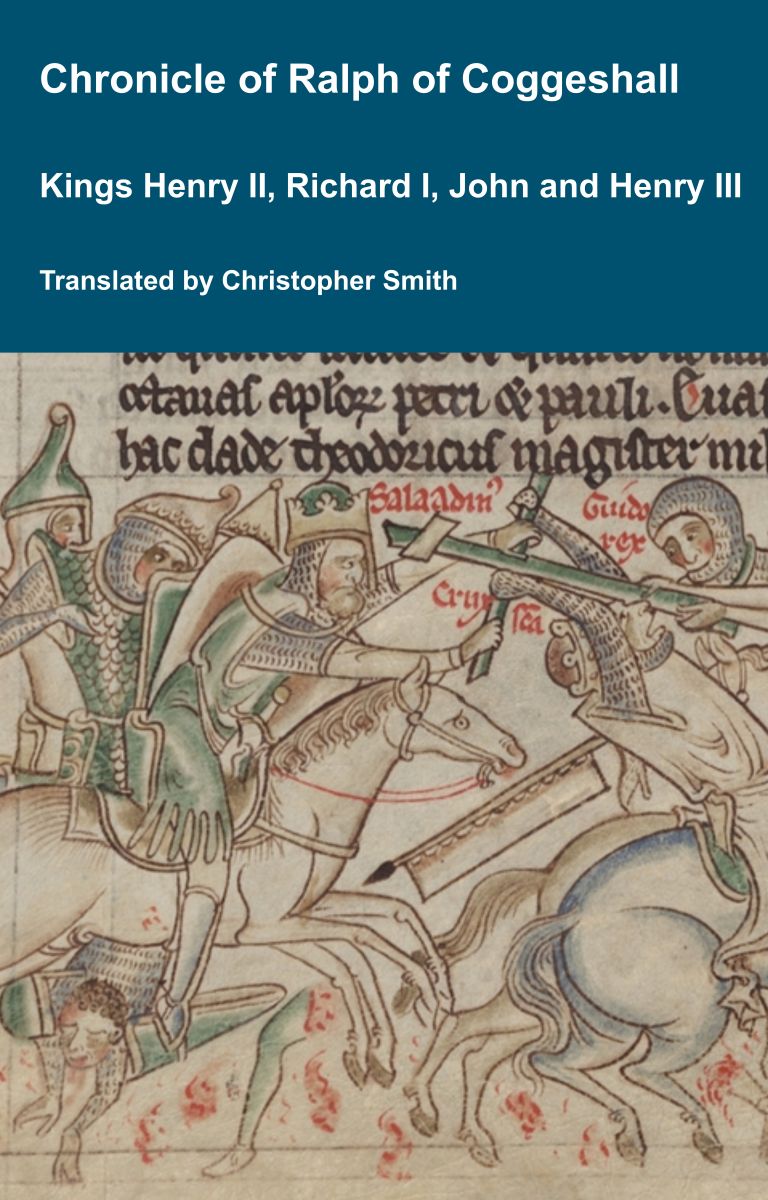
Chronicle of Abbot Ralph of Coggeshall
The Chronicle of Abbot Ralph of Coggeshall (Chronicon Anglicanum) is an indispensable medieval history that brings to life centuries of English and European affairs through the eyes of a learned Cistercian monk. Ralph of Coggeshall, abbot of the Abbey of Coggeshall in Essex in the early 13th century, continued and expanded his community’s chronicle, documenting events from the Norman Conquest of 1066 into the tumultuous reign of King Henry III. Blending eyewitness testimony, careful compilation, and the monastic commitment to record-keeping, this chronicle offers a rare narrative of political intrigue, royal power struggles, and social upheaval in England and beyond. Ralph’s work captures the reigns of pivotal figures such as Richard I and King John, providing invaluable insights into their characters, decisions, and the forces that shaped medieval rule. More than a simple annal, Chronicon Anglicanum conveys the texture of medieval life and governance, making it a rich source for scholars and readers fascinated by English history, monastic authorship, and the shaping of the medieval world.
Available at Amazon in eBook and Paperback format.
Grammont. Lady Robarts was then in the zenith of her glory: her beauty was striking; yet notwithstanding the brightness of the finest complexion, with all the bloom of youth, and with every requisite for inspiring desire, she nevertheless was not attractive. The Duke of York, however, would probably have been successful, if difficulties, almost insurmountable, had not disappointed his good intentions: Lord Robarts, her husband, was an old, snarling, troublesome, peevish fellow, in love with her to distraction, and, to complete her misery, a perpetual attendant on her person.
She perceived his royal highness's attachment to her, and seemed as if she was inclined to be grateful: this redoubled his eagerness, and every outward mark of tenderness he could possibly shew her; but the watchful husband redoubling his zeal and assiduity, as he found the approaches advance, every art was practised to render him tractable: several attacks were made upon his avarice and his ambition. Those who possessed the greatest share of his confidence, insinuated to him, that it was his own fault, if Lady Robarts, who was so worthy of being at court, was not received into some considerable post, either about the queen or the duchess: he was offered to be made lord lieutenant of the county where his estate was; or to have the management of the Duke of York's revenues in Ireland, of which he should have the entire disposal, provided he immediately set out to take possession of his charge; and having accomplished it, he might return as soon as ever he thought proper.
He perfectly well understood the meaning of these proposals, and was fully apprized of the advantages he might reap from them: in vain did ambition and avarice hold out their allurements; he was deaf to all their temptations, nor could ever the old fellow be persuaded to be made a cuckold. It is not always an aversion to, or a dread of this distinction, which preserves us from it: of this her husband was very sensible; therefore, under the pretence of a pilgrimage to Saint Winifred the virgin and martyr, who was said to cure women of barrenness, he did not rest, until the highest mountains in Wales were between his wife and the person who had designed to perform this miracle in London, after his departure.
The duke was for some time entirely taken up with the pleasures of the chase, and only now and then engaged in those of love; but his taste having undergone a change in this particular, and the remembrance of Lady Robarts wearing off by degrees, his eyes and wishes were turned towards Miss Brook; and it was in the height of this pursuit, that Lady Chesterfield threw herself into his arms, as we shall see, by resuming the sequel of her adventures.


[his son] John Robartes was born to John Robartes 1st Earl Radnor and Letitia Isabella Smythe Countess Radnor. He was educated at Exeter College, Oxford University.