

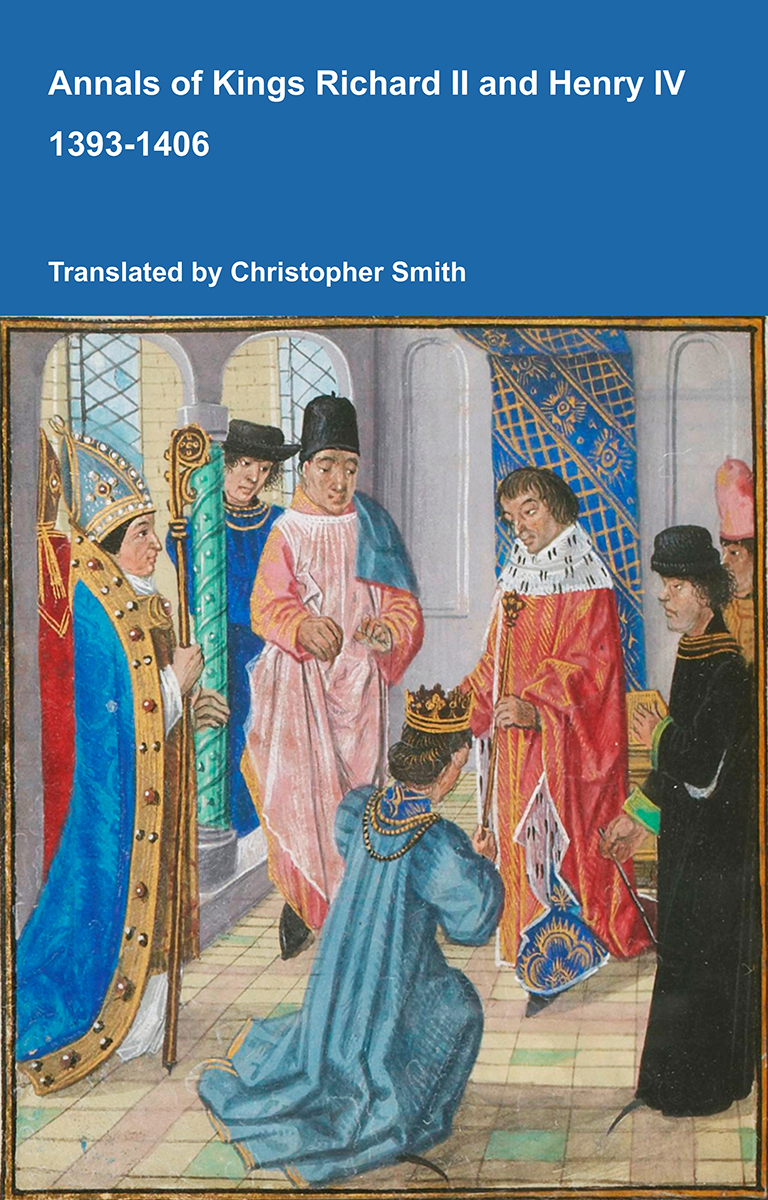
Annals of Kings Richard II and Henry IV 1393-1406
The Annals of Kings Richard II and Henry IV offers a vivid contemporary account of one of the most turbulent periods in late medieval England. Covering the reigns of Richard II and Henry IV, the chronicle records royal ceremonies, political conflict, rebellion, war, taxation, religious controversy, executions, popular unrest and remarkable portents. Its pages include a detailed description of Richard II’s coronation, the fall and deposition of the king, Henry IV’s seizure of the throne, the Percy rebellion, the execution of Archbishop Richard Scrope, the campaigns of Owain Glyndŵr, and England’s relations with Scotland, France, Portugal and Scandinavia. Alongside affairs of state, the annalist preserves reports of miracles, eclipses, prophecies, supernatural events and the experiences of ordinary townspeople, clergy, soldiers and travellers. Written from a monastic perspective, the work combines political observation with moral judgement, presenting victories and disasters as evidence of divine favour or punishment. At once a historical record and a reflection of medieval belief, the Annals provides an invaluable window into the challenges, ceremonies and conflicts of England at the turn of the fifteenth century.
Available at Amazon in eBook and Paperback format.
In 1547 Nicholas Hilliard was born in Exeter, Devon [Map].
In 1571 Nicholas Hilliard [aged 24] produced "a booke of portraitures" for Robert Dudley 1st Earl of Leicester [aged 38].


In 1572 Nicholas Hilliard [aged 25] painted the "Phoenix Portrait" of Elizabeth I [aged 38].
Research in 2010 found the painting used wood from the same tree used for the Pelican Portrait.

1572. Nicholas Hilliard [aged 25]. Portrait probably of Levina Bening aka Teerlinc [aged 57].

In 1572 Nicholas Hilliard [aged 25] painted the "Pelican Portrait" of Elizabeth I [aged 38].
The Pelican being the pendant hung from her necklace of pearls; pearls a symbol of virginity. Pelicans traditionally used as sign of self-sacrifice since the Pelican was believed to peck at her own breast to feed her young; the symbolism meaning Elizabeth had sacrificed herself for England.
Other details include the highly decorated armlet above her elbow and many jewels over her red velvet gown and headress. The two cherries tucked into her right ear possibly refer to her virginity; possibly an over-interpretation of the modern use of cherry.
Research in 2010 found the painting used wood from the same tree used for the Phoenix Portrait.
In 1572 Nicholas Hilliard [aged 25] became portrait painter to Elizabeth I [aged 38].


Around 1574 Nicholas Hilliard [aged 27] invested in a gold mine in Scotland. The venture failed. Hilliard's life was beset with money issues.

1576. Nicholas Hilliard [aged 29]. Miniature Portrait of Charles Howard 1st Earl Nottingham [aged 40].

In 1576. After Nicholas Hilliard [aged 29]. Portrait of Mary Queen of Scots [aged 33].

In 1576 Nicholas Hilliard [aged 29] travelled to France where he stayed with the English Ambassdor to France Amyas Paulett.

In 1576 Nicholas Hilliard [aged 29], whilst in France, painted a portrait of Francis Bacon 1st Viscount St Alban [aged 14] who was attached to the English Embassy at the time.
On 5th May 1576 Nicholas Hilliard [aged 29] was given the monopoly on producing miniatures and engravings of King James I of England and Ireland and VI of Scotland [aged 9] by the King.


Around 1577 Nicholas Hilliard [aged 30] painted a portrait of Amyas Paulett.

In 1577 Nicholas Hilliard [aged 30] was provided with a stipend of 200 livres by Francis Valois Duke Anjou [aged 21], a suitor of Elizabeth I [aged 43].

Around 1585. Nicholas Hilliard [aged 38]. Miniature Portrait of Anthony Mildmay [aged 35]. Hilliard represents Mildmay standing in a luxurious tent filled with beautiful furniture preparing for a tournament surrounded by objects that allow the artist to feature a variety of rich textures including red velvet, blue ostrich feathers, and gleaming metal.

Around 1590 Nicholas Hilliard [aged 43]. Portrait of George Clifford 3rd Earl of Cumberland [aged 31].

Around 1590 Nicholas Hilliard [aged 43]. Portrait of Mary Sidney Countess Pembroke [aged 28].
Mary Sidney Countess Pembroke: On 27th October 1561 she was born to Henry Sidney and Mary Dudley. On 21st April 1577 Henry Herbert 2nd Earl Pembroke and she were married. She by marriage Countess Pembroke. The difference in their ages was 23 years. He the son of William Herbert 1st Earl Pembroke and Anne Parr Countess Pembroke. They were sixth cousins. On 25th September 1621 Mary Sidney Countess Pembroke died of smallpox at Herbert Townhouse Aldersgate Street. Her funeral was held at St Paul's Cathedral [Map]. She was buried at Salisbury Cathedral [Map].

In 1591 Nicholas Hilliard [aged 44] painted a portrait of Francis Drake [aged 51].

In 1591 Nicholas Hilliard [aged 44] painted a portrait of Walter Raleigh [aged 37].

Around 1592 Nicholas Hilliard [aged 45] painted a portrait of Lettice Knollys Countess Essex and Leicester [aged 48].
In 1597 the John Donne [aged 24] praised Nicholas Hilliard [aged 50] in his poem "The Storm": A hand or an eye, By Hilliard drawn is worth an history, By a worse painter made.
In 1599 Nicholas Hilliard [aged 52] secured an annual allowance from Elizabeth I [aged 65] of £40.

Around 1600 Nicholas Hilliard [aged 53] painted the portrait of King James I of England and Ireland and VI of Scotland [aged 33].
Around 1600 Nicholas Hilliard [aged 53] wrote his treaty on painting called "The Art of Limning".
In July 1601 Nicholas Hilliard [aged 54] wrote to Robert Cecil 1st Earl Salisbury [aged 38], asking permission to retire from London and live more cheaply in the countryside. He explained that he had trained apprentices who now competed with him in the private painting market. Hilliard asked that Cecil employ his son as a clerk, because he could not keep him in his own trade.


In 1617 Elizabeth I gave Nicholas Hilliard [aged 70] £400 for having made a second Great Seal.
In 1617 Nicholas Hilliard [aged 70] was briefly imprisoned in Ludgate Prison after standing surety for the debt of another, and being unable to produce the amount.
On 3rd January 1619 Nicholas Hilliard [aged 72] died.
On 7th January 1619 Nicholas Hilliard [deceased] was buried in St Martin's in the Fields [Map]. In his will he left twenty shillings to the poor of the parish, thirty between his two sisters, some goods to his maidservant, and all the rest of his effects to his son, Lawrence Hilliard, his sole executor.