

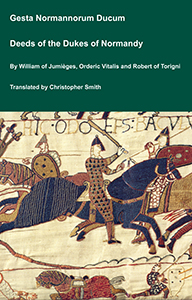
The Deeds of the Dukes of Normandy
The Gesta Normannorum Ducum [The Deeds of the Dukes of Normandy] is a landmark medieval chronicle tracing the rise and fall of the Norman dynasty from its early roots through the pivotal events surrounding the Norman Conquest of England. Originally penned in Latin by the monk William of Jumièges shortly before 1060 and later expanded at the behest of William the Conqueror, the work chronicles the deeds, politics, battles, and leadership of the Norman dukes, especially William’s own claim to the English throne. The narrative combines earlier historical sources with firsthand information and oral testimony to present an authoritative account of Normandy’s transformation from a Viking settlement into one of medieval Europe’s most powerful realms. William’s history emphasizes the legitimacy, military prowess, and governance of the Norman line, framing their expansion, including the conquest of England, as both divinely sanctioned and noble in purpose. Later chroniclers such as Orderic Vitalis and Robert of Torigni continued the history, extending the coverage into the 12th century, providing broader context on ducal rule and its impact. Today this classic work remains a foundational source for understanding Norman identity, medieval statesmanship, and the historical forces that reshaped England and Western Europe between 800AD and 1100AD.
Available at Amazon in eBook and Paperback format.
Around 1327 Richard Scrope 1st Baron Scrope of Bolton was born to [his father] Henry Scrope.
On 7th September 1336 [his father] Henry Scrope died. He was buried at Easby Abbey, Yorkshire.
On 26th August 1346 the army of King Edward III of England defeated the French army at the Battle of Crécy. The English army was commanded by King Edward III of England, his son Edward "Black Prince", Thomas Beauchamp 11th Earl Warwick, William Bohun 1st Earl of Northampton and John Beauchamp 1st Baron Beauchamp Warwick.
The English army was included: Bishop Thomas of Hatfield, Hugh Despencer 1st Baron Despencer, Bernard Brocas, Thomas Felton, James Audley, Robert Bourchier 1st Baron Bourchier, Bartholomew "The Elder" Burghesh 1st Baron Burghesh, Bartholomew "The Younger" Burghesh 2nd Baron Burghesh, Reginald Cobham 1st Baron Cobham, John Darcy 1st Baron Darcy of Knayth, Robert Ferrers 3rd Baron Ferrers of Chartley, Richard Scrope 1st Baron Scrope of Bolton, William Scrope, Stephen Scrope, William Latimer 4th Baron Latimer of Corby, John Lisle 2nd Baron Lisle, Gerard Lisle 1st Baron Lisle, Nicholas Longford, Edward Montagu 1st Baron Montagu, Walter Paveley 4th Baron Burghesh, Michael Poynings 1st Baron Poynings, Robert Ufford 1st Earl Suffolk, John de Vere 7th Earl of Oxford, Thomas West, John Willoughby 2nd Baron Willoughby, John Wingfield, Henry Percy 11th and 3rd Baron Percy, Hugh Courtenay 2nd or 10th Earl Devon (possibly), Walter "Elder" Devereux, John Devereux, Enion Sais Brecon, John Chandos, Richard Pembridge and John Sully.
The French army suffered significant casualties. King Philip "Fortunate" VI of France was wounded. William de Coucy and his son Enguerrand 6th Lord de Coucy and were killed.
Charles II Count Alençon was killed. Charles Valois Archbishop of Lyons succeeded Count Alençon.
Louis Chatillon II Count Blois I Count Chatillon was killed. Louis Chatillon III Count Blois Count Soissons succeeded III Count Blois.
Louis Dampierre II Count Nevers I Count Flanders was killed. Louis of Male III Count Nevers II Count Flanders succeeded III Count Nevers, II Count Flanders.
King John I of Bohemia was killed. Charles IV King Bohemia Holy Roman Emperor Luxemburg succeeded IV King Bohemia, Holy Roman Emperor Luxemburg. Blanche Valois Holy Roman Empress Luxemburg by marriage Holy Roman Empress Luxemburg.
Rudolph "Valiant" Metz I Duke Lorraine was killed. John Metz I Duke Lorraine succeeded I Duke Lorraine.
Jean IV de Harcourt was killed.
In 1350 [his son] William Scrope 1st Earl Wiltshire was born to Richard Scrope 1st Baron Scrope of Bolton and [his future wife] Blanche Pole Baroness Scrope Bolton. He married 1396 Isabel Russell Countess Wiltshire.
Around 1355 [his son] Stephen Scrope was born to Richard Scrope 1st Baron Scrope of Bolton and [his future wife] Blanche Pole Baroness Scrope Bolton. He married before 1408 Millicent Tiptoft, daughter of Robert Tiptoft 3rd Baron Tibetot and Margaret Deincourt Baroness Tibetot.
In or before 1369 [his son] Roger Scrope 2nd Baron Scrope of Bolton was born to Richard Scrope 1st Baron Scrope of Bolton and [his wife] Blanche Pole Baroness Scrope Bolton. He married in or before 1393 Margaret Tiptoft Baroness Scrope Bolton, daughter of Robert Tiptoft 3rd Baron Tibetot and Margaret Deincourt Baroness Tibetot, and had issue.
In or before 1369 Richard Scrope 1st Baron Scrope of Bolton and Blanche Pole Baroness Scrope Bolton were married. She by marriage Baroness Scrope of Bolton.
In 1371 Richard Scrope 1st Baron Scrope of Bolton was created 1st Baron Scrope of Bolton.
Around 1378 [his wife] Blanche Pole Baroness Scrope Bolton died at Bolton, North Yorkshire.
In or before 1393 [his son] Roger Scrope 2nd Baron Scrope of Bolton and [his daughter-in-law] Margaret Tiptoft Baroness Scrope Bolton were married. She by marriage Baroness Scrope of Bolton.
In 1396 [his son] William Scrope 1st Earl Wiltshire and [his daughter-in-law] Isabel Russell Countess Wiltshire were married.
On 29th July 1399 [his son] William Scrope 1st Earl Wiltshire, Henry Green and John Bussy were beheaded at Bristol Castle, Gloucestershire. Earl Wiltshire forfeit.
After 7th January 1400. The names of the lords who were present at the said declaration are as follows:
Henry, earl of Northumberland.
John, Lord Charlton.
Reginald, Lord Grey of Ruthin.
Thomas, Lord Furnivall.
Robert, Lord Scales.
John, Lord Beaumont.
William, Lord Ferrers of Groby.
Richard Lescrope.


Around August 1403 Richard Scrope 1st Baron Scrope of Bolton died. He was buried at Easby Abbey, Yorkshire. [his son] Roger Scrope 2nd Baron Scrope of Bolton succeeded 2nd Baron Scrope of Bolton.

Parliament Rolls Richard II. 5. The following are assigned to be triers of petitions from England, Ireland, Wales, and Scotland:
The duke of Guyenne and duke of Lancaster.
Sir Richard le Scrope.
Sir Philip Spenser.
William Thirning.
William Rickhill.
John Wadham.
to act all together, or at least six of the aforesaid prelates and lords; consulting with the chancellor, treasurer, steward, and chamberlain, and also the king's serjeants when necessary. And they shall hold their session in the chamberlain's room near the Painted Chamber.
[his son] Richard Scrope was born to Richard Scrope 1st Baron Scrope of Bolton and Blanche Pole Baroness Scrope Bolton.