

Henrici Quinti, Angliæ Regis, Gesta, is a first-hand account of the Agincourt Campaign, and subsequent events to his death in 1422. The author of the first part was a Chaplain in King Henry's retinue who was present from King Henry's departure at Southampton in 1415, at the siege of Harfleur, the battle of Agincourt, and the celebrations on King Henry's return to London. The second part, by another writer, relates the events that took place including the negotiations at Troye, Henry's marriage and his death in 1422.
Available at Amazon in eBook and Paperback format.
Maternal Family Tree: Amy Fermor 1509-1580
In 1560 Sarah Higham was born to John Higham and Martha Yelverton.

On 11th January 1588 Richard Bingham [aged 60] and Sarah Higham [aged 28] were married. The difference in their ages was 32 years.
In 1597 [her father] John Higham died.
On 19th January 1599 [her husband] Richard Bingham [aged 71] died.
After 19th January 1599 Edward Waldegrave [aged 33] and Sarah Higham [aged 39] were married.

Around 1602 [her daughter] Jemima Waldegrave Baroness Crew was born to [her husband] Edward Waldegrave [aged 36] and Sarah Higham [aged 42]. She married in or before 1624 John Crew 1st Baron Crew and had issue.
Autobiography Simon D'Ewes. 3rd May 1621. The gentlewoman [aged 19], after the decease of her father, was at last married to John Crew [aged 23], Esq., son and heir of Sir Thomas Crew [aged 57], Knt., for whom, to say truly she was a much fitter match than for myself, who, being younger than herself, (although I knew it not at first,) it would doubtless in process of time have bred much nauseating and inconvenience. Yet I cannot deny that in respect of her fair extraction, comeliness, and good education; of my own wants, loss of time, and discontent; of my fear of my father's match with a young widow with whom he was now in treaty, and to get an estate settled upon me, I did omit no care, pains, or endeavour to have accomplished this match, which God of his infinite goodness did frustrate, not only for my temporal, but for my spiritual good. For he afterwards provided for me not only a much younger gentlewoman [aged 9], but more nobly extracted, and the heir of her family. My cousin Crew herself, (for my wife was her near kinswoman,) whom I went to visit awhile after I had been married, told me I had gotten a far greater fortune than she would have been; and the old Lady Bingham [aged 61] her mother, being then a widow, upon my coming to Lawford Hall, to her in her sickness to comfort her, told me, I dealt with her as Joseph had done with his brethren; for she only had been the cause of the breaking off my intended match with her daughter, and yet I would vouchsafe to visit her. "Why, Madam," answered I, "should enmity between Christians be perpetual - especially seeing what you intended against me is turned by God's Providence, to greater good?"
Autobiography Simon D'Ewes. 3rd May 1621. At my next return therefore thither, he wrote a strange letter to the young gentlewoman, and gave it me in charge to bring him an answer from her. It was penned in a good phrase, but mixed with some unseasonable imperious passages, so as pressing what eflFects it would produce, I kept it two or three. days ere I delivered it after I was come to Mr. Waldegrave's; but fearing my father's displeasure if I still kept it, and so an abortive issue of this overture, I at last rather chose to put it to the hazard. Truly, both the father and the young gentlewoman, whose affection I had gained very far, were content for my sake to have passed it over, but the Lady Bingham [aged 61] her mother told me plainly, my father took so early authority upon him as her daughter should never come imder his power; and 80 after all that cost bestowed by my father, being near upon £80, and all the travel and pains which had been bestowed by myself and others to effect this business, (although it hung in suspense till the 19th day of September next ensuing,) yet all was finally dashed.
Autobiography Simon D'Ewes. 3rd May 1621. All things being provided for my journey thither, and Easter Term being ended, the same day the Parliament was again adjourned till after Whitsuntide, being Saturday the 19th day of this instant May, I went with my father and the rest of his family to Newplace, in Upminster, in the county of Essex, where my Aunt Lathum dwelt, being little out of the way to Lawford Hall aforesaid; whither I set forward alone upon Thmsday morning, lying at Maiden that night, May 24. The next day, being Friday, May 25, I arrived at Colchester between twelve and one, and that afternoon saw [her daughter] Miss Jemima [aged 19] with the Lady Bingham [aged 61] her mother, (whom, having been the widow of [her former husband] Sir Richard Bingham, Knt., Mr. Waldegrave had married to his second wife,) and had some discourse with the old lady, and some short view of the gentlewoman, whom I did not take to be so handsome at this first view as I thought her afterwards. I went not home at this time with the old lady, but lay at a town called Langham, near to Lawford, at one Mr. Littlebury's house; from whence, the next day, I went with him to Mr. Waldegrave's in the afternoon, and had full access in private discourse afforded me with the young gentlewoman. That night I returned again with Mr. Littlebury (who had used a great deal of faithful care to make up this match) to his house; where having staid till Monday, May 28th, in the forenoon we went again to Mr. Waldegrave's, and dined there. After which ended, I had several discourses with the young gentlewoman, and received from her so many remonstrances of acceptation and affection, as her own father acknowledged she never had done before, and we all thought the business in fair forwardness for the consummation thereof. But I, fearing my father's inconstancy, by reason he was to settle above £1100 per annum upon me, and to receive no portion, had all my expectations even at this present mixed with doubts, which were the more increased upon my return to him next day to Newplace, (for, his coach-horses going cheerfully, I went the whole thirty-eight miles from Lawford thither in a day,) where, having related to him my unexpected success, I found him in some atrtut, as if he knew not well now how to break it off, or go back.
Autobiography Simon D'Ewes. 12th February 1622. The latter part of this January I spent reasonably well in the study of the common law, which had like to have been interrupted again the ensuing February with the renovation of my old cares, which had hindered it in my former wooing-time; for [her husband] Mr. Waldegrave [aged 56], of Lawford in Essex, between whose younger daughter [aged 20] and coheir and myself there had been a treaty of marriage, as is before set down, deceasing on Tuesday, the 12th day of this February, and leaving the Lady Bingham [aged 62], his second wife, a widow, on Monday the 18th day of the same month next ensuing my father [aged 55] sent for me early in the morning, to give me notice of it, and told me that he should not only be willing that the treaty for myself might again be renewed with the daughter, but that he should be willing himself also to match with the mother. This new overture took up my thoughts and time for some few days, but it proving abortive soon afterj I had free liberty again to settle to my studies.
On 12th February 1622 [her husband] Edward Waldegrave [aged 56] died.
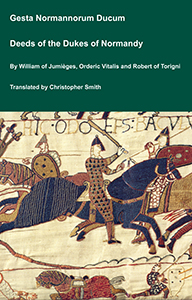
The Deeds of the Dukes of Normandy
The Gesta Normannorum Ducum [The Deeds of the Dukes of Normandy] is a landmark medieval chronicle tracing the rise and fall of the Norman dynasty from its early roots through the pivotal events surrounding the Norman Conquest of England. Originally penned in Latin by the monk William of Jumièges shortly before 1060 and later expanded at the behest of William the Conqueror, the work chronicles the deeds, politics, battles, and leadership of the Norman dukes, especially William’s own claim to the English throne. The narrative combines earlier historical sources with firsthand information and oral testimony to present an authoritative account of Normandy’s transformation from a Viking settlement into one of medieval Europe’s most powerful realms. William’s history emphasizes the legitimacy, military prowess, and governance of the Norman line, framing their expansion, including the conquest of England, as both divinely sanctioned and noble in purpose. Later chroniclers such as Orderic Vitalis and Robert of Torigni continued the history, extending the coverage into the 12th century, providing broader context on ducal rule and its impact. Today this classic work remains a foundational source for understanding Norman identity, medieval statesmanship, and the historical forces that reshaped England and Western Europe between 800AD and 1100AD.
Available at Amazon in eBook and Paperback format.
In or before 1624 [her son-in-law] John Crew 1st Baron Crew [aged 25] and [her daughter] Jemima Waldegrave Baroness Crew [aged 21] were married.
In 1634 Sarah Higham [aged 74] died.
Father: John Higham
Great x 4 Grandfather: John Yelverton
Great x 3 Grandfather: William Yelverton
Great x 2 Grandfather: William Yelverton
Great x 1 Grandfather: William Yelverton
GrandFather: William Yelverton
Mother: Martha Yelverton
Great x 3 Grandfather: Thomas Fermor alias Ricards 
Great x 2 Grandfather: Laurence Fermor
Great x 1 Grandfather: Henry Fermor
GrandMother: Amy Fermor