

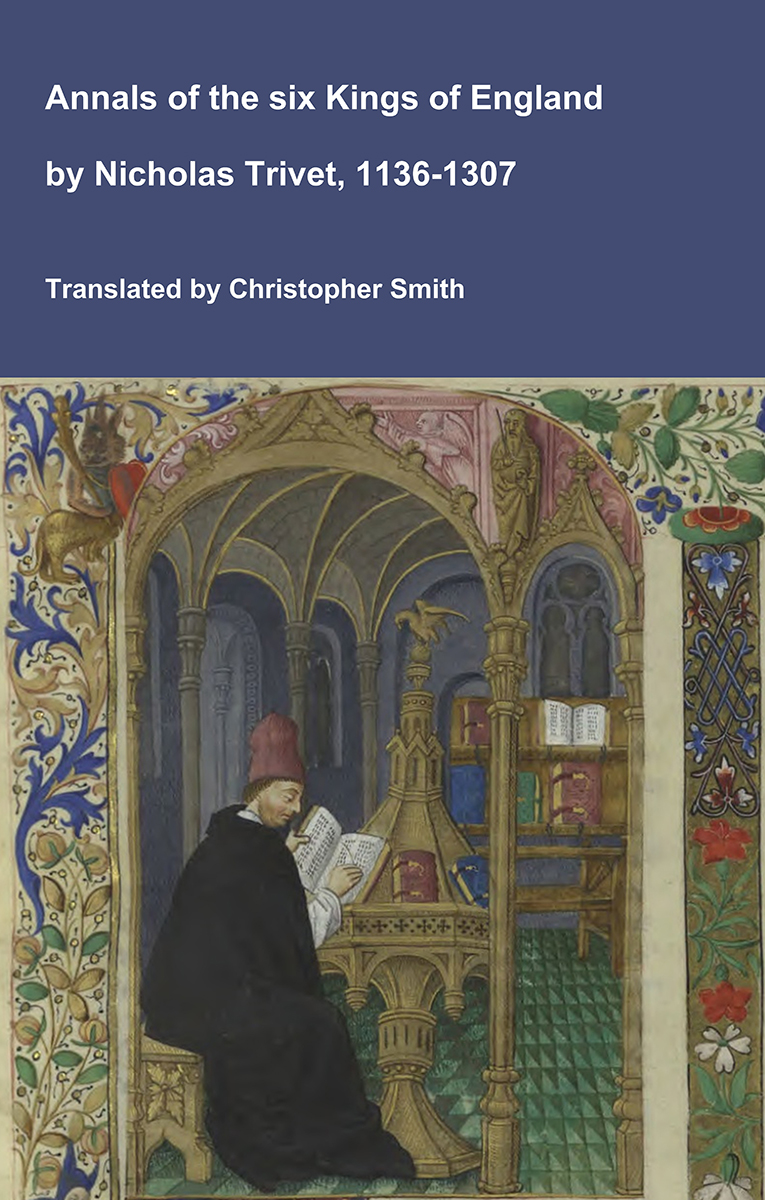
Annals of the six Kings of England by Nicholas Trivet
Translation of the Annals of the Six Kings of England by that traces the rise and rule of the Angevin aka Plantagenet dynasty from the mid-12th to early 14th century. Written by the Dominican scholar Nicholas Trivet, the work offers a vivid account of English history from the reign of King Stephen through to the death of King Edward I, blending political narrative with moral reflection. Covering the reigns of six monarchs—from Stephen to Edward I—the chronicle explores royal authority, rebellion, war, and the shifting balance between crown, church, and nobility. Trivet provides detailed insight into defining moments such as baronial conflicts, Anglo-French rivalry, and the consolidation of royal power under Edward I, whose reign he describes with particular immediacy. The Annals combines careful year-by-year reporting with thoughtful interpretation, presenting history not merely as a sequence of events but as a moral and political lesson. Ideal for readers interested in medieval history, kingship, and the origins of the English state, this chronicle remains a valuable and accessible window into the turbulent world of the Plantagenet kings.
Available at Amazon in eBook and Paperback format.
 St Pancras Old Church
 2A Melbury Road, Kensington
 Stanley Chapel, St Cybi's Church, Holyhead
 Tonbridge, Kent
 18 Wynnstay Gardens, Kensington
 Carlisle Cathedral
 Wolvercote Cemetery Oxford
In 1840 [his father] Thomas Thornycroft [aged 24] and [his mother] Mary Francis [aged 31] were married. She the daughter of [his grandfather] John Francis [aged 59] and [his grandmother] Mary Evetts [aged 60].
On 9th March 1850 William Hamo Thornycroft was born to Thomas Thornycroft [aged 34] and Mary Francis [aged 41]. He was baptised on 9th June 1850 at St Pancras Old Church [Map].
On 21st February 1862 Sarah Cave 3rd Baroness Braye [aged 93] died. Baron Braye abeyant. Monument at St Nicholas' Church, Stanford-on-Avon [Map] sculpted by [his mother] Mary Francis [aged 53] and commissioned by her daughter Catherine Otway [aged 53], widow of John Lygon 3rd Earl Beauchamp.
Catherine Otway: Before 1809 she was born to Henry Otway of Castle Otway in Tipperary and Sarah Cave 3rd Baroness Braye. On 19th October 1826 Henry Murray and she were married. He the son of Bishop George Murray. On 11th February 1850 John Lygon 3rd Earl Beauchamp and she were married. The difference in their ages was 24 years. He the son of William Lygon 1st Earl Beauchamp and Catherine Denn Countess Beauchamp. On 4th November 1875 she died without issue.


In 1881 William Hamo Thornycroft [aged 30] was living at his father's home 2A Melbury Road, Kensington [Map].

1884. Theodore Blake Wirgman [aged 35]. Portrait of William Hamo Thornycroft [aged 33].

Around 1884. Joseph Parkin Mayall [aged 45]. Portrait of William Hamo Thornycroft [aged 33].
On 24th February 1884 William Owen Stanley [aged 81] died. Monument in the Stanley Chapel, St Cybi's Church, Holyhead [Map] sculpted by William Hamo Thornycroft [aged 33].


Around May 1884 William Hamo Thornycroft [aged 34] and Agatha Cox [aged 19] were married at Tonbridge, Kent [Map]. He the son of Thomas Thornycroft [aged 68] and Mary Francis [aged 75].
On 30th August 1885 [his father] Thomas Thornycroft [aged 70] died.
Around 1889 John Tweed [aged 19] studied with William Hamo Thornycroft [aged 38].
In 1891 William Hamo Thornycroft [aged 40] was living at 18 Wynnstay Gardens, Kensington [Map] with his wife Agatha Cox [aged 26] with two children Oliver and Joan.
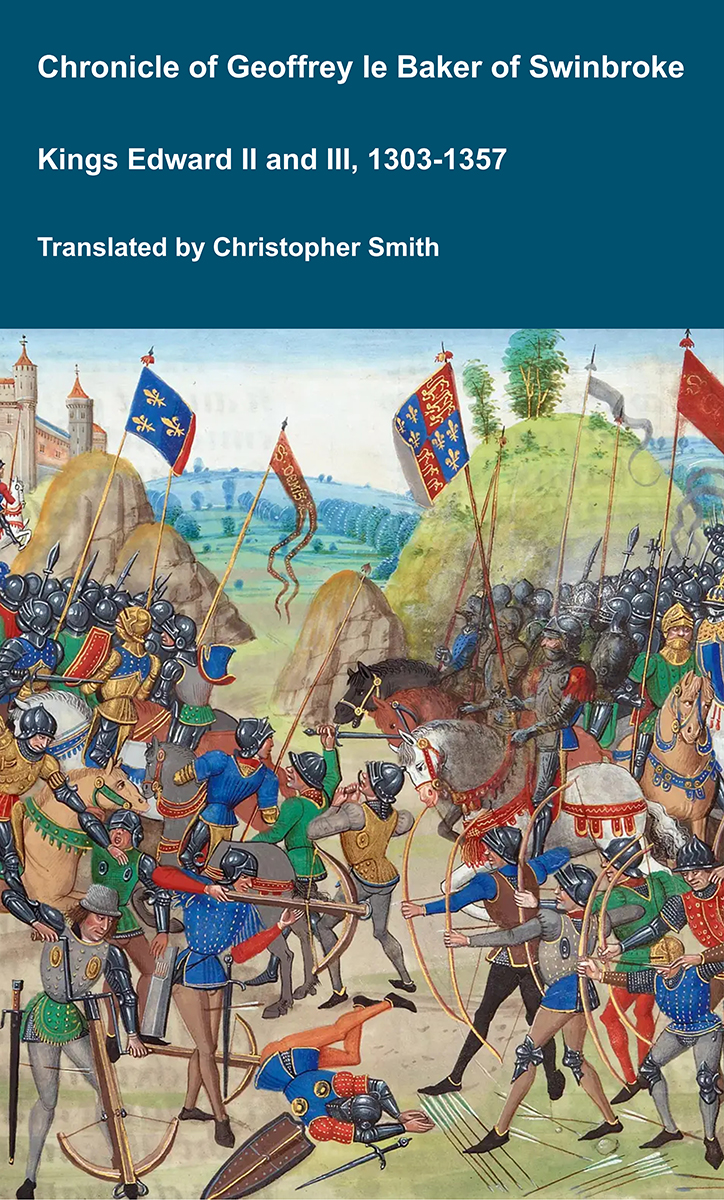
Chronicle of Geoffrey le Baker of Swinbroke
Baker was a secular clerk from Swinbroke, now Swinbrook, an Oxfordshire village two miles east of Burford. His Chronicle describes the events of the period 1303-1356: Gaveston, Bannockburn, Boroughbridge, the murder of King Edward II, the Scottish Wars, Sluys, Crécy, the Black Death, Winchelsea and Poitiers. To quote Herbert Bruce 'it possesses a vigorous and characteristic style, and its value for particular events between 1303 and 1356 has been recognised by its editor and by subsequent writers'. The book provides remarkable detail about the events it describes. Baker's text has been augmented with hundreds of notes, including extracts from other contemporary chronicles, such as the Annales Londonienses, Annales Paulini, Murimuth, Lanercost, Avesbury, Guisborough and Froissart to enrich the reader's understanding. The translation takes as its source the 'Chronicon Galfridi le Baker de Swynebroke' published in 1889, edited by Edward Maunde Thompson.
Available at Amazon in eBook and Paperback format.
In 1891 [his daughter] Rosalind Thornycroft was born to William Hamo Thornycroft [aged 40] and [his wife] Agatha Cox [aged 26]. She married 1926 Arthur E Hugh Popham.
After 25th November 1891. Carlisle Cathedral [Map]. Monument to Bishop Harvey Goodwin [deceased] sculpted by William Hamo Thornycroft [aged 41].
Bishop Harvey Goodwin: On 9th October 1818 he was born in King's Lynn, Norfolk [Map]. In October 1869 Bishop Harvey Goodwin was elected Bishop of Carlisle. On 25th November 1891 he died in Bishopthorpe York whilst on a visit to William Maclagan, Archbishop of York.


On 1st February 1895 [his mother] Mary Francis [aged 86] died.
In 1901 William Hamo Thornycroft [aged 50] was living at The Chalet, Redington Road, Hampstead with his wife Agatha Cox [aged 36] with two children Joan (12) and Rosalind (9).

Academy Architecture 1905. 1905. Brotherhood, Part of the Gladstone Memorial, Hamp Thornycroft [aged 54], R. A., Sculptor.
In 1911 William Hamo Thornycroft [aged 60] was living at The Chalet, Redington Road, Hampstead with his wife Agatha Cox [aged 46] with four children Oliver (25), Joan (25), Rosalind (22) and Elfrida (9).
On 18th December 1925 William Hamo Thornycroft [aged 75] died. He was buried at Wolvercote Cemetery Oxford [Map].
In 1958 [his former wife] Agatha Cox [aged 93] died.
GrandFather: John Thornycroft
Father: Thomas Thornycroft