

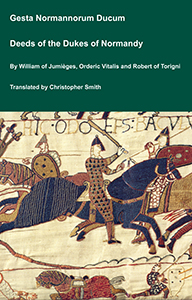
The Deeds of the Dukes of Normandy
The Gesta Normannorum Ducum [The Deeds of the Dukes of Normandy] is a landmark medieval chronicle tracing the rise and fall of the Norman dynasty from its early roots through the pivotal events surrounding the Norman Conquest of England. Originally penned in Latin by the monk William of Jumièges shortly before 1060 and later expanded at the behest of William the Conqueror, the work chronicles the deeds, politics, battles, and leadership of the Norman dukes, especially William’s own claim to the English throne. The narrative combines earlier historical sources with firsthand information and oral testimony to present an authoritative account of Normandy’s transformation from a Viking settlement into one of medieval Europe’s most powerful realms. William’s history emphasizes the legitimacy, military prowess, and governance of the Norman line, framing their expansion, including the conquest of England, as both divinely sanctioned and noble in purpose. Later chroniclers such as Orderic Vitalis and Robert of Torigni continued the history, extending the coverage into the 12th century, providing broader context on ducal rule and its impact. Today this classic work remains a foundational source for understanding Norman identity, medieval statesmanship, and the historical forces that reshaped England and Western Europe between 800AD and 1100AD.
Available at Amazon in eBook and Paperback format.
Paternal Family Tree: Rossetti
In 1826 [his father] Gabriele Pasquale Giuseppe Rossetti [aged 42] and [his mother] Frances Mary Lavinia Polidori [aged 25] were married.


On 25th September 1829 William Michael Rossetti was born to Gabriele Pasquale Giuseppe Rossetti [aged 46] and Frances Mary Lavinia Polidori [aged 29].
In September 1847 the Pre-Raphaelite Brotherhood was formed at 7 Gower Street, Camden [Map], the home of John Everett Millais 1st Baronet [aged 18]. The seven founder members were Millais, brothers Dante Gabriel Rossetti [aged 19] and William Michael Rossetti [aged 17], William Holman Hunt [aged 20], James Collinson [aged 22], Frederick George Stephens [aged 19] and Thomas Woolner [aged 21].

1849. John Everett Millais 1st Baronet [aged 19]. "Isabella". From the poem Isabella and the Pot of Basil and the book Decameron Day Four Story Five. Note the initials PRB on the bottom of the table leg. The painting is on display at the Walker Art Gallery, Liverpool.
The models are believed to be:
[his brother] Dante Gabriel Rossetti [aged 20]: Far right drinking from glass.
William Michael Rossetti [aged 19]: Lorenzo, offering an orange to Isabella.
Isabella: Decameron Day Four Story Five. Summary. Lisabetta's brothers murder her lover. He appears to her in a dream and shows her where he is buried. She secretly disinters the head and places it in a pot of basil, over which she weeps for a long time every day. In the end her brothers take it away from her, and shortly thereafter she dies of grief.

March 1850. [his brother] Dante Gabriel Rossetti [aged 21]. "Ecce Ancilla Domini!" aka The Annunciation. Models: Angel William Michael Rossetti [aged 20], Mary [his sister] Christina Georgina Rossetti [aged 19].
On 5th April 1853 [his future father-in-law] Ford Madox Brown [aged 31] and Emma Matilda Hill [aged 23] were married at St Dunstan's in the West, Fleet Street [Map]. The witnesses were [his brother] Dante Gabriel Rossetti [aged 24] and Thomas Seddon [aged 31]. Rector Edward Auriol [aged 48] performed the ceremony.
Edward Auriol: On 27th February 1805 he was born to James Peter Auriol. On 28th September 1829 Edward Auriol and Georgina Morris were married. On 7th January 1842 he was appointed Rector of St Dunstan's in the West, Fleet Street [Map]. On 10th July 1880 Edward Auriol died.


On 26th April 1854 [his father] Gabriele Pasquale Giuseppe Rossetti [aged 71] died. He was buried in the Rossetti Family Grave at Highgate Cemetery.

1856. James Collinson [aged 30]. "A Son of the Soil". Exhibited this painting at the British institution in 1856, no. 375, the first work that he exhibited there. William Michael Rossetti [aged 26] wrote in the Spectator: "Mr. Collinson's Son of the Soil – a lusty labourer seated in a public-house with his pewter pot of beer before him, and behind him an advertisement for men to serve in the Army Works Corps – is an exact study from nature". In the collection of Manchester Art Gallery.
The Diary of George Price Boyce 1855-1857. 6th June 1857. Received from Wm. Rossetti [aged 27] circular of the New York Exhibition of British Art. Works to be in readiness by end of August. Augustus Ruxton projector. [his future father-in-law] F. M. Brown [aged 36] goes with the things.
The Diary of George Price Boyce 1855-1857. 30th June 1857. Wm. Rossetti [aged 27] told me that Roughskin [aged 38] had married his wife [Euphemia "Effie" Gray Lady Millais [aged 29]] when she was very ill ....
On 23rd May 1860 [his brother] Dante Gabriel Rossetti [aged 32] and [his sister-in-law] Elizabeth Siddal [aged 30] were married at St Clement's Church, Hastings.
Jean de Waurin's Chronicle of England Volume 6 Books 3-6: The Wars of the Roses
Jean de Waurin was a French Chronicler, from the Artois region, who was born around 1400, and died around 1474. Waurin’s Chronicle of England, Volume 6, covering the period 1450 to 1471, from which we have selected and translated Chapters relating to the Wars of the Roses, provides a vivid, original, contemporary description of key events some of which he witnessed first-hand, some of which he was told by the key people involved with whom Waurin had a personal relationship.
Available at Amazon in eBook and Paperback format.
On 11th February 1862 at twenty past seven in the morning [his sister-in-law] Elizabeth Siddal [aged 32] overdosed on laudanum at 14 Chatham Place. Possibly suicide - there may have been a note that said "look after Harry (her invalid brother)" which [his future father-in-law] Ford Madox Brown [aged 40] persuaded Dante Gabriel Rossetti [aged 33] to burn. Shortly after her death Sarah Cox aka Fanny Cornforth [aged 27] moved into the family home to become housekeeper to Dante Gabriel Rossetti.


On 28th December 1865 William Holman Hunt [aged 38] and Fanny Waugh [aged 32] were married at Christ Church Paddington. William Michael Rossetti [aged 36], and her brother and sister George and Emily were witnesses. She, Fanny, would die the following year eight days short of their anniversary. He would, ten years later, marry her younger sister Marion Edith Waugh [aged 18]; an example of Married to Two Siblings.


The Diary of George Price Boyce 1866. 8th April 1866 (Sunday). To Fred Leighton's [aged 35] to breakfast, meeting there [his brother] Gabriel [aged 37] and Wm. Rossetti [aged 36] and Simeon Solomon [aged 25]. L. excessively jolly and interesting. Has a large picture, young Greek girls in procession to sacrifice to Diana the first large picture1 he has painted.
Note 1. See The Syracusan Bride leading Wild Animals in Procession to the Temple of Diana.


Letters of Christina Rossetti. 56 Euston Square, London, N.W.
Thursday afternoon. [August 1869]
My dear Alice [aged 44]
You who are lady of castle and lands, and deal justice not only to man and maid but likewise to fish and fowl, might be amused to witness the painstaking responsibility and toil with which I keep house for two. This arduous housekeeping added to my habitual labours and enterprises must explain your kind letter's having waited awhile for its answer; its enclosed plume of fluff1 fans the flame of my grateful remembrance of you and Penkill,-not that this needed fanning.
Please thank Mr Scott [aged 58] for the note which puts my scrap to the blush, and assure him that if a second creative moment unlocks the lips of Sir Bedavere2 the golden utterance will reach [his sister] Maria [aged 42] whether addressed to her in Euston Sq., or at 3 Copt Hall Place-Folkestone.
It is a blameless triumph that a letter reached you on Tuesday morning. I hope the oldest inhabitant continues to thrive, and that if the crabb-dear me! I have turned him into ½ a poet!3-if the crab's position becomes too pitiable he may regain freedom and peace in his native sea. Aunt Eliza was delighted with the weed we picked up together, and cannot have had such a haul I know not when.-Mrs Scott shared with me the enjoyment of your letter last Saturday when I had the pleasure of lunching with her at Notting Hill. She looked and seemed well. Now I am hoping, but not with confidence, that she will say "yes" and meet the Edgcomes4 at tea here next Saturday. These mutual friends are migrating to the immediate neighbourhood of Oxford with an eye to retrenchment, and have promised to make two at a peculiarly festive festivity which may call together no more than themselves and Aunt Eliza to honour my teaboard;-for Mrs Scott may say "no", and William [aged 39] may have flitted to Folkestone for a glimpse of our Mother. [his brother] Gabriel [aged 41] le désiré has asked people to dine with him tomorrow, so presumably he cannot at once be exchanging Chelsea for lovely Penkill;-but I merely infer.-I hope the red lady and her blossoming bower grace and enhance each other;- and that the S.K. windows are progressing to the satisfaction both of blue-eyes and light-(!)-eyes; not to the production of a permanent "Grecian bend".5-William has read me his life of Shelley6, in which I find matter to interest me and impartiality to admire. Certainly impartiality is not a feminine virtue.-Poor ducklings suggestive of green peas! Perhaps the gentleman who discerned in you a "dear girl" might also view you as a "duck"-and thus make you a cannibal.
Note 1. The enclosure does not remain with the letter.
Note 2. CGR's allusion here is obscure.
Note 3. George Crabbe was one of CGR's favorite poets.
Note 4. Not identified.
Note 5. The first reference is to the paintings illustrative of The King's Quair, in process when CGR was first at Penkill in 1866 and completed by her second visit in June of 1869; the second is to WBS's stained-glass windows for the Ceramic Gallery of the South Kensington Museum (Bornand, p. 145 n. 1). "Blue-eyes and light-(!)-eyes" probably refer to Alice Boyd and Letitia Scott. "Grecian Bend" remains obscure.
Note 6. See letter no. 373, n. 2.


In 1873 William Michael Rossetti [aged 43] and [his future wife] Emma Lucy Madox Brown [aged 29] were engaged.
On 31st March 1874 William Michael Rossetti [aged 44] and Emma Lucy Madox Brown [aged 30] were married. She the daughter of Ford Madox Brown [aged 52] and Elizabeth Bromley.
On 30th September 1875 [his daughter] Olivia Madox Rossetti was born to William Michael Rossetti [aged 46] and [his wife] Emma Lucy Madox Brown [aged 32].
In February 1877 [his son] Gabriel Arthur Rossetti was born to William Michael Rossetti [aged 47] and [his wife] Emma Lucy Madox Brown [aged 33].
In November 1879 [his daughter] Helen Maria was born to William Michael Rossetti [aged 50] and [his wife] Emma Lucy Madox Brown [aged 36].
In April 1881 [his daughter] Mary Elizabeth was born to William Michael Rossetti [aged 51] and [his wife] Emma Lucy Madox Brown [aged 37].
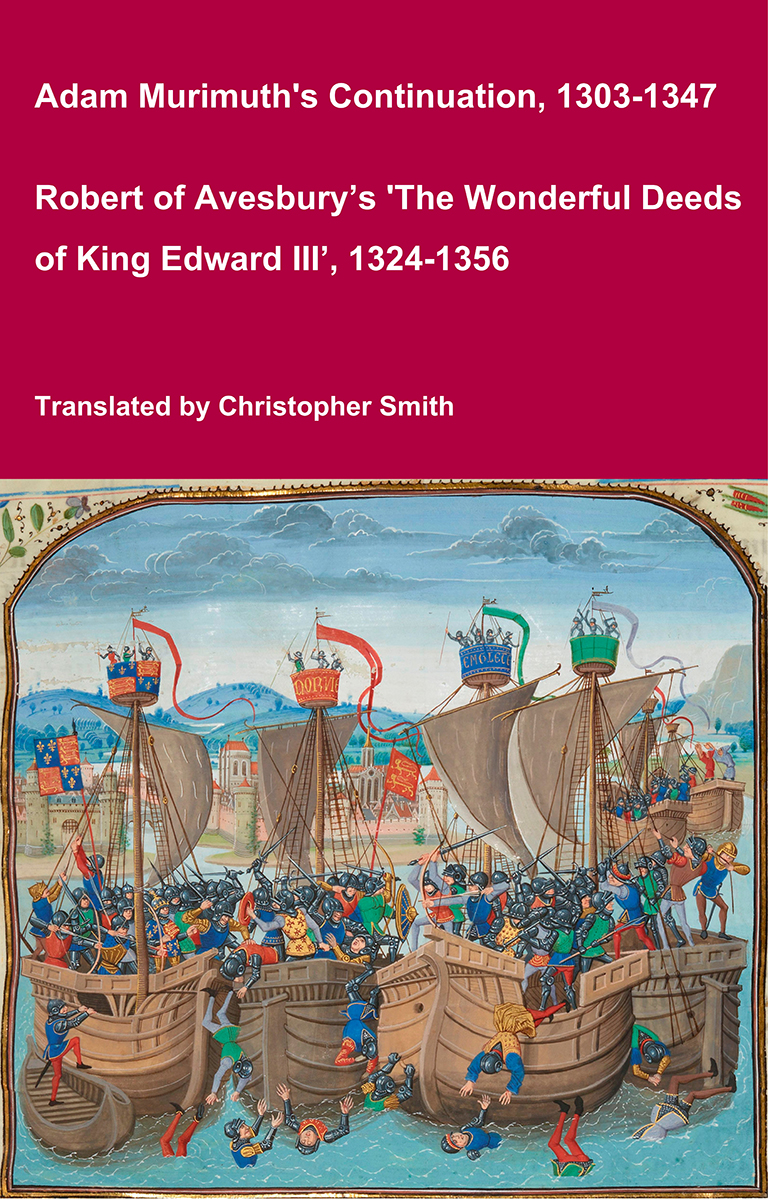
Adam Murimuth's Continuation and Robert of Avesbury’s 'The Wonderful Deeds of King Edward III'
This volume brings together two of the most important contemporary chronicles for the reign of Edward III and the opening phases of the Hundred Years’ War. Written in Latin by English clerical observers, these texts provide a vivid and authoritative window into the political, diplomatic, and military history of fourteenth-century England and its continental ambitions. Adam Murimuth Continuatio's Chronicarum continues an earlier chronicle into the mid-fourteenth century, offering concise but valuable notices on royal policy, foreign relations, and ecclesiastical affairs. Its annalistic structure makes it especially useful for establishing chronology and tracing the development of events year by year. Complementing it, Robert of Avesbury’s De gestis mirabilibus regis Edwardi tertii is a rich documentary chronicle preserving letters, treaties, and official records alongside narrative passages. It is an indispensable source for understanding Edward III’s claim to the French crown, the conduct of war, and the mechanisms of medieval diplomacy. Together, these works offer scholars, students, and enthusiasts a reliable and unembellished account of a transformative period in English and European history. Essential for anyone interested in medieval chronicles, the Hundred Years’ War, or the reign of Edward III.
Available at Amazon in eBook and Paperback format.
In April 1881 [his son] Michael Ford was born to William Michael Rossetti [aged 51] and [his wife] Emma Lucy Madox Brown [aged 37]. He died in infancy.
On 9th April 1882 Dante Gabriel Rossetti [aged 53] died. He was buried at All Saints Church, Birchington on Sea [Map]. There is a Celtic Cross marking his grave commissioned by his mother Frances Mary Lavinia Polidori [aged 81], designed by Ford Madox Brown [aged 60] and erected in the presence of his brother William Michael Rossetti [aged 52] and sister Christina Georgina Rossetti [aged 51] as written on the base of the cross.

Letters of Christina Rossetti. 30, Torrington Square, London. W.C., October 23. 1882.
My dear Alice [aged 57]
I think you will read my letter with both pleasure and pain. My dearest [his mother] Mother [aged 82] sends love to you and hopes it will please you to accept from her a trifling remembrance of your dear friend who so truly admired you, our own Gabriel. Among a few things yesterday divided between herself and William [aged 53] is the brass plate of a sundial-perhaps the very one in the old Cheyne Walk garden-about 5 1/2 inches square. It has its 4 corner-screws all ready to work into stone or tree-stump and is (so far as I can perceive) quite perfect in condition. May we send it you down to Penkill?-and think of it as marking time somewhere in the beautiful place where you and Miss Losh2 cared for himself and for his health so kindly.
Send me a consenting word, please. Then my Mother will have the major gratification of presenting, and I the minor gratification of packing.
Always
Your affectionate friend
Christina G. Rossetti [aged 51].
Alice Boyd (1825-97) was the companion of William Bell Scott and his wife Letitia until his death. When AB's brother died in February of 1865, she inherited Penkill Castle, which both DGR and CGR visited during the 1860s. AB was introduced to CGR late in 1847 or early in 1848. Their subsequent friendship remained strong until CGR's death.
Note 2. AB's half sister. See letter no. 1299, n. 1.
On 8th April 1886 [his mother] Frances Mary Lavinia Polidori [aged 85] died. She was buried in the Rossetti Family Grave.

5th April 1891. Census. 3 St Edmunds Terrace.
William Michael Rossetti [aged 61]. Head. 61.
[his wife] Emma Lucy Madox Brown [aged 47]. Wife. 47.
[his daughter] Olivia Madox Rossetti [aged 15]. Son. 15
[his son] Gabriel Arthur Rossetti [aged 14]. Son. 14.
Helen Maria [aged 11]. Daughter. 11.
Mary Elizabeth [aged 10]. Daughter. 9.
3 x Servants.
On 12th April 1894 [his wife] Emma Lucy Madox Brown [aged 50] died at Hotel Victoria. Her husband William Michael Rossetti [aged 64] and daughter Olivia Madox Rossetti [aged 18] were present.
Around 1903 [his son] Gabriel Arthur Rossetti [aged 25] died.
1911 Encyclopædia Britannica. 1911. Shelley, Percy Bysshe by William Michael Rossetti [aged 81].


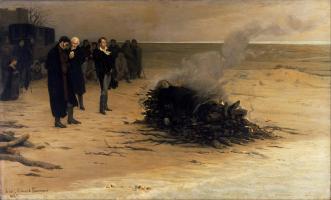
On 5th February 1919 William Michael Rossetti [aged 89] died. He was buried in the Rossetti Family Grave.
GrandFather: Gaetano Fedele Polidori
Mother: Frances Mary Lavinia Polidori
GrandMother: Anna Maria Pierce of Middlesex