

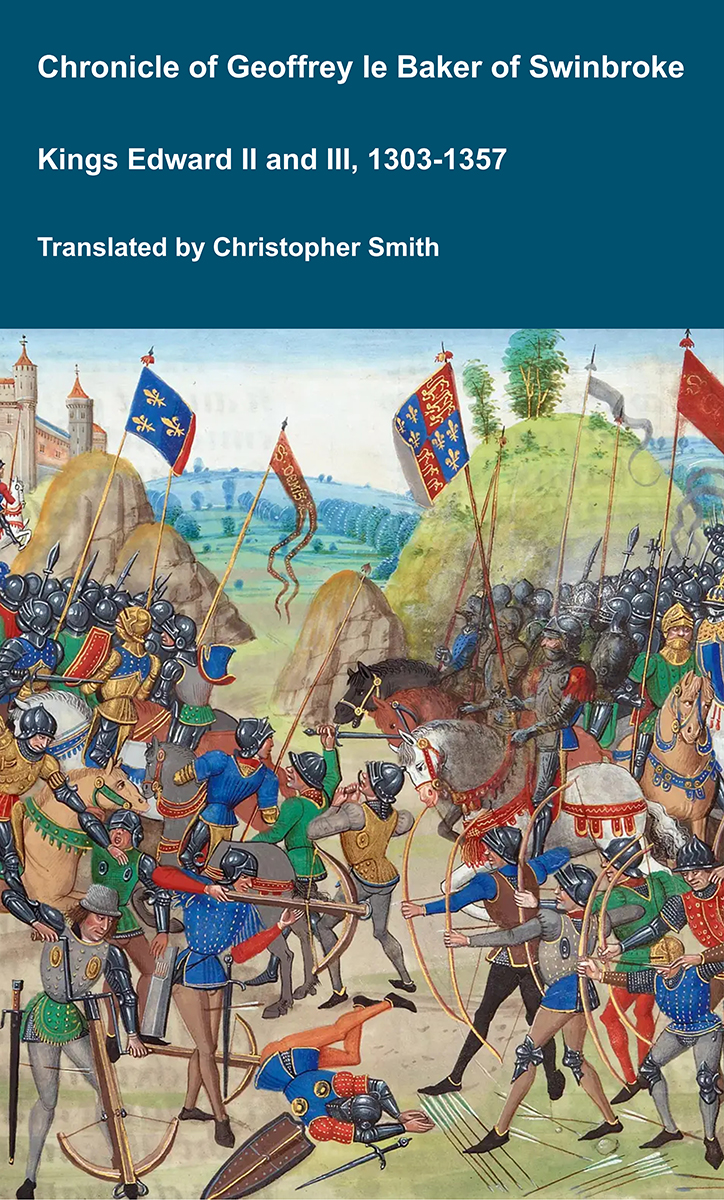
Chronicle of Geoffrey le Baker of Swinbroke
Baker was a secular clerk from Swinbroke, now Swinbrook, an Oxfordshire village two miles east of Burford. His Chronicle describes the events of the period 1303-1356: Gaveston, Bannockburn, Boroughbridge, the murder of King Edward II, the Scottish Wars, Sluys, Crécy, the Black Death, Winchelsea and Poitiers. To quote Herbert Bruce 'it possesses a vigorous and characteristic style, and its value for particular events between 1303 and 1356 has been recognised by its editor and by subsequent writers'. The book provides remarkable detail about the events it describes. Baker's text has been augmented with hundreds of notes, including extracts from other contemporary chronicles, such as the Annales Londonienses, Annales Paulini, Murimuth, Lanercost, Avesbury, Guisborough and Froissart to enrich the reader's understanding. The translation takes as its source the 'Chronicon Galfridi le Baker de Swynebroke' published in 1889, edited by Edward Maunde Thompson.
Available at Amazon in eBook and Paperback format.
Bristol Cathedral is in Bristol, Gloucestershire [Map], Cathedrals in England.
See: Nave, Bristol Cathedral.
Before 3rd December 1184 William de Saltmarsh was Prior of St Augustine's, Bristol [Map].
On 29th November 1243 Thomas Berkeley 4th Baron Berkeley [aged 73] died at Berkeley Castle [Map]. He was buried at St Augustine's Abbey, Bristol [Map]. His son Maurice [aged 25] succeeded 5th Baron Berkeley Feudal. Isabella Plantagenet Baroness Berkeley by marriage Baroness Berkeley Feudal.
On 22nd May 1276 Joan Somery Baroness Berkeley [aged 81] died at St Augustine's Abbey, Bristol [Map].
On 4th April 1281 Maurice Berkeley 5th Baron Berkeley [aged 63] died at Thornbury, Gloucestershire. He was buried at St Augustine's Abbey, Bristol [Map]. His son Thomas [aged 35] succeeded 6th Baron Berkeley Feudal. Joan Ferrers Baroness Berkeley by marriage Baroness Berkeley Feudal.
On 23rd July 1321 Thomas Berkeley 6th and 1st Baron Berkeley [aged 76] died at St Augustine's Abbey, Bristol [Map]. His son Maurice [aged 50] succeeded 7th Baron Berkeley Feudal, 2nd Baron Berkeley. Isabella Clare Baroness Berkeley [aged 59] by marriage Baroness Berkeley Feudal, Baroness Berkeley.
On 31st May 1326 Maurice Berkeley 7th and 2nd Baron Berkeley [aged 55] died at Wallingford Castle [Map]. He was buried at St Augustine's Abbey, Bristol [Map]. His son Thomas [aged 30] succeeded 8th Baron Berkeley Feudal, 3rd Baron Berkeley. Margaret Mortimer Baroness Berkeley [aged 22] by marriage Baroness Berkeley Feudal.
On 3rd August 1336 Roger Mortimer 1st Baron Mortimer of Chirk [aged 80] died at the Tower of London [Map] after four and a half years imprisonment. He was buried at either Wigmore Abbey [Map] or St Augustine's Priory, Bristol [Map]. His son Roger succeeded 2nd Baron Mortimer of Chirk although he was never summoned to Parliament.
On 22nd October 1463 James Berkeley 11th and 1st Baron Berkeley [aged 69] died at Berkeley Castle [Map]. He was buried at St Augustine's Abbey, Bristol [Map]. His son William [aged 37] succeeded 12th Baron Berkeley Feudal, 2nd Baron Berkeley.
In September 1506 Maurice Berkeley 3rd Baron Berkeley [aged 71] died at Berkeley Castle [Map]. He was buried at St Augustine's Abbey, Bristol [Map]. His son Maurice [aged 39] succeeded 4th Baron Berkeley.
On 5th November 1552 George Carew [aged 54] was appointed Dean of Bristol Cathedral.
On 18th November 1554 Bishop John Holyman [aged 59] was consecrated Bishop of Bristol.
Henrici Quinti, Angliæ Regis, Gesta, is a first-hand account of the Agincourt Campaign, and subsequent events to his death in 1422. The author of the first part was a Chaplain in King Henry's retinue who was present from King Henry's departure at Southampton in 1415, at the siege of Harfleur, the battle of Agincourt, and the celebrations on King Henry's return to London. The second part, by another writer, relates the events that took place including the negotiations at Troye, Henry's marriage and his death in 1422.
Available at Amazon in eBook and Paperback format.
In 1558 George Carew [aged 60] was appointed Dean of Bristol Cathedral.

On 13th November 1589 Bishop Richard Fletcher [aged 44] was elected Bishop of Bristol.
On 14th December 1589 Bishop Richard Fletcher [aged 44] was consecrated Bishop of Bristol.
In 1623 Bishop Robert Wright [aged 63] was appointed Bishop of Bristol.
On 10th February 1633 Bishop George Coke [aged 62] was consecrated Bishop of Bristol.

On 12th August 1684 Bishop John Lake [aged 60] was translated to Bishop of Bristol.

In 1685 Bishop Jonathan Trelawny 3rd Baronet [aged 34] was appointed Bishop of Bristol.
In 1708 Dean Robert Booth [aged 46] was appointed Dean of Bristol Cathedral.
Before 1734 Bishop Charles Cecil [aged 38] was appointed Bishop of Bristol.
On 19th October 1738 Bishop Joseph Butler [aged 46] was elected Bishop of Bristol.
On 3rd December 1738 Bishop Joseph Butler [aged 46] was consecrated Bishop of Bristol at Lambeth Palace [Map].
On 16th June 1752 Bishop Joseph Butler [aged 60] died unmarried at Rosemead House Kingsmead Square Bath, Somerset. He was buried at Bristol Cathedral [Map].
In 1782 Bishop Lewis Bagot [aged 41] was appointed Bishop of Bristol.
In 1783 Bishop Christopher Wilson [aged 69] was appointed Bishop of Bristol which position he held until his death in 1792.
On 3rd June 1793 Bishop Spencer Madan [aged 64] was consecrated Bishop of Bristol.
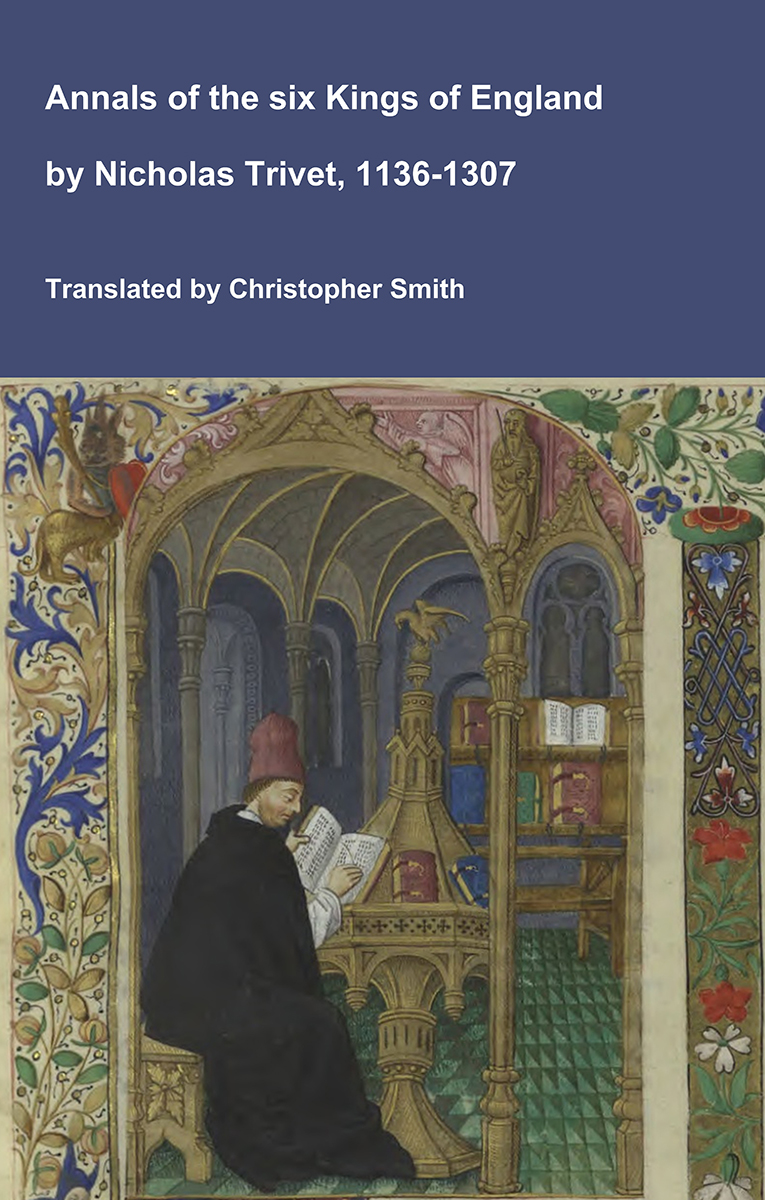
Annals of the six Kings of England by Nicholas Trivet
Translation of the Annals of the Six Kings of England by that traces the rise and rule of the Angevin aka Plantagenet dynasty from the mid-12th to early 14th century. Written by the Dominican scholar Nicholas Trivet, the work offers a vivid account of English history from the reign of King Stephen through to the death of King Edward I, blending political narrative with moral reflection. Covering the reigns of six monarchs—from Stephen to Edward I—the chronicle explores royal authority, rebellion, war, and the shifting balance between crown, church, and nobility. Trivet provides detailed insight into defining moments such as baronial conflicts, Anglo-French rivalry, and the consolidation of royal power under Edward I, whose reign he describes with particular immediacy. The Annals combines careful year-by-year reporting with thoughtful interpretation, presenting history not merely as a sequence of events but as a moral and political lesson. Ideal for readers interested in medieval history, kingship, and the origins of the English state, this chronicle remains a valuable and accessible window into the turbulent world of the Plantagenet kings.
Available at Amazon in eBook and Paperback format.
On 11th May 1794 Bishop Reginald Courtenay [aged 52] was consecrated as Bishop of Bristol.
In 1803 Bishop George Pelham [aged 36] was consecrated Bishop of Bristol.
In May 1803 Bishop Bowyer Sparke [aged 44] was appointed Dean of Bristol Cathedral.
In 1820 Bishop John Kaye [aged 36] was appointed Bishop of Bristol.

In 1834 Bishop Joseph Allen [aged 64] was appointed Bishop of Bristol.

1835. William James Müller [aged 22]. View of Bristol Cathedral [Map].

1837. William James Müller [aged 24]. View of Bristol Cathedral [Map].
In 1892 Hemming Robeson was appointed Archdeacon Bristol which post he held until 1904.
On 7th September 1875 Poulett George Henry Somerset [aged 53] died. He was buried at Nave, Bristol Cathedral.