

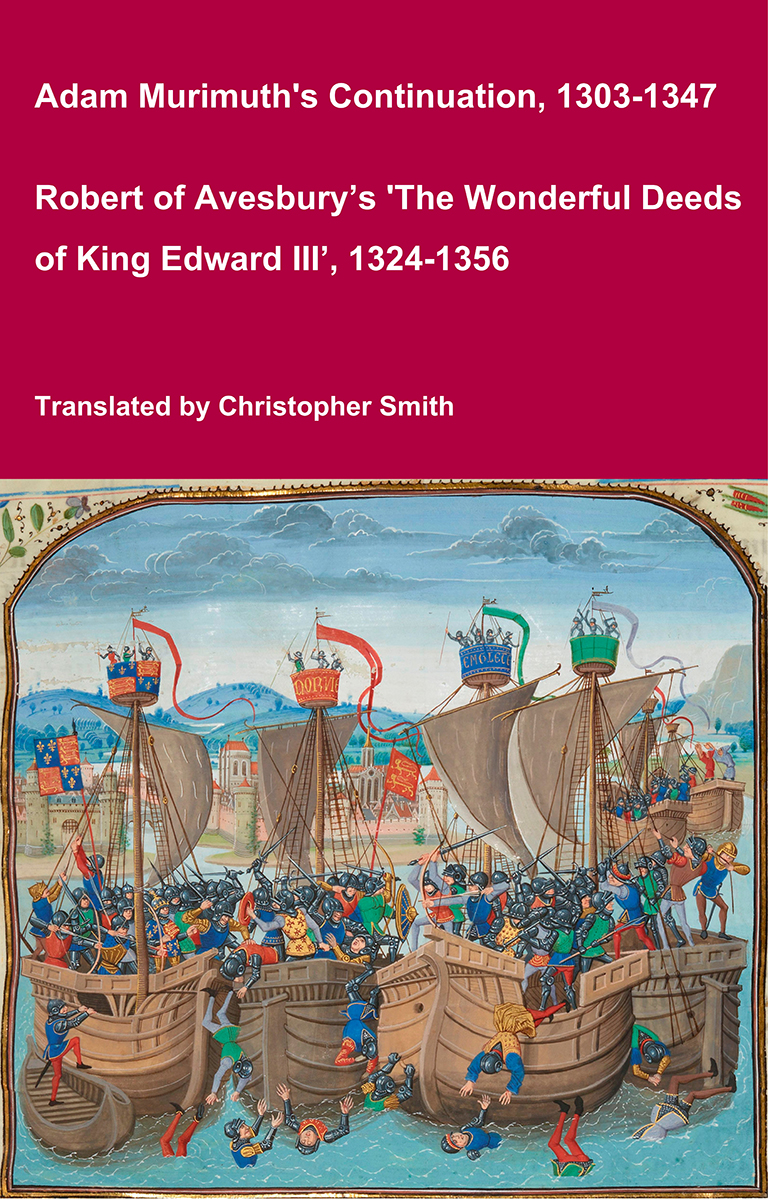
Adam Murimuth's Continuation and Robert of Avesbury’s 'The Wonderful Deeds of King Edward III'
This volume brings together two of the most important contemporary chronicles for the reign of Edward III and the opening phases of the Hundred Years’ War. Written in Latin by English clerical observers, these texts provide a vivid and authoritative window into the political, diplomatic, and military history of fourteenth-century England and its continental ambitions. Adam Murimuth Continuatio's Chronicarum continues an earlier chronicle into the mid-fourteenth century, offering concise but valuable notices on royal policy, foreign relations, and ecclesiastical affairs. Its annalistic structure makes it especially useful for establishing chronology and tracing the development of events year by year. Complementing it, Robert of Avesbury’s De gestis mirabilibus regis Edwardi tertii is a rich documentary chronicle preserving letters, treaties, and official records alongside narrative passages. It is an indispensable source for understanding Edward III’s claim to the French crown, the conduct of war, and the mechanisms of medieval diplomacy. Together, these works offer scholars, students, and enthusiasts a reliable and unembellished account of a transformative period in English and European history. Essential for anyone interested in medieval chronicles, the Hundred Years’ War, or the reign of Edward III.
Available at Amazon in eBook and Paperback format.
Chichester Cathedral is in Chichester [Map], Cathedrals in England.
Chronicon ex Chronicis by Florence and John of Worcester. 23rd May 1070. On Whitsunday [3rd May] the king [aged 42], at Windsor, Berkshire [Map], gave the archbishopric of York to the venerable Thomas, canon of Bayeux, and the bishopric of Winchester to his chaplain, Walkeline. On the following day, by the king's command, Ermenfrid, bishop of Sion, held a synod, [the other legates] the cardinals John and Peter having returned to Rome. At this synod, Ethelric, bishop of Sussex, was uncanonically deposed; and although he was guilty of no crime, the king soon afterwards placed him in confinement at Marlborough, Wiltshire [Map]; several abbots were also deprived. After these depositions, the king gave the bishopric of East-Anglia to Arfast, and the bishopric of Sussex to Stigand79, who were both his chaplains; which Stigand transferred his see to Chichester, the chief city in his diocese: the king also gave abbeys to some Norman monks. The archbishop of Canterbury being degraded, and the archbishop of York dead, Walkeline was, by the king's command, consecrated by the same Ermenfrid, bishop of Sion, on the octave of Whitsunday [30th May].
Note 79. This first bishop of Chichester must not be confounded with the archbishop of the same name.
Chronicon ex Chronicis by Florence and John of Worcester. 1125. Simon, the queen's chancellor, and Sigefred, abbot of Glastonbury, both men of distinguished worth and piety, were chosen bishops while they were in Normandy; Simon being appointed to the see of Worcester, and Sigefred to the see of Chichester. Hugh, a man of great prudence, archdeacon successively to Samson and Theowulf, bishops of Worcester, died on the twelfth of the calends of April [21st March). After Easter [29th March], the bishops-elect, Simon and Sigefred, with the archbishops William [aged 55] and Thurstan [aged 55], and a cardinal of Rome named John, came to England,
Chronicon ex Chronicis by Florence and John of Worcester. 12th April 1125. ... and Sigefred was consecrated as bishop of Chichester at Lambeth by archbishop William [aged 55] on the second of the ides [the 12th] of April; there being present at this consecration the Roman cardinal, Thurstan [aged 55], archbishop of York, Everard, bishop of Norwich, Richard of Hereford, Bernard of St. David's, David of Bangor, Urban of Glamorgan [aged 49], and John, bishop-elect of Rochester.
In or before 1178 Seffrid was appointed Dean of Chichester Cathedral.
On 16th November 1180 Bishop Seffrid was consecrated Bishop of Chichester.
In or before 1215 Bishop Richard Poore was appointed Bishop of Chichester.
Before 1st November 1222 Bishop Ralph Neville was elected Bishop of Chichester.
On 5th April 1305 Bishop John Langton was elected Bishop of Chichester.
On 19th September 1305 Bishop John Langton was consecrated Bishop of Chichester.
Between 23rd July 1337 and 18th August 1337 Robert de Stratford [aged 45] was elected Bishop of Chichester.
On 17th November 1389 Bishop Richard Mitford was elected Bishop of Chichester.
On 10th April 1390 Bishop Richard Mitford was consecrated Bishop of Chichester.
In 1429 Bishop Thomas Brunce [aged 41] was elected Bishop of Chichester although Bishop Simon Sydenham was awared the position.
On 11th February 1431 Bishop Simon Sydenham was consecrated Bishop of Chichester.
Adam Murimuth's Continuation and Robert of Avesbury’s 'The Wonderful Deeds of King Edward III'
This volume brings together two of the most important contemporary chronicles for the reign of Edward III and the opening phases of the Hundred Years’ War. Written in Latin by English clerical observers, these texts provide a vivid and authoritative window into the political, diplomatic, and military history of fourteenth-century England and its continental ambitions. Adam Murimuth Continuatio's Chronicarum continues an earlier chronicle into the mid-fourteenth century, offering concise but valuable notices on royal policy, foreign relations, and ecclesiastical affairs. Its annalistic structure makes it especially useful for establishing chronology and tracing the development of events year by year. Complementing it, Robert of Avesbury’s De gestis mirabilibus regis Edwardi tertii is a rich documentary chronicle preserving letters, treaties, and official records alongside narrative passages. It is an indispensable source for understanding Edward III’s claim to the French crown, the conduct of war, and the mechanisms of medieval diplomacy. Together, these works offer scholars, students, and enthusiasts a reliable and unembellished account of a transformative period in English and European history. Essential for anyone interested in medieval chronicles, the Hundred Years’ War, or the reign of Edward III.
Available at Amazon in eBook and Paperback format.
On 24th September 1445 Bishop Adam Moleyns was elected Bishop of Chichester.
On 6th February 1446 Bishop Adam Moleyns was consecrated Bishop of Chichester at Lambeth Palace [Map].
On 23rd March 1450 Bishop Reginald Peacock [aged 55] was translated to Bishop of Chichester.
In January 1459 Bishop Reginald Peacock [aged 64] was forced to resign as Bishop of Chichester.
On 11th February 1478 Bishop Edward Story was translated to Bishop of Chichester.
On 29th November 1503 Bishop Richard Fitzjames was translated to Bishop of Chichester.
In 1508 Bishop Robert Sherbourne [aged 55] was appointed Bishop of Chichester.
On 11th June 1536 Bishop Richard Sampson was elected Bishop of Chichester.
In 1541 Bishop Henry Man was appointed Dean of Chichester Cathedral.

In 1543 Bishop George Day [aged 42] was consecrated Bishop of Chichester by Archbishop Thomas Cranmer [aged 53].
In October 1551 Bishop George Day [aged 50] was deprived of the Bishopric of Chichester.
In 1552 Bishop John Scory [aged 42] was appointed Bishop of Chichester.
Before 30th September 1553 Bishop George Day [aged 52] was restored to the Bishopric of Chichester.
In 1557 Bishop John Christopherson was appointed Bishop of Chichester which post he held until 1558.
In 1559 five new Bishops were consecrated including:
Archbishop Edwin Sandes [aged 40] was consecrated Bishop of Worcester.
Bishop William Barlow [aged 61] was consecrated Bishop of Chichester.
Archbishop Edmund Grindal [aged 40] was consecrated Bishop of London.
Chronicle of Walter of Guisborough
A canon regular of the Augustinian Guisborough Priory, Yorkshire, formerly known as The Chronicle of Walter of Hemingburgh, describes the period from 1066 to 1346. Before 1274 the Chronicle is based on other works. Thereafter, the Chronicle is original, and a remarkable source for the events of the time. This book provides a translation of the Chronicle from that date. The Latin source for our translation is the 1849 work edited by Hans Claude Hamilton. Hamilton, in his preface, says: 'In the present work we behold perhaps one of the finest samples of our early chronicles, both as regards the value of the events recorded, and the correctness with which they are detailed; Nor will the pleasing style of composition be lightly passed over by those capable of seeing reflected from it the tokens of a vigorous and cultivated mind, and a favourable specimen of the learning and taste of the age in which it was framed.'
Available at Amazon in eBook and Paperback format.
In 1596 Bishop Anthony Watson was appointed Bishop of Chichester.
On 31st October 1605 Bishop Lancelot Andrewes [aged 50] was elected Bishop of Chichester.
On 3rd November 1605 Bishop Lancelot Andrewes [aged 50] was consecrated Bishop of Chichester.
On 18th November 1605 Bishop Lancelot Andrewes [aged 50] was installed Bishop of Chichester at Chichester Cathedral [Map].

In 1638 Bishop Brian Duppa [aged 48] was elected Bishop of Chichester.
John Evelyn's Diary. 9th July 1638. I went home to visit my friends, and, on the 26th, with my brother [aged 21] and sister to Lewes [Map], where we abode till the 31st; and thence to one Mr. Michael's, of Houghton, near Arundel [Map], where we were very well treated; and, on the 2d of August, to Portsmouth, Hampshire [Map], and thence, having surveyed the fortifications (a great rarity in that blessed halcyon time in England), we passed into the Isle of Wight [Map], to the house of my Baroness Richards, in a place called Yaverland; but were turned the following day to Chichester [Map], where, having viewed the city and fair cathedral [Map], we returned home.
On 6th February 1642 Bishop Henry King [aged 50] was appointed Bishop of Chichester.
In 1669 Zachary Crodock [aged 6] was appointed Canon Chichester Cathedral.

In 1669 Bishop Peter Gunning [aged 55] was appointed Bishop of Chichester.
John Evelyn's Diary. 26th March 1675. Dr. Brideoak [aged 62] was elected Bishop of Chichester, on the translation of Dr. Gunning [aged 61] to Ely.
John Evelyn's Diary. 24th March 1676. Dr. Brideoake [aged 63], Bishop of Chichester, preached a mean discourse for a Bishop. I also heard Dr. Fleetwood [aged 72], Bishop of Worcester, on Matt. xxvi. 38, of the sorrows of Christ, a deadly sorrow caused by our sins; he was no great preacher.
John Evelyn's Diary. 2nd September 1676. The Dean of Chichester preached before the King [aged 46], on Acts xxiv. 16; and Dr. Crichton preached the second sermon before him on Psalm xc. 12, of wisely numbering our days, and well employing our time.

On 19th October 1685 Bishop John Lake [aged 61] was translated to Bishop of Chichester.
In 1689 Bishop Simon Patrick [aged 62] was appointed Bishop of Chichester.
On 30th August 1691 Bishop Robert Grove [aged 57] was consecrated Bishop of Chichester.
Adam Murimuth's Continuation and Robert of Avesbury’s 'The Wonderful Deeds of King Edward III'
This volume brings together two of the most important contemporary chronicles for the reign of Edward III and the opening phases of the Hundred Years’ War. Written in Latin by English clerical observers, these texts provide a vivid and authoritative window into the political, diplomatic, and military history of fourteenth-century England and its continental ambitions. Adam Murimuth Continuatio's Chronicarum continues an earlier chronicle into the mid-fourteenth century, offering concise but valuable notices on royal policy, foreign relations, and ecclesiastical affairs. Its annalistic structure makes it especially useful for establishing chronology and tracing the development of events year by year. Complementing it, Robert of Avesbury’s De gestis mirabilibus regis Edwardi tertii is a rich documentary chronicle preserving letters, treaties, and official records alongside narrative passages. It is an indispensable source for understanding Edward III’s claim to the French crown, the conduct of war, and the mechanisms of medieval diplomacy. Together, these works offer scholars, students, and enthusiasts a reliable and unembellished account of a transformative period in English and European history. Essential for anyone interested in medieval chronicles, the Hundred Years’ War, or the reign of Edward III.
Available at Amazon in eBook and Paperback format.
On 25th September 1696 Bishop Robert Grove [aged 62] died in a carriage accident. He was buried in Chichester Cathedral [Map].
On 29th December 1806 Charles Lennox 3rd Duke Richmond [aged 71] died at Goodwood West Sussex. He was buried at Chichester Cathedral [Map]. His nephew Charles [aged 42] succeeded 4th Duke Richmond, 4th Earl March, 4th Baron Settrington. Charlotte Gordon Duchess Richmond [aged 38] by marriage Duchess Richmond.


In 1824 James Lloyd 1st Baronet [aged 61] was appointed Bishop of Chichester.
In 1831 Bishop Edward Maltby [aged 60] was appointed Bishop of Chichester.
In 1836 Bishop William Otter [aged 67] was appointed Bishop of Chichester.