

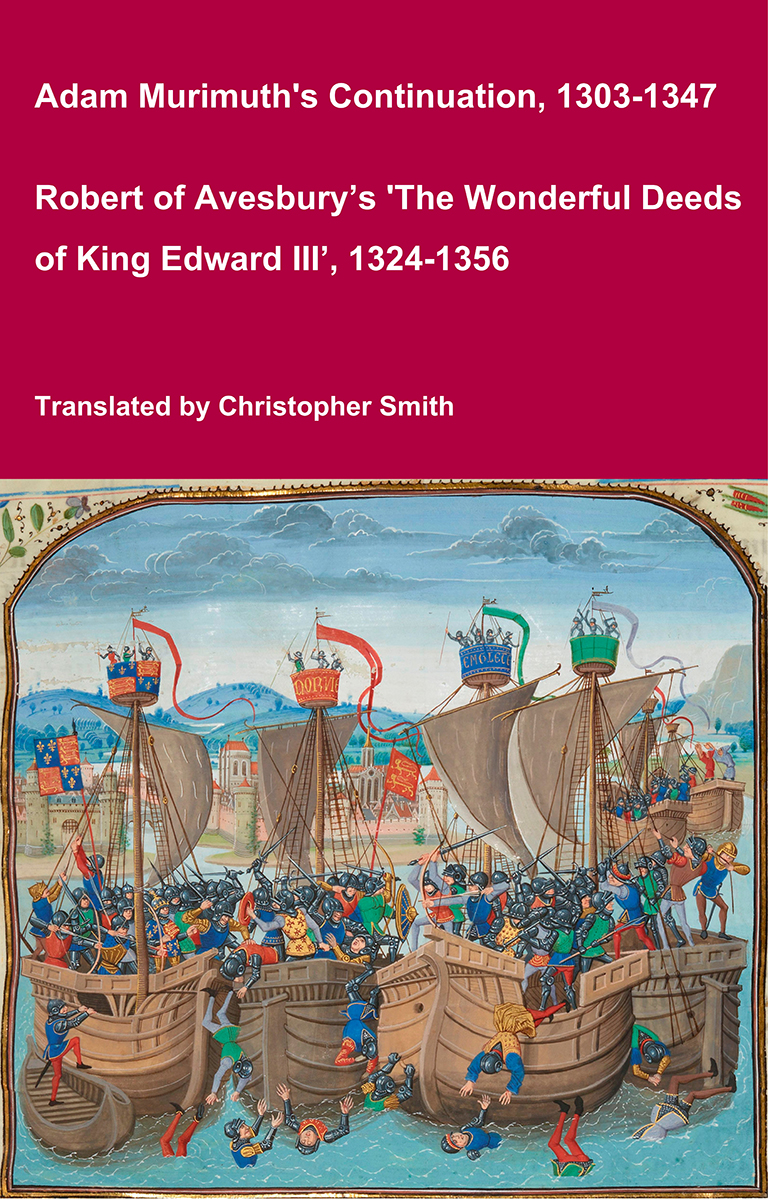
Adam Murimuth's Continuation and Robert of Avesbury’s 'The Wonderful Deeds of King Edward III'
This volume brings together two of the most important contemporary chronicles for the reign of Edward III and the opening phases of the Hundred Years’ War. Written in Latin by English clerical observers, these texts provide a vivid and authoritative window into the political, diplomatic, and military history of fourteenth-century England and its continental ambitions. Adam Murimuth Continuatio's Chronicarum continues an earlier chronicle into the mid-fourteenth century, offering concise but valuable notices on royal policy, foreign relations, and ecclesiastical affairs. Its annalistic structure makes it especially useful for establishing chronology and tracing the development of events year by year. Complementing it, Robert of Avesbury’s De gestis mirabilibus regis Edwardi tertii is a rich documentary chronicle preserving letters, treaties, and official records alongside narrative passages. It is an indispensable source for understanding Edward III’s claim to the French crown, the conduct of war, and the mechanisms of medieval diplomacy. Together, these works offer scholars, students, and enthusiasts a reliable and unembellished account of a transformative period in English and European history. Essential for anyone interested in medieval chronicles, the Hundred Years’ War, or the reign of Edward III.
Available at Amazon in eBook and Paperback format.
Guisborough Priory is in Guisborough, Yorkshire, Priories in England.
On 11th May 1141 Robert Bruce 1st Lord Annandale 1st Lord Skelton [aged 71] died at Guisborough Priory [Map]. His son Adam [aged 36] succeeded 2nd Lord Annandale, 2nd Lord Skelton.
On 16th July 1212 William Bruce 3rd Lord Annandale [aged 58] died. He was buried at Guisborough Priory [Map]. His son Robert [aged 17] succeeded 4th Lord Annandale.
On 7th September 1241 Unknown Brus was born at Marseilles, France. He was buried at Guisborough Priory [Map].
In 1245 Robert Bruce 4th Lord Annandale [aged 50] died. He was buried at Guisborough Priory [Map]. His son Robert [aged 30] succeeded 5th Lord Annandale.
Before 1257 Bishop Ralph de Ireton became a Canon at Guisborough Priory [Map].
In 1261 Bishop Ralph de Ireton was elected Prior of Guisborough Priory [Map].
On 10th July 1264 Isabel Clare Lady Annandale [aged 37] died. She was buried at Guisborough Priory [Map].
On 31st March 1295 Robert Bruce 5th Lord Annandale [aged 80] died. He was buried at Guisborough Priory [Map]. His son Robert [aged 51] succeeded 6th Lord Annandale.
 Chronicle of Walter of Guisborough. In the same year, in his own land of Annandale, at Lochmaben, that noble man Lord Robert de Brus the Fourth [aged 80] died, on Maundy Thursday [31st March 1295]. As previously mentioned, he had disputed with John Balliol before the king of England over the succession to the Scottish throne. And, as he had ordered while alive, he was buried in our house at Guisborough [Map], beside his father, on the second Sunday after Easter, the fifteenth day before the Kalends of May [17th April 1295], with the highest honour and great reverence, as was fitting. Throughout his life, he was glorious, gracious, wealthy, and generous, and he abounded in all things both in life and in death.
Eodem anno in terra sua Vallis Anandiæ apud Loghmaban obiit nobilis ille vir dominus Robertus de Bruys quartus, in Cœna Domini, qui, ut superius tactum est, circa successionem regni Scotiæ cum Johanne de Balliolo coram rege Anglorum disceptavit; et, ut vivens ipse jusserat, sepultus est in domo nostra Gisseburne juxta patrem suum, Dominica secunda post Pascha, XV kalendas Maii, cum summo honore, ut decuit, et reverentia magna. Hic toto tempore vitæ suæ gloriosus extitit, facetus, dives, et largus, et abundavit in omnibus in vita et in morte.
Abbot John Whethamstede’s Chronicle of the Abbey of St Albans
Abbot John Whethamstede's Register aka Chronicle of his second term at the Abbey of St Albans, 1451-1461, is a remarkable text that describes his first-hand experience of the beginning of the Wars of the Roses including the First and Second Battles of St Albans, 1455 and 1461, respectively, their cause, and their consequences, not least on the Abbey itself. His text also includes Loveday, Blore Heath, Northampton, the Act of Accord, Wakefield, and Towton, and ends with the Coronation of King Edward IV. In addition to the events of the Wars of the Roses, Abbot John, or his scribes who wrote the Chronicle, include details in the life of the Abbey such as charters, letters, land exchanges, visits by legates, and disputes, which provide a rich insight into the day-to-day life of the Abbey, and the challenges faced by its Abbot.
Available at Amazon in eBook and Paperback format.
On 30th May 1347 John Darcy 1st Baron Darcy of Knayth [aged 67] died. He was buried at Guisborough Priory [Map]. His son John [aged 30] succeeded 2nd Baron Darcy of Knayth. Elizabeth Meinhill Baroness Darcy Knayth and Haversham [aged 15] by marriage Baroness Darcy of Knayth.
On 29th September 1362 Walter Fauconberg 4th Baron Fauconberg [aged 43] died at Guisborough Priory [Map]. His son Thomas [aged 17] succeeded 5th Baron Fauconberg.
On 28th May 1381 William Latimer 4th Baron Latimer of Corby [aged 51] died. He was buried at Guisborough Priory [Map]. His daughter Elizabeth [aged 24] succeeded 5th Baroness Latimer of Corby.
On 9th January 1463 William Neville 1st Earl Kent [aged 58] died. He was buried at Guisborough Priory [Map]. No surviving legitimate issue. Earl Kent extinct.
Around 30th May 1537 the Abbots of Fountains Abbey, North Yorkshire [Map], Marmaduke Bradley, and Guisborough Priory [Map], Robert Pursglove, were hanged, drawn and quartered at Tyburn [Map] for their role in the Pilgrimage of Grace. Their heads were displayed on London Bridge [Map].
In 1545 John Lumley 4th Baron Lumley [aged 53] died. He was buried at Guisborough Priory [Map]. Baron Lumley forfeit since his son George aka William Lumley was been executed eight years previously and whose attainder (presuming there was one) prevented his grandson John Lumley [aged 12] from succeeding to the title. His grandson John Lumley 1st Baron Lumley was created Baron Lumley of the third creation in 1547.

1801. Thomas Girtin [aged 25]. Guisborough Priory [Map].