

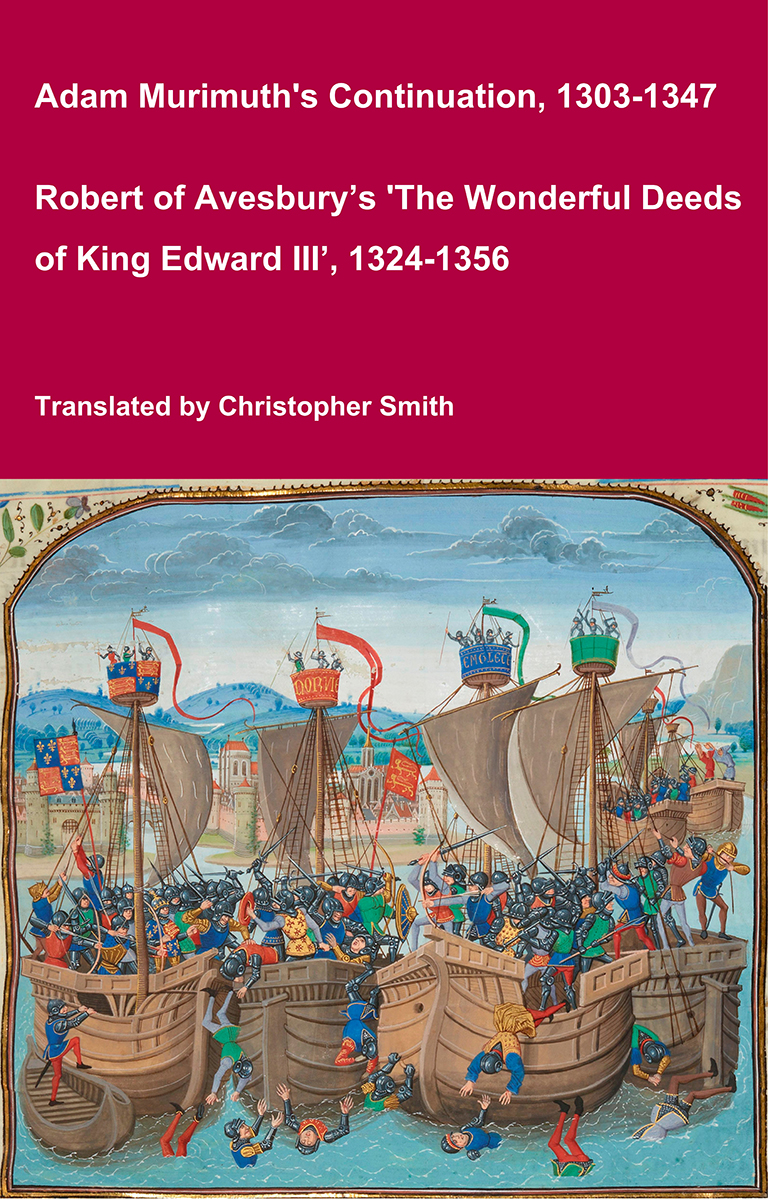
Adam Murimuth's Continuation and Robert of Avesbury’s 'The Wonderful Deeds of King Edward III'
This volume brings together two of the most important contemporary chronicles for the reign of Edward III and the opening phases of the Hundred Years’ War. Written in Latin by English clerical observers, these texts provide a vivid and authoritative window into the political, diplomatic, and military history of fourteenth-century England and its continental ambitions. Adam Murimuth Continuatio's Chronicarum continues an earlier chronicle into the mid-fourteenth century, offering concise but valuable notices on royal policy, foreign relations, and ecclesiastical affairs. Its annalistic structure makes it especially useful for establishing chronology and tracing the development of events year by year. Complementing it, Robert of Avesbury’s De gestis mirabilibus regis Edwardi tertii is a rich documentary chronicle preserving letters, treaties, and official records alongside narrative passages. It is an indispensable source for understanding Edward III’s claim to the French crown, the conduct of war, and the mechanisms of medieval diplomacy. Together, these works offer scholars, students, and enthusiasts a reliable and unembellished account of a transformative period in English and European history. Essential for anyone interested in medieval chronicles, the Hundred Years’ War, or the reign of Edward III.
Available at Amazon in eBook and Paperback format.
 Boyton, Wiltshire
 Bratton, Wiltshire
 Chittern Anstey, Wiltshire
 Codford St Mary, Wiltshire
 Fosse Gate, Wiltshire
 Heytesbury, Wiltshire
 Upton Lovell, Wiltshire
Heytesbury Hundred, Wiltshire is in Wiltshire.
Around 1246 Hugh Giffard died at Boyton, Wiltshire [Map].
Before 20th May 1282 John Neville (age 42) died at Boyton, Wiltshire [Map].
On 29th May 1299 John Giffard 1st Baron Giffard Brimpsfield (age 67) died at his home in Boyton, Wiltshire [Map]. His son John (age 11) succeeded 2nd Baron Giffard Brimpsfield. Aveline Courtenay Baroness Giffard Brimpsfield (age 18) by marriage Baroness Giffard Brimpsfield.
Hugh Giffard was born to William Giffard at Boyton, Wiltshire [Map].
The River Wylye rises on the White Sheet Downs, Wiltshire [Map] from where it flows past Kingston Deverill, Wiltshire [Map], Monkton Deverill, Wiltshire [Map], Brixton Deverill, Wiltshire [Map], Hill Deverill, Wiltshire [Map], Longbridge Deverill, Wiltshire [Map], one kilometre south of Warminster, Wiltshire [Map], Bishopstrow, Wiltshire [Map], Norton Bavant, Wiltshire [Map], Heytesbury, Wiltshire [Map], Upton Lovell, Wiltshire [Map], Boyton, Wiltshire [Map], Sherrington, Wiltshire [Map], Codford St Mary, Wiltshire [Map], Fisherton de la Mere, Wiltshire [Map], Wylye, Wiltshire [Map], Steeple Langford, Wiltshire [Map] after which it is joined by the River Till at Sherrington, Wiltshire [Map].
Thereafter it flows around Great Wishford, Wiltshire [Map], South Newton, Wiltshire [Map] to Wilton, Wiltshire [Map] where it joins the River Nadder.

Boyton Down Long Barrow is also in South England Neolithic Burials.

Archaeologia Volume 15 Section XXXIII. Archaeologia Volume 15 Plate XVI: 1. Boyton Barrow 2 [Map], 2. Boyton Down Long Barrow [Map], 3. Boyton Barrow 1 [Map], Corton Long Barrow [Map] South View,
Wiltshire Archaeological Magazine 1913 V38 Pages 379-414. Sherrington. 4. [Boyton Down Long Barrow [Map]] On the Boyton — Sherrington parish boundary, S. of Boyton Church, E. of Boyton Field Barn, on a conspicuous ridge of down. Length 150ft.; E. and W. No recorded opening. It is shown on Hoare's Map of Wylye Station (S. of the village of Boyton) as opened, but there seems to be no mention of it in the text. It is not included in Thurnam's list of long barrows opened by Hoare and Cunnington, and there is only an incidental mention of it in Wm. Cunnington's account of "Barrows opened on the Manors of Corton, Boyton, and Sherrington " (Arch. xv. 338) although a sketch of the barrow is given on Pl. XVI. fig. 2. Only the fringe and a few feet at the western end of the mound remain, but it must once have been a very fine barrow, and very conspicuously situated. The mound appears to have been wide and high for its length, the width at the east end being now 64ft. It stands on cultivated ground with no trace of the ditches above ground. Labourers on the spot stated that the material of the mound had been taken away from time to time to mend the adjacent trackway. O.M. 58 NE.; Arch. xv. 340, PL VI. fig. 2; A.W. I. Map of Wylye Station.
Bratton Camp, Wiltshire is also in Iron Age Hill Forts Wiltshire.
Wiltshire Archaeological Magazine 1872 V13 Pages 339-342. Dr. Thurnam began by observing that the Barrow on and around which those present were now standing, though placed in the centre of the British encampment, popularly known as Bratton Castle [Map] is probably of much earlier date, and has none but an accidental connection with that earthwork. It is a Long Barrow of large size, measuring 230 feet in length, lies east and west; and was opened by Dr. Thurnam in 1866. It belongs to the class of Long Barrows, a form of tumulus which differs essentially from the much more numerous Round Barrows, by which, on the Wiltshire Downs, they are everywhere surrounded. These latter, the Round Barrows, much more commonly than otherwise — at least three times as often — contain interments of burnt bodies, often accompanied by bronze weapons or implements,and especially bronze knives or daggers, and by ornaments of glass, amber, jet or shale, and gold. Sometimes there are flint and other stone implements, but these are all of a kind known to have been in use at the same time as those of bronze. The Round Barrows belong, essentially, and as a rule, to the Bronze Age of this country, and to an age of burning the dead. When the interment is that of the unburnt body — which, in Wiltshire, is less than one in four — the body has been buried with the knees bent and drawn up towards the chest. That the burnt and unburnt interments are of one and the same period is proved by the similarity, or rather identity, of the accompanying implements and ornaments.
Bratton Long Barrow is also in South England Neolithic Burials.
Wiltshire Archaeological Magazine 1913 V38 Pages 379-414. Bratton. 1. [Bratton Long Barrow [Map]] In Bratton Camp. Length 230ft. (Thurnam); E. and W. Opened by Wm. Cunnington, who found a secondary burial of three skeletons near the top of the larger end, but failed to find the primary one. Thurnam, who re-opened it in 1866, seems to have found the primary burial on the floor of the barrow, consisting of "a heap of imperfectly burnt, or rather charred, human bones, apparently those of one or two adults"1 This barrow is now a rather unshapely heap and much cut about; the mound is not ploughed but it stands on cultivated ground and all trace of the ditches is obliterated. O.M. 45, NW.; A.W. I. 55; Arch. XLII. 180, 192; W.A.M. XIII. 341.
Note 1. In Gough's Camden I. 146 it is said that "many human bones mixed vith stag's horns, fragments of urns, and pieces of iron weapons, and mill-stones," have been found "under the mound."
On 3rd May 1602 Thomas Hungerford was born to John Hungerford (age 44) at Bremhill, Wiltshire.
Jean de Waurin's Chronicle of England Volume 6 Books 3-6: The Wars of the Roses
Jean de Waurin was a French Chronicler, from the Artois region, who was born around 1400, and died around 1474. Waurin’s Chronicle of England, Volume 6, covering the period 1450 to 1471, from which we have selected and translated Chapters relating to the Wars of the Roses, provides a vivid, original, contemporary description of key events some of which he witnessed first-hand, some of which he was told by the key people involved with whom Waurin had a personal relationship.
Available at Amazon in eBook and Paperback format.
On 31st March 1636 John Hungerford (age 16) died at Bremhill, Wiltshire.
On 31st March 1636 John Hungerford (age 78) died at Bremhill, Wiltshire.
In 1637 George Hungerford was born to Edward Hungerford at Bremhill, Wiltshire. He married 5th April 1665 Frances Seymour, daughter of Charles Seymour 2nd Baron Seymour of Trowbridge and Mary Smith.
In May 1712 George Hungerford (age 75) died at Bremhill, Wiltshire.
In 1525 Dorothy Wroughton was born to William Wroughton of Broad Hinton (age 15) at Broad Hinton, Wiltshire. She married 1556 John Thynne and had issue.
Around 1492 Edward Bayntun was born to John Bayntun of Bromham at Bronham, Wiltshire. He married (1) before 1505 Elizabeth Sulyard and had issue (2) 18th January 1531 Isabel Leigh and had issue.
Knook Castle Long Barrow is also in South England Neolithic Burials.
Wiltshire Archaeological Magazine 1913 V38 Pages 379-414. Knook. 5.. [Knook Castle Long Barrow [Map]] On Knook Down, NE. of "Knook Barrow," E. of Bowl's Barrow, and N. of " Old Ditch." Length 78ft; E. and W. Opened in 1801. Under the usual stratum of black earth three skeletons were found near the E. end, and a little to the W. of these another skeleton. This barrow stands on uncultivated down and is in fair condition. It is a small mound, flat, low, and broad; the ditches are fairly well defined. O.M. 52 NE.; A. W. I. 86; Arch. xlii. 180. Referred to by Thurnam as "Knook b."
Knook Long Barrow is also in South England Neolithic Burials.
Wiltshire Archaeological Magazine 1913 V38 Pages 379-414. Knook. 2. "Knook Barrow [Map]," on Knook Down, E. of the "British Village." Length 90ft. (Hoare); a recent measurement 100ft.; nearly N. and S. Opened by Wm. Cunnington 1801 — 2, when he found under a heap of flint and marl stones, and on a pavement of flints, a number of charred human and other animal bones, and charred wood; the bones seemed to be those of seven or eight individuals. A secondary burial of four headless skeletons was also found near the centre of the mound, at a depth of about 18in. The barrow was reopened by Thurnam without further result. This barrow stands on uncultivated down land and is in fair condition, but with some rabbits in it; the ditches are distinct. O.M. 52 NE.; A. W. I. 83; Arch. xlii. 180, 192; xv. 345. This is the barrow referred to by Thurnam as " Knook a."
The River Wylye rises on the White Sheet Downs, Wiltshire [Map] from where it flows past Kingston Deverill, Wiltshire [Map], Monkton Deverill, Wiltshire [Map], Brixton Deverill, Wiltshire [Map], Hill Deverill, Wiltshire [Map], Longbridge Deverill, Wiltshire [Map], one kilometre south of Warminster, Wiltshire [Map], Bishopstrow, Wiltshire [Map], Norton Bavant, Wiltshire [Map], Heytesbury, Wiltshire [Map], Upton Lovell, Wiltshire [Map], Boyton, Wiltshire [Map], Sherrington, Wiltshire [Map], Codford St Mary, Wiltshire [Map], Fisherton de la Mere, Wiltshire [Map], Wylye, Wiltshire [Map], Steeple Langford, Wiltshire [Map] after which it is joined by the River Till at Sherrington, Wiltshire [Map].
Thereafter it flows around Great Wishford, Wiltshire [Map], South Newton, Wiltshire [Map] to Wilton, Wiltshire [Map] where it joins the River Nadder.
Fosse Way. After Batheaston the Fosse Way continues along Bannerdown Road [Map] where it curves around Solsbury Hill, Somerset [Map] to reach the high ground where the road straightens out passing Three Shires Stone [Map], Fosse Gate, Wiltshire [Map], crossing the Gloucestershire River Avon 1.2km south-west of Easton Grey [Map] before reaching the Cotswold Airport, Gloucestershire [Map] after which it travels to Corinium Dobunnorum [Map] aka Cirencester.
Chronicle of a Bourgeois of Valenciennes
Récits d’un bourgeois de Valenciennes aka The Chronicle of a Bourgeois of Valenciennes is a vivid 14th-century vernacular chronicle written by an anonymous urban chronicler from Valenciennes in the County of Hainaut. It survives in a manuscript that describes local and regional history from about 1253 to 1366, blending chronology, narrative episodes, and eyewitness-style accounts of political, military, and social events in medieval France, Flanders, and the Low Countries. The work begins with a chronological framework of events affecting Valenciennes and its region under rulers such as King Philip VI of France and the shifting allegiances of local nobility. It includes accounts of conflicts, sieges, diplomatic manoeuvres, and the impact of broader struggles like the Hundred Years’ War on urban life in Hainaut. Written from the perspective of a burgher (bourgeois) rather than a monastery or royal court, the chronicle offers a rare lay viewpoint on high politics and warfare, reflecting how merchants, townspeople, and civic institutions experienced the turbulence of the 13th and 14th centuries. Its narrative style combines straightforward reporting of events with moral and civic observations, making it a valuable source for readers interested in medieval urban society, regional politics, and the lived experience of war and governance in pre-modern Europe.
Available at Amazon in eBook and Paperback format.
The River Wylye rises on the White Sheet Downs, Wiltshire [Map] from where it flows past Kingston Deverill, Wiltshire [Map], Monkton Deverill, Wiltshire [Map], Brixton Deverill, Wiltshire [Map], Hill Deverill, Wiltshire [Map], Longbridge Deverill, Wiltshire [Map], one kilometre south of Warminster, Wiltshire [Map], Bishopstrow, Wiltshire [Map], Norton Bavant, Wiltshire [Map], Heytesbury, Wiltshire [Map], Upton Lovell, Wiltshire [Map], Boyton, Wiltshire [Map], Sherrington, Wiltshire [Map], Codford St Mary, Wiltshire [Map], Fisherton de la Mere, Wiltshire [Map], Wylye, Wiltshire [Map], Steeple Langford, Wiltshire [Map] after which it is joined by the River Till at Sherrington, Wiltshire [Map].
Thereafter it flows around Great Wishford, Wiltshire [Map], South Newton, Wiltshire [Map] to Wilton, Wiltshire [Map] where it joins the River Nadder.