

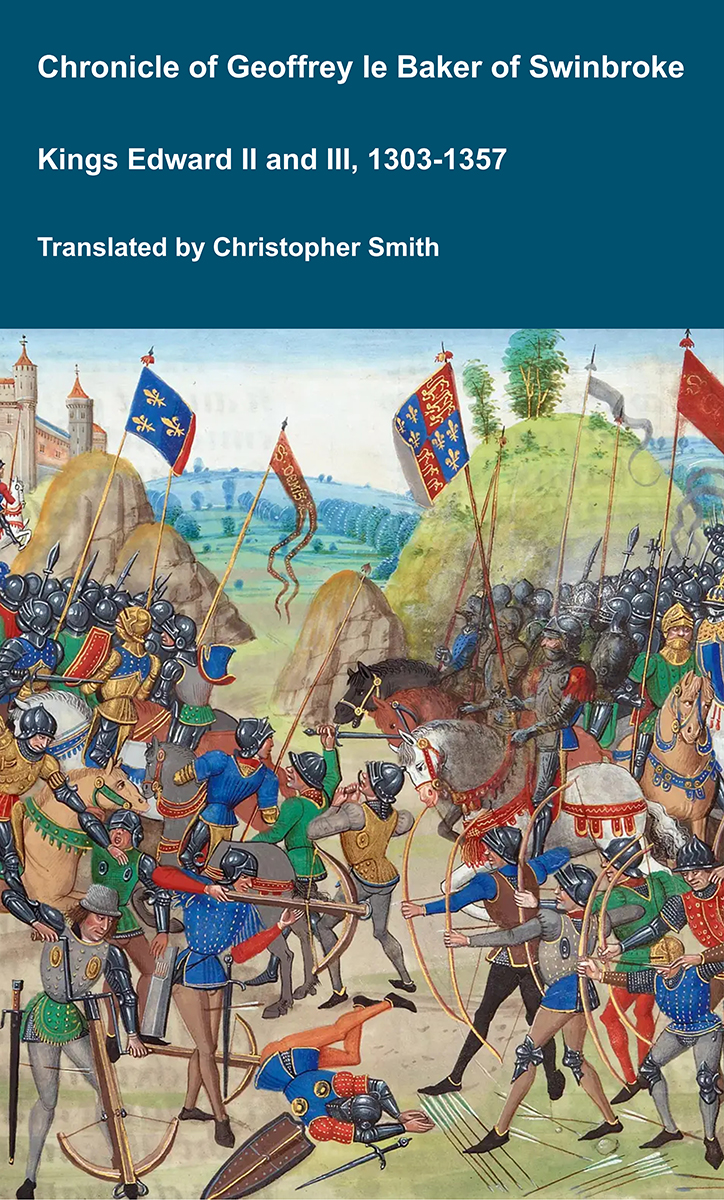
Chronicle of Geoffrey le Baker of Swinbroke
Baker was a secular clerk from Swinbroke, now Swinbrook, an Oxfordshire village two miles east of Burford. His Chronicle describes the events of the period 1303-1356: Gaveston, Bannockburn, Boroughbridge, the murder of King Edward II, the Scottish Wars, Sluys, Crécy, the Black Death, Winchelsea and Poitiers. To quote Herbert Bruce 'it possesses a vigorous and characteristic style, and its value for particular events between 1303 and 1356 has been recognised by its editor and by subsequent writers'. The book provides remarkable detail about the events it describes. Baker's text has been augmented with hundreds of notes, including extracts from other contemporary chronicles, such as the Annales Londonienses, Annales Paulini, Murimuth, Lanercost, Avesbury, Guisborough and Froissart to enrich the reader's understanding. The translation takes as its source the 'Chronicon Galfridi le Baker de Swynebroke' published in 1889, edited by Edward Maunde Thompson.
Available at Amazon in eBook and Paperback format.
Newmarket, Suffolk is in Suffolk.
See: , Palace House, Rutland Arms Hotel, Stanley House.
On 12th December 1618 Francis Leigh of Addington [aged 28] was knighted at Newmarket, Suffolk.

On 22nd January 1619 Edward Dering 1st Baronet [aged 21] was knighted at Newmarket, Suffolk.
On 16th October 1636 Thomas Ingram [aged 22] was knighted at Newmarket, Suffolk.
On 12th March 1642 John Reade 1st Baronet [aged 26] was knighted by King Charles II of England Scotland and Ireland [aged 11] at Newmarket, Suffolk.
John Evelyn's Diary. 31st August 1654. Thence to Caius, and afterward to King's College [Map], where I found the chapel [Map] altogether answered expectation, especially the roof, all of stone, which for the flatness of its laying and carving may, I conceive, vie with any in Christendom. The contignation of the roof (which I went upon), weight, and artificial joining of the stones is admirable. The lights are also very fair. In one aisle lies the famous Dr. Collins, so celebrated for his fluency in the Latin tongue. From this roof we could descry Ely [Map], and the encampment of Sturbridge fair now beginning to set up their tents and booths; also Royston [Map], Newmarket, Suffolk, etc., houses belonging to the King. The library is too narrow.
Samuel Pepys' Diary. 5th October 1663. Up with pain, and with Sir J. Minnes [aged 64] by coach to the Temple [Map], and then I to my brother's, and up and down on business, and so to the New Exchange, and there met Creed, and he and I walked two or three hours, talking of many businesses, especially about Tangier [Map], and my Lord Tiviot's bringing in of high accounts, and yet if they were higher are like to pass without exception, and then of my Lord Sandwich [aged 38] sending a messenger to know whether the King [aged 33] intends to come to Newmarket, Suffolk, as is talked, that he may be ready to entertain him at Hinchingbroke [Map].


Samuel Pepys' Diary. 22nd May 1668. Thence to my tailor's and a mercer's for patterns to carry my wife of cloth and silk for a bed, which I think will please her and me, and so home, and fitted myself for my journey to-morrow, which I fear will not be pleasant, because of the wet weather, it raining very hard all this day; but the less it troubles me because the King [aged 37] and Duke of York [aged 34] and Court are at this day at Newmarket, Suffolk, at a great horse-race, and proposed great pleasure for two or three days, but are in the same wet. So from the office home to supper, and betimes to bed.
Samuel Pepys' Diary. 23rd May 1668. Up by four o'clock; and, getting my things ready, and recommending the care of my house to W. Hewer [aged 26], I with my boy Tom, whom I take with me, to the Bull, in Bishopsgate Street, and there, about six, took coach, he and I, and a gentleman and his man, there being another coach also, with as many more, I think, in it; and so away to Bishop's Stafford, and there dined, and changed horses and coach, at Mrs. Aynsworth's; but I took no knowledge of her. Here the gentleman and I to dinner, and in comes Captain Forster, an acquaintance of his, he that do belong to my Lord Anglesey [aged 53], who had been at the late horse-races at Newmarket, Suffolk, where the King [aged 37] now is, and says that they had fair weather there yesterday, though we here, and at London, had nothing but rain, insomuch that the ways are mighty full of water, so as hardly to be passed. Here I hear Mrs. Aynsworth is going to live at London: but I believe will be mistaken in it; for it will be found better for her to be chief where she is, than to have little to do at London. There being many finer than she there.


Samuel Pepys' Diary. 18th July 1668. So home and to my office, and then to walk in the garden, and home to supper and to bed. They say the King of France [aged 29] is making a war again, in Flanders, with the King of Spain [aged 6]; the King of Spain refusing to give him all that he says was promised him in the treaty. Creed told me this day how when the King [aged 38] was at my Lord Cornwallis's when he went last to Newmarket, Suffolk, that being there on a Sunday, the Duke of Buckingham [aged 40] did in the afternoon to please the King make a bawdy sermon to him out of Canticles, and that my Lord Cornwallis did endeavour to get the King a whore, and that must be a pretty girl the daughter of the parson of the place, but that she did get away, and leaped off of some place and killed herself, which if true is very sad.


Jean de Waurin's Chronicle of England Volume 6 Books 3-6: The Wars of the Roses
Jean de Waurin was a French Chronicler, from the Artois region, who was born around 1400, and died around 1474. Waurin’s Chronicle of England, Volume 6, covering the period 1450 to 1471, from which we have selected and translated Chapters relating to the Wars of the Roses, provides a vivid, original, contemporary description of key events some of which he witnessed first-hand, some of which he was told by the key people involved with whom Waurin had a personal relationship.
Available at Amazon in eBook and Paperback format.
Samuel Pepys' Diary. 29th October 1668. At the office all the morning, where Mr. Wren [aged 39] first tells us of the order from the King [aged 38], came last night to the Duke of York [aged 35], for signifying his pleasure to the Sollicitor-General [aged 46] for drawing up a Commission for suspending of my Lord Anglesey [aged 54], and putting in Sir Thomas Littleton [aged 47] and Sir Thomas Osborne, the former a creature of Arlington's [aged 50], and the latter of the Duke of Buckingham's [aged 40], during the suspension. The Duke of York was forced to obey, and did grant it, he being to go to Newmarket, Suffolk this day with the King, and so the King pressed for it. But Mr. Wren do own that the Duke of York is the most wounded in this, in the world, for it is done and concluded without his privity, after his appearing for Lord Anglesey, and that it is plain that they do ayme to bring the Admiralty into Commission too, and lessen the Duke of York. This do put strange apprehensions into all our Board; only I think I am the least troubled at it, for I care not at all for it: but my Lord Brouncker [aged 48] and Pen do seem to think much of it.


Samuel Pepys' Diary. 7th March 1669. By and by, after two hours' stay, they rose, having, as Wren tells me, resolved upon sending six ships to the Streights forthwith, not being contented with the peace upon the terms they demand, which are, that all our ships, where any Turks or Moores shall be found slaves, shall be prizes; which will imply that they, must be searched. I hear that to-morrow the King [aged 38] and the Duke of York [aged 35] set out for Newmarket, Suffolk, by three in the morning; to some foot and horse-races, to be abroad ten or twelve days: So I away, without seeing the Duke of York; but Mr. Wren [aged 40] showed me the Order of Council about the balancing the Storekeeper's accounts, passed the Council in the very terms I drew it, only I did put in my name as he that presented the book of Hosier's preparing, and that is left out-I mean, my name-which is no great matter.
Samuel Pepys' Diary. 26th April 1669. After dinner comes one Colonel Macnachan, one that I see often at Court, a Scotchman, but know him not; only he brings me a letter from my Lord Middleton [aged 61], who, he says, is in great distress for £500 to relieve my Lord Morton with, but upon, what account I know not; and he would have me advance it without order upon his pay for Tangier, which I was astonished at, but had the grace to deny him with an excuse. And so he went away, leaving me a little troubled that I was thus driven, on a sudden, to do any thing herein; but Creed, coming just now to see me, he approves of what I have done. And then to talk of general matters, and, by and by, Sheres being gone, my wife, and he, and I out, and I set him down at Temple Bar, and myself and wife went down the Temple [Map] upon seeming business, only to put him off, and just at the Temple [Map] gate I spied Deb. with another gentlewoman, and Deb. winked on me and smiled, but undiscovered, and I was glad to see her. So my wife and I to the 'Change [Map], about things for her; and here, at Mrs. Burnett's shop, I am told by Betty, who was all undressed, of a great fire happened in Durham-Yard last night, burning the house of one Lady Hungerford, who was to come to town to it this night; and so the house is burned, new furnished, by carelessness of the girl sent to take off a candle from a bunch of candles, which she did by burning it off, and left the rest, as is supposed, on fire. The King [aged 38] and Court were here, it seems, and stopped the fire by blowing up of the next house. The King and Court went out of town to Newmarket, Suffolk this morning betimes, for a week.


John Evelyn's Diary. 22nd July 1670. We rode out to see the great mere, or level, of recovered fen land, not far off. In the way, we met Lord Arlington [aged 52] going to his house in Suffolk, accompanied with Count Ogniati, the Spanish minister, and Sir Bernard Gascoigne [aged 56]; he was very importunate with me to go with him to Euston, being but fifteen miles distant; but, in regard of my company, I could not. So, passing through Newmarket, Suffolk, we alighted to see his Majesty's [aged 40] house there, now new-building; the arches of the cellars beneath are well turned by Mr. Samuel, the architect, the rest mean enough, and hardly fit for a hunting house. Many of the rooms above had the chimneys in the angles and corners, a mode now introduced by his Majesty, which I do at no hand approve of. I predict it will spoil many noble houses and rooms, if followed. It does only well in very small and trifling rooms, but takes from the state of greater. Besides, this house is placed in a dirty street, without any court or avenue, like a common one, whereas it might and ought to have been built at either end of the town, upon the very carpet where the sports are celebrated; but, it being the purchase of an old wretched house of my Lord Thomond's, his Majesty was persuaded to set it on that foundation, the most improper imaginable for a house of sport and pleasure.
John Evelyn's Diary. 22nd September 1671. During my stay here with Lord Arlington [aged 53], near a fortnight, his Majesty [aged 41] came almost every second day with the Duke [aged 37], who commonly returned to Newmarket, Suffolk, but the King often lay here, during which time I had twice the honor to sit at dinner with him, with all freedom. It was universally reported that the fair lady -- [Note. Probably Louise Kéroualle 1st Duchess Portsmouth [aged 22]], was bedded one of these nights, and the stocking flung, after the manner of a married bride; I acknowledge she was for the most part in her undress all day, and that there was fondness and toying with that young wanton; nay, it was said, I was at the former ceremony; but it is utterly false; I neither saw nor heard of any such thing while I was there, though I had been in her chamber, and all over that apartment late enough, and was myself observing all passages with much curiosity. However, it was with confidence believed she was first made a Miss, as they called these unhappy creatures, with solemnity at this time.
John Evelyn's Diary. 9th October 1671 and 10th October 1671. I went, after evening service, to London, in order to a journey of refreshment with Mr. Treasurer [aged 41], to Newmarket, Suffolk, where the King [aged 41] then was, in his coach with six brave horses, which we changed thrice, first, at Bishop-Stortford [Map], and last, at Chesterford; so, by night, we got to Newmarket, Suffolk, where Mr. Henry Jermain [aged 35] (nephew to the Earl of St. Alban [aged 66]) lodged me very civilly. We proceeded immediately to Court, the King and all the English gallants being there at their autumnal sports. Supped at the Lord Chamberlain's; and, the next day, after dinner, I was on the heath, where I saw the great match run between Woodcock and Flatfoot, belonging to the King, and to Mr. Eliot, of the bedchamber, many thousands being spectators; a more signal race had not been run for many years.


John Evelyn's Diary. 16th October 1671. Came all the great men from Newmarket, Suffolk, and other parts both of Suffolk and Norfolk, to make their court, the whole house filled from one end to the other with lords, ladies, and gallants; there was such a furnished table, as I had seldom seen, nor anything more splendid and free, so that for fifteen days there were entertained at least 200 people, and half as many horses, besides servants and guards, at infinite expense.
John Evelyn's Diary. 21st October 1671. Quitting Euston, I lodged this night at Newmarket, Suffolk, where I found the jolly blades racing, dancing, feasting, and reveling; more resembling a luxurious and abandoned rout, than a Christian Court. The Duke of Buckingham [aged 43] was now in mighty favor, and had with him that impudent woman, the Countess of Shrewsbury [aged 29], with his band of fiddlers, etc.


John Evelyn's Diary. 13th September 1677. My Lord's coach conveyed me to Bury [Map], and thence baiting at Newmarket, Suffolk, stepping in at Audley-End [Map] to see that house again, I slept at Bishop-Stortford [Map], and, the next day, home. I was accompanied in my journey by Major Fairfax, of a younger house of the Lord Fairfax, a soldier, a traveler, an excellent musician, a good-natured, well-bred gentleman.
John Evelyn's Diary. 23rd October 1679. Dined at my Lord Chamberlain's [aged 61], the King [aged 49] being now newly returned from his Newmarket, Suffolk recreations.
Before 21st March 1683 the Rye House Plot was an attempt to assassinate King Charles II of England Scotland and Ireland [aged 52] and his brother King James II of England Scotland and Ireland [aged 49] as they passed Rye House, Hoddesdon when were returning from the races at Newmarket, Suffolk on 1st April 1683. In the event a fire at Newmarket, Suffolk on the 22nd March 1683 the races were cancelled.


John Evelyn's Diary. 23rd September 1683. There was this day a collection for rebuilding Newmarket, consumed by an accidental fire, which removing his Majesty [aged 53] thence sooner than was intended, put by the assassins, who were disappointed of their rendezvous and expectation by a wonderful providence. This made the King more earnest to render Winchester the seat of his autumnal field diversions for the future, designing a palace there, where the ancient castle stood; infinitely indeed preferable to Newmarket for prospects, air, pleasure, and provisions. The surveyor has already begun the foundation for a palace, estimated to cost £35,000, and his Majesty is purchasing ground about it to make a park, etc.
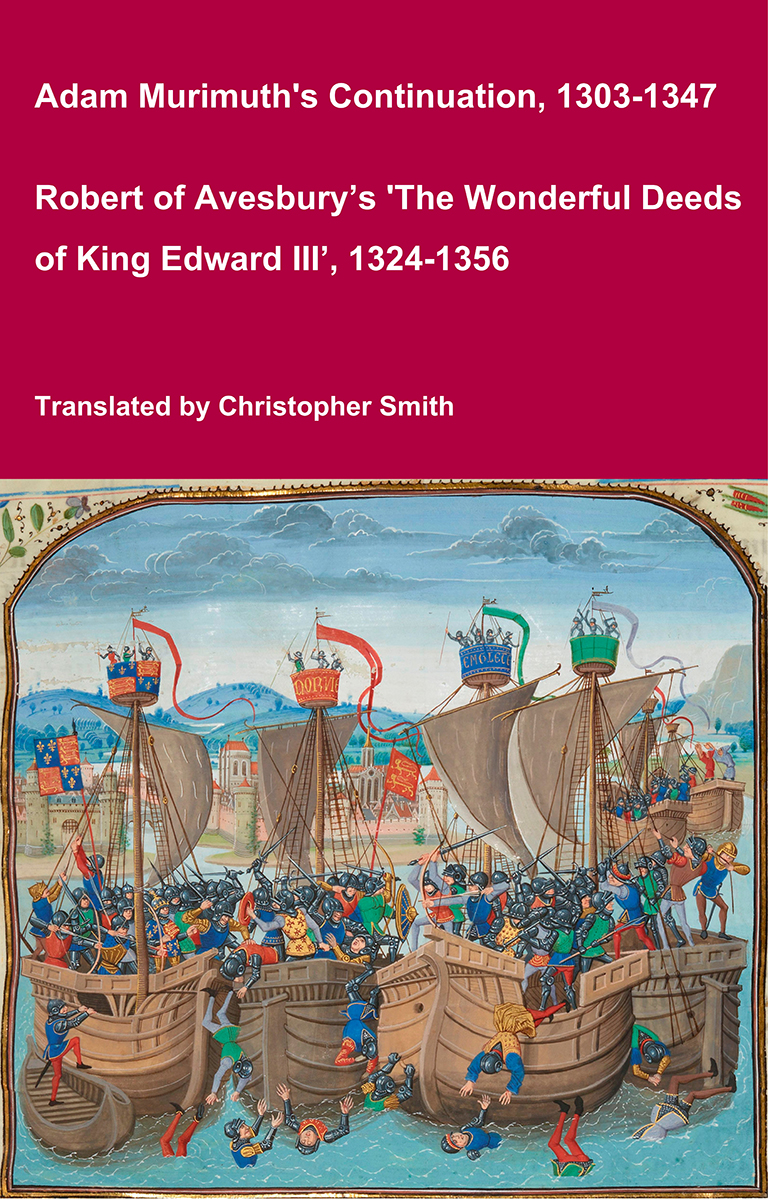
Adam Murimuth's Continuation and Robert of Avesbury’s 'The Wonderful Deeds of King Edward III'
This volume brings together two of the most important contemporary chronicles for the reign of Edward III and the opening phases of the Hundred Years’ War. Written in Latin by English clerical observers, these texts provide a vivid and authoritative window into the political, diplomatic, and military history of fourteenth-century England and its continental ambitions. Adam Murimuth Continuatio's Chronicarum continues an earlier chronicle into the mid-fourteenth century, offering concise but valuable notices on royal policy, foreign relations, and ecclesiastical affairs. Its annalistic structure makes it especially useful for establishing chronology and tracing the development of events year by year. Complementing it, Robert of Avesbury’s De gestis mirabilibus regis Edwardi tertii is a rich documentary chronicle preserving letters, treaties, and official records alongside narrative passages. It is an indispensable source for understanding Edward III’s claim to the French crown, the conduct of war, and the mechanisms of medieval diplomacy. Together, these works offer scholars, students, and enthusiasts a reliable and unembellished account of a transformative period in English and European history. Essential for anyone interested in medieval chronicles, the Hundred Years’ War, or the reign of Edward III.
Available at Amazon in eBook and Paperback format.
John Evelyn's Diary. 7th March 1684. Dr. Meggot, Deane of Winchester, preached an incomparable sermon, (the King [aged 53] being now gone to Newmarket,) on 12 Heb. 15. shewing and pathetically pressing the care we ought to have least we come short of the grace of God. Afterwards I went to visite Dr. Tenison [aged 47] at Kensington, whither he was retired to refresh after he had ben sick of the smallpox.
John Evelyn's Diary. 30th March 1699. The Duke of Devon [aged 59] lost £1,900 at a horse race at Newmarket, Suffolk.


Adeline Horsey Recollections. I made my first acquaintance with Newmarket, Suffolk when I was ten years old. I went there with my dear mother, and we stayed at the Rutland Arms Hotel, and I remember being very much interested at seeing handsome old Sir Henry Mildmay [aged 46] lifted on his horse to ride to the course. People always rode or drove there, and there was only one stand, which was reserved for members of the Jockey Club and their friends.
Adeline Horsey Recollections. My uncle, Admiral Rous, was a great personage at Newmarket, Suffolk, and I cannot describe him better than by quoting what has been written by a well-known sporting judge.
"There was the old Admiral himself, the King of Sportsmen and good fellows. Horse or man-o'-war, it was all one to him; and although sport may not be regarded as of the same importance with politics, who knows which has the more beneficial effect on man-kind .'* I would have backed Admiral Rous to save us from war, and if we drifted into it, to save us from the enemy against any men in the world".
Mrs. Rous was very dictatorial, and I remember one day after her death calling to inquire how my uncle was. "Indeed, my Lady", said the servant, "I may say the Admiral is a deal better since Mrs. Rous's death". I believe the same answer was given to all callers, and how angry my aunt would have been could she have heard it!
After I became a widow I often stayed with my uncle, and later on I bought the house associated with so many pleasant memories of the dear Admiral.
Adeline Horsey Recollections. Caroline, Duchess of Montrose, was a very well-known figure at Newmarket, Suffolk, but she was highly unpopular, and was once mobbed on the course for having Mr. Crawfurd's horse pulled as there was not enough money on it! She was very much in love with Mr. Crawfurd, whom she afterwards married.
Crawfurd owned a horse called "Corrie Roy", and as the Duchess was nicknamed "Carrie Red", these names were the subject of some amusing doggerel written by Lord Winchilsea ... "Corrie Roy and Carry Red, One for the course, the other for bed, Is not Craw a lucky boy, To have Carry Red and Corrie Roy? ".
Adeline Horsey Recollections. After my marriage Lord Cardigan and I always went to the different meetings, and generally met all our friends; among others, Lord and Baroness Westmorland, Lord and Baroness Hastings, the Duchess of Beaufort, Willie Craven, George Bruce, and Prince Batthyany. Newmarket was quite a charming rendezvous of society then, so different from the mixed crowd that goes there nowadays, and it could be easily re-christened "Jewmarket", for the Chosen are everywhere.


Adeline Horsey Recollections. Poor Henry Blackwood, the highwayman of Cassiobury, met his death when he was riding to the course with Lord Cardigan and myself. A rope had been stretched across the road for some reason or other, and Henry Blackwood, who never saw it, rode right into it and was pitched off his horse. He was picked up insensible and carried back to Newmarket, Suffolk. He lingered in an unconscious state for three days and then died. It was a curious coincidence that Lord Cardigan was to die in almost exactly the same way through a fall from his horse, and that he also was to lie in a stupor for three days.
Lady Amelia Blackwood was with her husband until he died, but another lady whom he had dearly loved would not be denied admittance to the death-chamber. Lady Amelia did not object, so the dying man's mistress and his wife waited for the end together - truly a strange situation!
John Evelyn's Diary. 22nd July 1670. We rode out to see the great mere, or level, of recovered fen land, not far off. In the way, we met Lord Arlington [aged 52] going to his house in Suffolk, accompanied with Count Ogniati, the Spanish minister, and Sir Bernard Gascoigne [aged 56]; he was very importunate with me to go with him to Euston, being but fifteen miles distant; but, in regard of my company, I could not. So, passing through Newmarket, Suffolk, we alighted to see his Majesty's [aged 40] house there, now new-building; the arches of the cellars beneath are well turned by Mr. Samuel, the architect, the rest mean enough, and hardly fit for a hunting house. Many of the rooms above had the chimneys in the angles and corners, a mode now introduced by his Majesty, which I do at no hand approve of. I predict it will spoil many noble houses and rooms, if followed. It does only well in very small and trifling rooms, but takes from the state of greater. Besides, this house is placed in a dirty street, without any court or avenue, like a common one, whereas it might and ought to have been built at either end of the town, upon the very carpet where the sports are celebrated; but, it being the purchase of an old wretched house of my Lord Thomond's, his Majesty was persuaded to set it on that foundation, the most improper imaginable for a house of sport and pleasure.
Adeline Horsey Recollections. I made my first acquaintance with Newmarket, Suffolk when I was ten years old. I went there with my dear mother, and we stayed at the Rutland Arms Hotel, and I remember being very much interested at seeing handsome old Sir Henry Mildmay [aged 46] lifted on his horse to ride to the course. People always rode or drove there, and there was only one stand, which was reserved for members of the Jockey Club and their friends.
On 25th September 1916 George Capell 7th Earl of Essex [aged 58] died at his home Stanley House having been run over by a taxi. His son Algernon [aged 32] succeeded 8th Earl Essex, 9th Baron Capell Hadham.

