

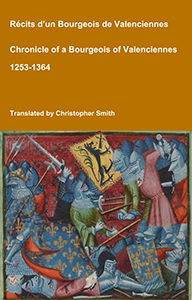
Chronicle of a Bourgeois of Valenciennes
Récits d’un bourgeois de Valenciennes aka The Chronicle of a Bourgeois of Valenciennes is a vivid 14th-century vernacular chronicle written by an anonymous urban chronicler from Valenciennes in the County of Hainaut. It survives in a manuscript that describes local and regional history from about 1253 to 1366, blending chronology, narrative episodes, and eyewitness-style accounts of political, military, and social events in medieval France, Flanders, and the Low Countries. The work begins with a chronological framework of events affecting Valenciennes and its region under rulers such as King Philip VI of France and the shifting allegiances of local nobility. It includes accounts of conflicts, sieges, diplomatic manoeuvres, and the impact of broader struggles like the Hundred Years’ War on urban life in Hainaut. Written from the perspective of a burgher (bourgeois) rather than a monastery or royal court, the chronicle offers a rare lay viewpoint on high politics and warfare, reflecting how merchants, townspeople, and civic institutions experienced the turbulence of the 13th and 14th centuries. Its narrative style combines straightforward reporting of events with moral and civic observations, making it a valuable source for readers interested in medieval urban society, regional politics, and the lived experience of war and governance in pre-modern Europe.
Available at Amazon in eBook and Paperback format.
Northallerton is in North Yorkshire.
In 1514 Bishop Edmund Gheast was born in Northallerton.
In 1577 Bishop Edmund Gheast [aged 63] died in Northallerton.
On 11th June 1762 Frances Lascelles was born to Edward Lascelles 1st Earl Harewood [aged 22] and Anne Chaloner Baroness Harewood [aged 19] at Northallerton. She married 4th October 1784 John Douglas, son of James Douglas 14th Earl Morton and Bridget Heathcote Countess Morton, and had issue.
On 4th October 1784 John Douglas [aged 28] and Frances Lascelles [aged 22] were married at Northallerton. She the daughter of Edward Lascelles 1st Earl Harewood [aged 44] and Anne Chaloner Baroness Harewood [aged 42]. He the son of James Douglas 14th Earl Morton and Bridget Heathcote Countess Morton.
The manor of Northallerton [Map] was granted by William II to Carileph, Bishop of Durham between 1087 and 1100. The palace was certainly in use by 1199 when the Archbishop of Canterbury stayed there as a guest of the Bishop of Durham. In common with aristocratic and high status buildings elsewhere there would have been a programme of enlargement, refurbishment and refortification often reflecting the latest architectural fashion: such renovation work happened in 1226, 1292 and 1309.

Collectanea by John Leland [1502-1552]. The XVIIIth Day of the Monneth [18th July 1503] the said Quene [aged 13] departed fro the said Newbrough, to Allerton; and at the Intrynge of the said Place, sche was receyved by the Vicayr and Folks of the Church [White Friars Priory, Northallerton [Map]] with the Freres Carmelits in Processyon, and the Byschop Morray did as before. From that Place she was conveyd, as Custome was, to the Manayr of the said Bisschop of Durham [Map].
On 22nd August 1138 an English army commanded by William of Blois 1st Earl Albemarle 1st Earl York [aged 37], William "The Younger" Peverell [aged 58] and Robert III Stuteville defeated a Scottish army led by King David I of Scotland [aged 54] and his son Henry Dunkeld 3rd Earl Huntingdon 1st Earl of Northumbria [aged 24]. The battle was fought at Cowton Moor, Northallerton. The name "Battle of the Standard" refers to the standard i.e. mast, pole, mounted on a cart on which the banners of the Bishops of Durham, York, Beverly and Ripon which were flown.
Robert III Stuteville: he was born to Robert Stuteville at Estouteville. Before 1186 Robert III Stuteville and Helewise de Murdac were married. In 1186 Robert III Stuteville died. Before 1186 Robert III Stuteville and Sibilla Valognes were married.


The River Swale rises on the moors at the top of the Birkdale [Map] after which it flows broadly east past Marrick Priory, North Yorkshire [Map], Ellerton Priory, North Yorkshire [Map], Richmond Castle, North Yorkshire [Map], under Catterick Bridge, North Yorkshire [Map], past Great Langton, North Yorkshire [Map], Moreton-on Swale, North Yorkshire [Map], Gatenby, North Yorkshire [Map], Maunby, North Yorkshire [Map], Holme, North Yorkshire [Map], Baldersby St James, North Yorkshire [Map], past Topcliffe Castle, North Yorkshire [Map], under Thornton Bridge [Map] to its confluence with the River Ure near Myton-on-Swale [Map].
Harsley Castle is also in Castles in North Yorkshire.
Around 1395 Thomas Strangeways was born to Robert "Henry" Strangeways [aged 40] at Harsley Castle [Map]. He married before 1437 Katherine Neville Duchess Norfolk, daughter of Ralph Neville 1st Earl of Westmoreland and Joan Beaufort Countess of Westmoreland, and had issue.
Around 1410 James Strangeways was born to James Strangeways [aged 28] at Harsley Castle [Map].
After 21st March 1442 Thomas Strangeways [deceased] died at Harsley Castle [Map].
On 20th August 1480 James Strangeways [aged 70] died at Harsley Castle [Map].
Mount Grace Priory, North Yorkshire is also in Priories in England.
The History of William Marshal was commissioned by his son shortly after William’s death in 1219 to celebrate the Marshal’s remarkable life; it is an authentic, contemporary voice. The manuscript was discovered in 1861 by French historian Paul Meyer. Meyer published the manuscript in its original Anglo-French in 1891 in two books. This book is a line by line translation of the first of Meyer’s books; lines 1-10152. Book 1 of the History begins in 1139 and ends in 1194. It describes the events of the Anarchy, the role of William’s father John, John’s marriages, William’s childhood, his role as a hostage at the siege of Newbury, his injury and imprisonment in Poitou where he met Eleanor of Aquitaine and his life as a knight errant. It continues with the accusation against him of an improper relationship with Margaret, wife of Henry the Young King, his exile, and return, the death of Henry the Young King, the rebellion of Richard, the future King Richard I, war with France, the death of King Henry II, and the capture of King Richard, and the rebellion of John, the future King John. It ends with the release of King Richard and the death of John Marshal.
Available at Amazon in eBook and Paperback format.
Mount Grace Priory, North Yorkshire [Map] was founded in as a Carthusian Charterhouse in 1398 by Thomas Holland 1st Duke Surrey [aged 24]. It was the last monastery established in Yorkshire, and one of the few founded anywhere in Britain in the period between the Black Death and the Reformation.
On 7th January 1400 at Cirencester, Gloucestershire [Map] Ralph Lumley 1st Baron Lumley [aged 40] was beheaded by the townspeople following an unsuccessful attempt to seize the town. Baron Lumley forfeit.
Thomas Holland 1st Duke Surrey [aged 26] was beheaded. He had to forfeit the honours and estates he had gained after the arrests of Gloucester and Arundel: Duke Surrey extinct. He retained those he had received before: His brother Edmund [aged 16] succeeded 4th Earl Kent, 3rd Baron Holand, 8th Baron Wake of Liddell. He was buried, or re-buried, at his foundation Mount Grace Priory, North Yorkshire [Map].
John Montagu 3rd Earl Salisbury [aged 50] was captured, tried and beheaded. Earl Salisbury, Baron Montagu, Baron Montagu, Baron Monthermer forfeit.
Bernard Brocas [aged 46] was captured.
In 1539 Mount Grace Priory, North Yorkshire [Map] was dissolved. The last prior, John Wilson, handed the keys over to Henry VIII's representatives. The site then passed into private ownership. It was valued at £382 5s. 11½d. gross (£323 2s. 10½d. net) which included £104 6s. 8d. from spiritualities in Lincolnshire, £164 from lands outside Yorkshire and the rest from its home county of Yorkshire.
In August 1612 Francis Lascelles was born to William Lascelles [aged 38] at Stank Hall, Northallerton. He married before 6th November 1655 Frances St Quintin and had issue.
White Friars Priory, Northallerton is also in Priories in England.
White Friars Priory, Northallerton [Map], situated in the east part of the town, was founded in 1356 by the king, who, with the consent of the Prior and convent of Durham, on 8 November gave to Walter Kellaw, provincial prior, and the friars a croft called Tentour Croft, with an adjacent meadow, which John Yole, merchant, of Northallerton, had granted to him for this purpose.