

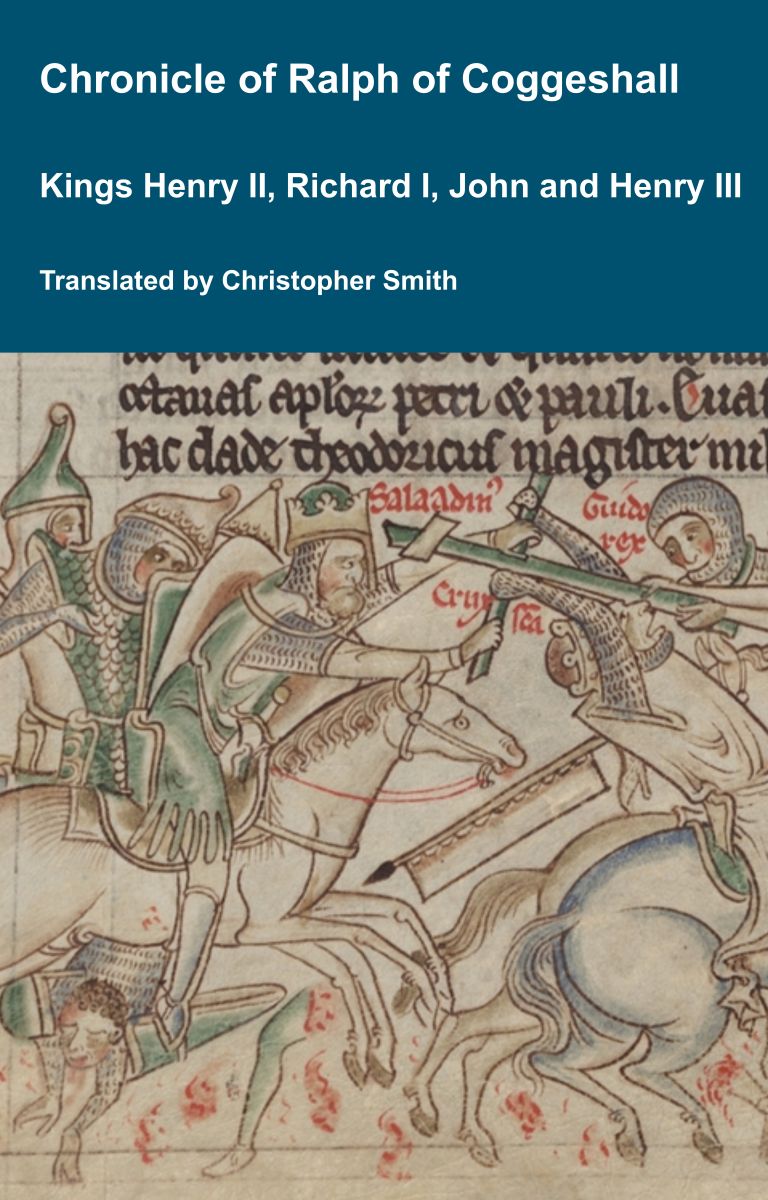
Chronicle of Abbot Ralph of Coggeshall
The Chronicle of Abbot Ralph of Coggeshall (Chronicon Anglicanum) is an indispensable medieval history that brings to life centuries of English and European affairs through the eyes of a learned Cistercian monk. Ralph of Coggeshall, abbot of the Abbey of Coggeshall in Essex in the early 13th century, continued and expanded his community’s chronicle, documenting events from the Norman Conquest of 1066 into the tumultuous reign of King Henry III. Blending eyewitness testimony, careful compilation, and the monastic commitment to record-keeping, this chronicle offers a rare narrative of political intrigue, royal power struggles, and social upheaval in England and beyond. Ralph’s work captures the reigns of pivotal figures such as Richard I and King John, providing invaluable insights into their characters, decisions, and the forces that shaped medieval rule. More than a simple annal, Chronicon Anglicanum conveys the texture of medieval life and governance, making it a rich source for scholars and readers fascinated by English history, monastic authorship, and the shaping of the medieval world.
Available at Amazon in eBook and Paperback format.
Crown is in England.
In 1739 Bishop Richard Terrick [aged 29] was appointed Chaplain to the Speaker of the House of Commons which position he held until 1742.
In 1874 Francis Edmund Cecil Byng 5th Earl Strafford [aged 38] was appointed Chaplain to the Speaker of the House of Commons.
In 1654 William Wray 1st Baronet [aged 29] was appointed Deputy Governor of Beaumaris Castle.
Adeline Horsey Recollections. After mamma's death I kept house for papa at 8 Upper Grosvenor Street. My brothers were rarely at home. William [aged 17] was educated at Eton [Map], and when he was sixteen years old the Duke of Wellington [aged 73] gave him a commission in the Grenadier Guards. Later he went through the Crimean War, and he retired from the Army in 1883, on account of ill-health, with the rank of Lieutenant-General.
Algernon [aged 16] entered the Navy in 1840 as a midshipman, and the same year took part in the operations on the coast of Syria. After the battle of Acre he received the Turkish medal and clasps: his promotion was rapid, and as Admiral, his flagship, the Shah, engaged the Huascar, which he forced to surrender to the Peruvian authorities.
Now that I was so much alone I occasionally found time hang heavy on my hands, and I welcomed any excitement as a break in the monotony, for of course our period of mourning prevented us entertaining or accepting invitations. One day my maid told me about a fortune-teller who had a wonderful gift for predicting the future. I was very much interested, and made up my mind to consult the oracle. My maid attempted to dissuade me, saying that the woman lived in Bridge Street, Westminster, which was not at all a nice neighbourhood. I have always had my own way and, disguised in a borrowed cloak, bonnet and thick veil, and accompanied by my protesting servant, I started off to Bridge Street late one November afternoon.
It was dusk when we reached Westminster and found Bridge Street, badly lighted and evil-smelling. We knocked at the door, stated whom we wished to see, and we were ushered through a dark passage into a dirty room reeking of tobacco.
The fortune-teller was a wrinkled old woman who was smoking a short clay pipe with evident enjoyment. When I told her what I had come for, she produced a greasy pack of cards, and after I had "crossed her pahn" she commenced to tell my future.
"Ah!" said she at last, and she looked curiously, "my pretty young lady, fate holds a great deal in store for you. You will not marry for several years, but when you do it will be to a widower - a man in a high position. You will suffer much unkindness before you experience real happiness, you will obtain much and lose much, you will marry again after your husband's death, and you will live to a great age".
I was quite impressed by my "fortune", but I was a little disappointed, for like most girls I had my day-dreams of a young husband, and the prospect of a widower was thus rather depressing.
Strangely enough, the prediction came true, for Lord Cardigan [aged 45] was a widower, and nearly all the men who proposed to me were widowers! I was asked in marriage by Lord Sherborne [aged 38], a widower with ten children; by the Duke of Leeds [aged 40], who was a widower with eleven children, and by Christopher Maunsell Talbot [aged 39], once Father of the House of Commons, also a widower with four children. Prince Soltykoff, the Duke of St. Albans [aged 41], Harry Howard, and Disraeli [aged 38] were other widowers who proposed to me, so I suppose I must have had some unaccountable fascination for bereaved husbands.


In 1644 Isaac Penington [aged 60] was appointed Governor of the Levant Company which position he held until 1654.
In 1469 Simon Montfort was appointed Lieutenant Carisbroke Castle.

In 1663 Colonel John Strode [aged 35] was appointed Lieutenant Dover Castle.
John Evelyn's Diary. 6th January 1665. To Dover, Kent [Map], where Colonel Stroode [aged 37], Lieutenant of the Castle, having received the letter I brought him from the Duke of Albemarle [aged 56], made me lodge in it, and I was splendidly treated, assisting me from place to place. Here I settled my first Deputy. The Mayor and officers of the Customs were very civil to me.


In 1644 William Compton [aged 19] was appointed Lieutenant-Governor of Banbury Castle.
Henrici Quinti, Angliæ Regis, Gesta, is a first-hand account of the Agincourt Campaign, and subsequent events to his death in 1422. The author of the first part was a Chaplain in King Henry's retinue who was present from King Henry's departure at Southampton in 1415, at the siege of Harfleur, the battle of Agincourt, and the celebrations on King Henry's return to London. The second part, by another writer, relates the events that took place including the negotiations at Troye, Henry's marriage and his death in 1422.
Available at Amazon in eBook and Paperback format.

John Evelyn's Diary. 24th May 1666. Dined with Lord Cornbury, now made Lord Chamberlain to the Queen; who kept a very honorable table.
After 1321 William Ros 2nd Baron Ros Helmsley [aged 36] was appointed Lord High Admiral.
In July 1462 William Neville 1st Earl Kent [aged 57] was appointed Lord High Admiral.
On 10th September 1488 Patrick Hepburn 1st Earl Bothwell [aged 36] was appointed Lord High Admiral.

On 4th May 1513 Thomas Howard 3rd Duke of Norfolk [aged 40] was appointed Lord High Admiral.
After 16th February 1547. The date uncertain but likely to be after the funeral of Henry VIII [deceased] King Edward VI of England and Ireland [aged 9] made a number of new appointments although given King Edward VI of England and Ireland was only nine years old at the time, the titles were, in effect, bestowed by Edward Seymour 1st Duke of Somerset [aged 47].
William Parr 1st Marquess Northampton [aged 35] was created 1st Marquess Northampton.
Thomas Seymour 1st Baron Seymour [aged 39] was created 1st Baron Seymour of Sudeley and appointed Lord High Admiral.
New Garter Knights:
318th Henry Grey 1st Duke of Suffolk [aged 30].
319th Edward Stanley 3rd Earl of Derby [aged 37].
320th Thomas Seymour 1st Baron Seymour.
321st William Paget 1st Baron Paget Beaudasert [aged 41].
John Carey [aged 56] and Henry Huberthorne were knighted by King Edward VI of England and Ireland.


On 20th March 1554 William Howard 1st Baron Howard [aged 44] was appointed Lord High Admiral.
In 1585 Charles Howard 1st Earl Nottingham [aged 49] was appointed Lord High Admiral.


Samuel Pepys' Diary. 16th May 1660. Soon as I was up I went down to be trimmed below in the great cabin, but then come in some with visits, among the rest one from Admiral Opdam1, who spoke Latin well, but not French nor English, to whom my Lord made me to give his answer and to entertain; he brought my Lord a tierce of wine and a barrel of butter, as a present from the Admiral. After that to finish my trimming, and while I was doing of it in comes Mr. North very sea-sick from shore, and to bed he goes. After that to dinner, where Commissioner Pett was come to take care to get all things ready for the King on board. My Lord in his best suit, this the first day, in expectation to wait upon the King. But Mr. Edw. Pickering [aged 42] coming from the King brought word that the King would not put my Lord to the trouble of coming to him; but that he would come to the shore to look upon the fleet to-day, which we expected, and had our guns ready to fire, and our scarlet waistcloathes out and silk pendants, but he did not come. My Lord and we at ninepins this afternoon upon the Quarterdeck, which was very pretty sport. This evening came Mr. John Pickering on board, like an ass, with his feathers and new suit that he had made at the Hague. My Lord very angry for his staying on shore, bidding me a little before to send to him, telling me that he was afraid that for his father's sake he might have some mischief done him, unless he used the General's name. To supper, and after supper to cards. I stood by and looked on till 11 at night and so to bed. This afternoon Mr. Edwd. Pickering told me in what a sad, poor condition for clothes and money the King was, and all his attendants, when he came to him first from my Lord, their clothes not being worth forty shillings the best of them2. And how overjoyed the King was when Sir J. Greenville brought him some money; so joyful, that he called the Princess Royal [aged 28] and Duke of York [aged 26] to look upon it as it lay in the portmanteau before it was taken out. My Lord told me, too, that the Duke of York is made High Admiral of England.
Note 1. The admiral celebrated in Lord Dorset's ballad,
To all you ladies now at land.
Should foggy Opdam chance to know
Our sad and dismal story;
The Dutch would scorn so weak a foe,
And quit their fort at Goree
For what resistance can they find
. From men who've left their hearts behind? B.
Note 2. Andrew Marvell alludes to the poor condition, for clothes and money, in which the King was at this time, in "A Historical Poem":-
At length, by wonderful impulse of fate,
The people call him back to help the State;
And what is more, they send him money, too,
And clothe him all from head to foot anew.


In 1473 George Talbot 4th Earl of Shrewsbury [aged 5] was appointed Lord High Steward of Ireland.
Diary of Edward VI. 2nd February 1550. Sir Anthony Wingfeld [aged 63], before visechamberlaine, made controller. Sir Thomas Darcy [aged 43] made visechamberlaine.3
Note 3. "On Candlemas day, [Feb. 2] William lord Saint John [aged 67] earl of Wiltshire, lord great master, president of the councell, was made Lord Treasurer; John Dudley [aged 46] earl of Warwich, lord great chamberlain, was made Lord Great Master; William Parre [aged 38], marques of Northampton, was made Lord Great Chamberlain; lord Wentworth was made Lord Cham


The True Chronicles of Jean le Bel Volume 1 Chapters 1-60 1307-1342
The True Chronicles of Jean le Bel offer one of the most vivid and immediate accounts of 14th-century Europe, written by a knight who lived through the events he describes, and experienced some of them first hand. Covering the early decades of the Hundred Years’ War, this remarkable chronicle follows the campaigns of Edward III of England, the politics of France and the Low Countries, and the shifting alliances that shaped medieval warfare. Unlike later historians, Jean le Bel writes with a strong sense of eyewitness authenticity, drawing on personal experience and the testimony of fellow soldiers. His narrative captures not only battles and sieges, but also the realities of military life, diplomacy, and the ideals of chivalry that governed noble society. A key source for Jean Froissart, Le Bel’s chronicle stands on its own as a compelling and insightful work, at once historical record and literary achievement. This translation builds on the 1905 edition published in French by Jules Viard, adding extensive translations from other sources Rymer's Fœdera, the Chronicles of Adam Murimuth, William Nangis, Walter of Guisborough, a Bourgeois of Valenciennes, Geoffrey le Baker of Swinbroke and Richard Lescot to enrich the original text and Viard's notes.
Available at Amazon in eBook and Paperback format.
On 17th June 1243 Nicholas Moels [aged 48] was appointed Seneschal of Gascony.
In 1255 Stephen Longespée [aged 39] was appointed Seneschal of Gascony.
In 1343 Nicholas de la Beche was appointed Seneschal of Gascony.
Richard Grey was appointed Seneschal of Gascony.