

Chronicle of Walter of Guisborough
A canon regular of the Augustinian Guisborough Priory, Yorkshire, formerly known as The Chronicle of Walter of Hemingburgh, describes the period from 1066 to 1346. Before 1274 the Chronicle is based on other works. Thereafter, the Chronicle is original, and a remarkable source for the events of the time. This book provides a translation of the Chronicle from that date. The Latin source for our translation is the 1849 work edited by Hans Claude Hamilton. Hamilton, in his preface, says: 'In the present work we behold perhaps one of the finest samples of our early chronicles, both as regards the value of the events recorded, and the correctness with which they are detailed; Nor will the pleasing style of composition be lightly passed over by those capable of seeing reflected from it the tokens of a vigorous and cultivated mind, and a favourable specimen of the learning and taste of the age in which it was framed.'
Available at Amazon in eBook and Paperback format.
1860-1899 Death of Prince Albert is in 19th Century Events.
On 14th December 1861 Prince Albert Saxe Coburg Gotha [aged 42] died at Windsor Castle [Map]. His wife, Queen Victoria of the United Kingdom [aged 42] never recovered from his death spending, more or less, the remainder of her life in mourning.
On 23rd December 1861 Prince Albert Saxe Coburg Gotha [deceased] was buried at St George's Chapel, Windsor Castle [Map].
The Times. 24th December 1861. Yesterday, with little of the pomp and pageantry of a State ceremonial, but with every outward mark of respect, and with all the solemnity which befitted his high station and his public virties, the mortal remains of the husband [deceased] of our Queen [aged 42] were interred in the last resting-place of England's Sovereigns-the Chapel Royal of St. George's, Windsor [Map]. By the express desire of his Royal Highness the funeral was of the plainest and most private character; but in the Chapel, to do honour to his obsequies, were assembled all the chiefest men of the State, and throughout England, by every sign of sorrow and imourning, the nation manifested its sense of the loss wlhich it has sustaiined. Windsor itself wore an aspect of the most profound gloom. Every shop was closed and every blind drawn down. The streets were silent and almost deserted, and all wvho appeared abroad were dressed in the deepest mourning. The great bell of Windsor Castle [Map] clanged out: its doleful sound at intervals from an early hour, and minute bells were tolled also at St. John's Church. At the parish church of Cleover and at St. John's there were services in the morning and: aternoon, and the day was observed throughout the Royal borough in the strictest manner. The weather was in character with the occasion, a chill, damp air, with a dull leaden sky above, increased the gloom which hung over all. There were but few visitors in the town, for the procession did not pass beyond the immediate precincts of the Chapel and Castle, and none were admitted except those connected with the Castle andi their friends. At 11 o'clock a strong force of the A division took possession of the avenues leading to the Chapel Royal, and from that time only the guests specially invited and those who were to take part in the ceremonial were allowed to pass. Shortly afterwards a of honour of the Grenadier Guards, of which regiment his Royal Highness was Colonel, with the colonrs of the regiment shrouded in crape, marched in and took up its position before the principal entrance to the Chapel Royal. Another guard of honour from the same regiment was also on duty in the Quadrangle at the entrance to the State apartments. They were speedily followed by a squadron of the 2nd Life Guards dismounted, and by two companies of the Fusileer Guards, who were drawn uip in single file along each side of the road by which the procession was to pass, from the Norman gateway to the Chapel door. The officers wore the deepest military mourning-scarves, sword-knots, and rosettes of crape. In the Rome Park was stationed a troop of Horse Artillery, which commenced firing minute guns at the end of the Long Walk, advancing slowly until it reached the Castle gates just at the close of the ceremony. The Ministers, the officers of the Queen's Household, and other distinguished personages who had been honoured with an invitation to attend the ceremonial, reached Windsor a special train from Paddington. They were met by carriages provided for them at the station, and began to arrive at the Chapel Royal soon after 11 o'clock. The Earl of Derby [aged 62], the Archbishop of Canterbury [aged 81], Earl Russell [aged 69], and the Duke of Buccleuch were among the first to make their appearance, and as they alighted at the door of the Chapel they were received by the proper officials and conducted to the seats appointed for them in the Choir. In the Great Quadrangle were drawn up the hearse and the mourning coaches, and, all the preparations having been completed within the Castle, the procession began to be formed shortly before 12 o'clock. It had been originally intended that it should leave the Castle by the St. George's gate, and, proceeding down Castle-hill, approach the Chapel through Henry VII.'s gateway, but at a late hour this arrangement was changed, and the shorter route by the Norman gatewvay was chosen.
The crowd which had gradually collected at the foot of Castle-hill, owing to this change, saw nothing of the procession but the empty carriages as they returned to the Castle after setting down at the Chapel. The few spectators who were fortunate enough to gain admission to the Lower Ward stood in a narrow fringe along the edge of the flags in front of the houses of the Poor Knights, and their presence was the only exception to the strict privacy of the ceremonial. The Prince of Wales [aged 20] and the other Royal mourners assembled in the Oak Room, but did not form part of the procession. They were conveyed to the Chapel in private carriages before the coffin was placed in the hearse, passing through St. George's gatewayinto the Lower Ward. In the first carriage were the Prince of Wales, Prince Arthur [aged 11], and the Duke of Saxe Coburg [aged 8]. The Crown Prince of Prussia [aged 30], the Duke of Brabant [aged 26], and the Count of Flanders [aged 24] followed in the next; and in the others were the Duke de Nemours [aged 47], Prince Louis of Hesse [aged 24], Prince Edward of Saxe-Weimar [aged 38], and the Maharajah Dhuleep Singh, with the gentlemen of their respective suites. Scarcely had they alighted at the door of Wolsey's Chapel, from which they were conducted through the Chapter Room to the door of the Chapel Royal to be in readiness to meet the coffin, when the first minute gun fired in tlhe distance, and the rattle of the troops reversing arms announced that the procession had started, and exactly at 12 o'clock the first mourning coach moved from under the Norman gateway. First came nine mourning coaches, each drawn by four horses, conveying the Physicians, Equerries, and other members of the household of the late Prince. In the last were the Lord Steward [aged 63] (Earl St. Germans), the Lord Chamberlain [aged 56] (Viscount Sidney), and the Master of the Horse [aged 57] (the Marquis of Ailesbury). The carriages and trappings were of the plainest description; the horses had black velvet housings and feathers, but on the carriages there, were no feathers or ornaments of any kind. The mourning coaches were followed by one of the Queen's carriages, drawn by six horses, and attended by servants in State liveries, in which was the Groom of the Stole [aged 26], Earl Spencer, carrying the crown, and a Lord of the Bedchamber, Lord George Lennox, carrying the baton, sword, and hat of his late Royal Highness. Next escorted by a troop of the 2nd Life Guards, came the hearse, drawn by six black horses, which, like the carriages, was quite plain and unornamented. On the housings of the horses and on the sides of the hearse were emblazoned the scutcheons of Her Majesty and of the Prince, each surmounted by a, crown, the Prince's arms being in black and Her Majesty's in white. The procession was closed by four State carriages.
 Become a Member via our Buy Me a Coffee page to read more.
In 1862 Queen Victoria of the United Kingdom [aged 42] appointed seven Knights of the Garter:
729th Charles Canning 1st Earl Canning [aged 49]. He died a month later.
730th Edward Adolphus Seymour 12th Duke of Somerset [aged 57].
731st. John Russell 1st Earl Russell [aged 69].
732nd Anthony Ashley-Cooper 7th Earl Shaftesbury [aged 60].
733rd William Thomas Wentworth-Fitzwilliam 6th and 4th Earl Fitzwilliam [aged 46].
734th Prince Louis Hesse Darmstadt IV Grand Duke [aged 24].
735th Grand Duke Frederick William of Mecklenburg-Strelitz [aged 42].


Become a Member via our Buy Me a Coffee page to read more.
On 10th January 1862 was a battle of the American Civil War fought in Eastern Kentucky at which the Union defeated the Confederates.
On 16th January 1862 the Hartley Colliery Disaster resulted in the death of 204 men and boys. The beam of the pit's pumping engine broke and fell down the shaft around 10:30 in the morning when a change of shift was taking plac so most men of both shifts were at the coal face. The beam came to rest jammed in the shaft and other falling debris created a blockage 27 metres deep trapping the men below. Five men were killed by the fall, the rest by asphyxiation.
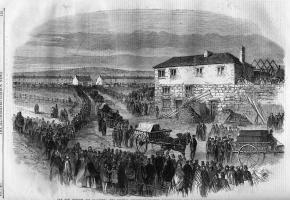
The Illustrated London News 1862. Saturday, January, 1862.
DREADFUL COLLIERY ACCIDENT. Loss of Two Hundred and twenty lives. The New Hartley Mining Disaster.
On 16 January 1862, tragedy struck the Northumberland village of New Hartley when the pumping engine beam of the Hartley Colliery snapped, blocking the only shaft and trapping over two hundred miners underground ...
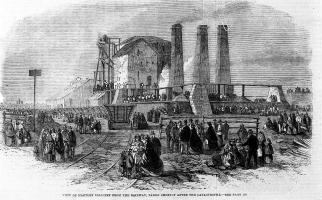
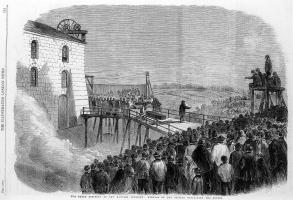
One of the worst colliery accidents which has occurred in this country took place on the morning of Thursday week (Jan 16th) at New Hartley Colliery, near Newcastle-on-Tyne, resulting in the immediate death of five poor fellows and the suffocation of 215 others. Hartley new pit is situated close to the Hartley junction of the Blyth and Tyne Railway, on the western side of the line. This colliery, like the majority of the mines in the northern coal district, has only one shaft, which is made to serve the double purpose of upcast and downcast work. For this purpose a wooden partition or "brattice" divided the shaft from top to bottom, and ventilation was by this means secured. The shaft itself was lined with wood, and part of the wall through which the shaft descended was built up with masonry to make it more secure. The colliery had been subject to inundations, and additional precautions were used to keep down the water. An immense pumping apparatus was erected close to the mouth of the colliery - the beam of the pump amost, indeed, projected over the shaft, and was of enormous strength. It weighed above forty tons, was 8ft broad in the centre and 5in. thick in the thinnest part, and, as such a beam should be, it was of the best material. I t was the breaking of this beam which caused the accident. It snapped in the middle, and, pitching direct down the shaft, smashed the brattice in its ponderous fall, pulling down after it the wooden lining of the shaft, bringing away masses of masonry, and, as it is supposed, stopping midway in its flight, and acting as a platform on which to pile an immense heap of broken timber, stone and rubbish.
Become a Member via our Buy Me a Coffee page to read more.
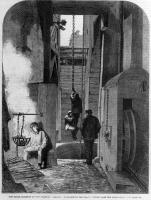
The Illustrated London News 1862. 1st February 1862. In this issue, extensive illustration and commentary on the "Hartley-Pit Tragedy" (New Hartley in Northumberland), detailing that fatal mining accident.
Picture below. The Fatal accident at New Hartley Colliery: Entrance to the shaft, viewed from the horse-hole
On 19th January 1862 the Battle of Mill Springs aka the Battle of Fishing Creek, the Battle of Logan's Cross Roads, the Battle of Somerset, was a victory for the Union fought near current Nancy, Kentucky during the American Civil War. Casualties were relatively light. Union losses were 39 killed and 207 wounded, Confederate 125 killed and 404 wounded or missing.
Henrici Quinti, Angliæ Regis, Gesta, is a first-hand account of the Agincourt Campaign, and subsequent events to his death in 1422. The author of the first part was a Chaplain in King Henry's retinue who was present from King Henry's departure at Southampton in 1415, at the siege of Harfleur, the battle of Agincourt, and the celebrations on King Henry's return to London. The second part, by another writer, relates the events that took place including the negotiations at Troye, Henry's marriage and his death in 1422.
Available at Amazon in eBook and Paperback format.
On 10th March 1863 King Edward VII of the United Kingdom [aged 21] and Alexandra of Denmark Queen Consort England [aged 18] were married at St George's Chapel, Windsor Castle [Map]. She the daughter of King Christian IX of Denmark [aged 44] and Queen Louise Hesse-Kassel of Denmark [aged 45]. He the son of Prince Albert Saxe Coburg Gotha and Queen Victoria of the United Kingdom [aged 43]. They were third cousin once removed. She a great x 3 granddaughter of King George II of Great Britain and Ireland.


10th March 1863. William Powell Frith [aged 44]. Marriage of the future King Edward VII and Alexandra. The artist has depicted the moment when the Prince [aged 21] is about to place the ring on the Princess' [aged 18] finger. The two little boys dressed in tartan are Prince Leopold [aged 9] and Prince Arthur [aged 12], Queen Victoria's youngest sons. At the top right of the painting the Queen [aged 43] herself looks down on the ceremony.
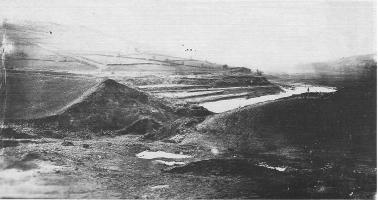
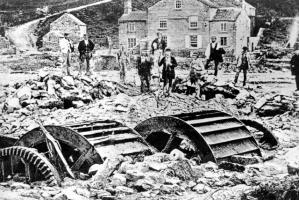
On 11th March 1864, at nearly midnight the Dale Dyke Dam broke as its reservoir was being filled for the first time. At least 240 people died and more than 600 houses were damaged or destroyed by the flood. An estimated 3 million cubic metres of water swept down the Loxley Valley, through Loxley Village and on to Malin Bridge and Hillsborough, where the River Loxley joins the River Don. The flood continued south down the Don into Sheffield centre, around the eastward bend of the Don at Lady's Bridge, then to Attercliffe. The centre of the town, situated on the hill to the south, escaped damage, but the densely populated district of the Wicker, around the new railway viaduct was completely destroyed.
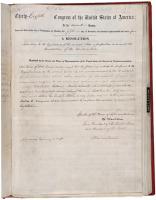
On 31st January 1865 the 13th Amendment by which Slavery was abolished was passed by the House of Representatives; he vote in the House was 121 to 24.
AMENDMENT XIII
Section 1.
Neither slavery nor involuntary servitude, except as a punishment for crime whereof the party shall have been duly convicted, shall exist within the United States, or any place subject to their jurisdiction.
Section 2.
Congress shall have power to enforce this article by appropriate legislation.
Become a Member via our Buy Me a Coffee page to read more.
Between 12th December 1866 and 17th December 1866 a series of explosions caused by firedamp ripped through the underground workings at the Oaks Colliery at Hoyle Mill near Stairfoot in Barnsley killing 361 miners and rescuers; the worst mining disaster in England.
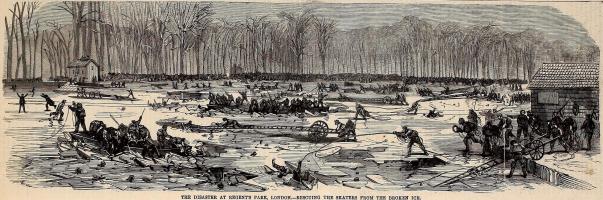
On 15th January 1867 sixty people died when the ice broke on the lake in London's Regent's Park on which around five hundred people were skating. As a consequence the lake bed which had been as deep as 3.7m, was raised to be a maximum of 1.2, Images from Harper's Weekly.
The Illustrated London News 1867. APPALLING ACCIDENT IN REGENT'S PARK.
On Tuesday afternoon [15th January 1867] an accident involving a serious loss of life occurred through the breaking of the ice on the ornamental water in Regent's Park. The scene of the terrible event was that portion of the lake extending along the side of the pleasure-ground in front of Sussex-place, and is about 300 yards in length by 130 in breadth. At the east and west ends are small islands, and on the north side there is a third small island midway between the other two, and opposite the end of the low park which bounds that side of the water.
On this part of the lake, which is the broadest, several thousand persons had been skating during the forenoon without any accident taking place, although the ice was looked upon by the experienced icemen on duty as very unsafe, from its being principally snow ice. About half-past three o'clock in the afternoon there were near the same spot about 500 skaters, among whom were many ladies, there being at the same time on the banks from 2000 to 3000 spectators. The excitement and fun were at their highest. Select circles were surrounding the more skilled skaters, men of all ages and classes were darting across in each direction, the park was resounding with sounds of merriment and life, when, without warning, the scene was terribly changed. The entire expanse of ice, covering nearly an acre of water, gave way according to some, exploded according to others, and was agitated as if by an earthquake according to others. The fatal cracks are described as shooting with sharp reports in every conceivable direction, and with such rapidity that it seemed as if the giving way was simultaneous in each direction. Within a minute the whole sheet of the ice over the full width of the lake gave way, and split up into fragments of a few yards square. A general rush was made for the banks, Unfortunately, this broke up the soft ice into still smaller pieces. Numbers of persons fell through the crevices into the water, which is, at this part 12ft. deep. About 200 persons were struggling in the water, and screaming for help. A few, with great presence of mind, threw themselves flat upon the surface of the pieces of ice and were thus instrumental in saving the lives of many of those in the water, as well as preserving their own until assistance came to them.
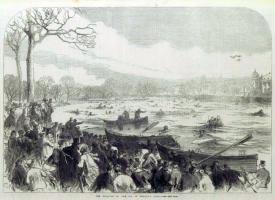
The Illustrated London News 1867. [26th January 1867] THE DISASTER ON THE ICE IN REGENT'S PARK. In our last publication we gave an account of the dreadful accident in Regent's Park on Tuesday week, when the ice of the lake or ornamental water, on which several hundred persons were skating or sliding, broke down so suddenly and unexpectedly that a great number of them were plunged into the water, by which more than forty were unhappily drowned. From a sketch made very soon afterwards by an eye-witness of the accident, we have prepared the Illustration engraved on the preceding page. The point of view is the bank opposite Sus-ex-terrace, looking across the broad part of the lake, with the largest island and the lawn belonging to a private honse called "The Holme" extending to the left-hand side. The scene was most distressing for many minutes after the breaking of the ice: a multitude of people, amongst whom were several women and children, were struggling in the water, and trying to save themselves by holding the pieces of ice, and most of them screaming in despair. Of those on shore, a few were able to give prompt assistance to the nearest sufferers and help them to scramble to land; but many were struck with horror and could do nothing but utter cries of lamentation. The icemen of the Royal Humane Society and the park-keepers, aided by some of the spectators, lost not a moment in bringing all their ropes, poles, ladders, and boats to the place, and endeavouring to rescre those who still remained above water, as is shown in our Engraving. Several remarkable incidents in the escape of those more fortunate persons were related last week. The total number of those who sank to rise no more proves considerably greater than was at first supposed, forty dead bodies having been recovered up to Saturday evening, when the adjourned inquest was resumed by Dr. Lankester, the Coroner, at the Marylebone Workhouse.
Become a Member via our Buy Me a Coffee page to read more.
On 20th August 1868 the Irish Mail train collided with goods wagons. The force of the collision derailed the engine, its tender and the leading guard's van. Two runaway wagons next to the brake van, which carried 50 wooden barrels, holding about 1,700 gallons of paraffin oil caught fire. The engine, tender, guard's van and the first three-passenger carriages were instantly enveloped in dense smoke and flames, which soon spread to the fourth carriage and the front of the leading post office van. This prevented any immediate attempt to rescue the occupants of the first four carriages, who all died.
Henry Maxwell 7th Baron Farnham [aged 69] and his wife Anna Frances Esther Stapleton [aged 63] were killed.
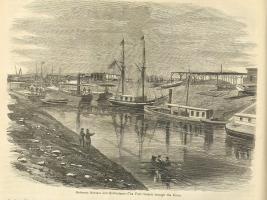
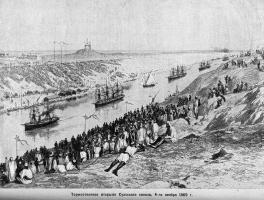
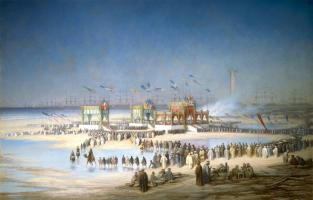
On 17th November 1869 the Suez Canal was officially opened. In the morning a procession of ships entered the canal, headed by the L'Aigle. Among the ships following was HMS Newport, captained by George Nares
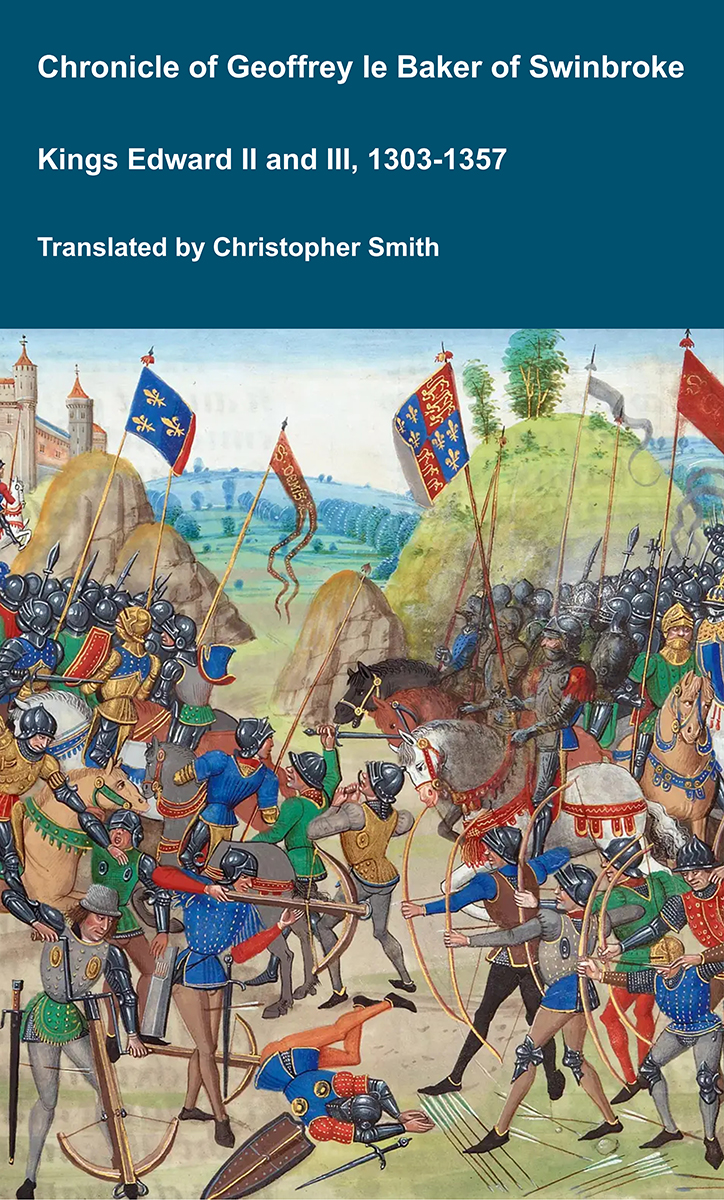
Chronicle of Geoffrey le Baker of Swinbroke
Baker was a secular clerk from Swinbroke, now Swinbrook, an Oxfordshire village two miles east of Burford. His Chronicle describes the events of the period 1303-1356: Gaveston, Bannockburn, Boroughbridge, the murder of King Edward II, the Scottish Wars, Sluys, Crécy, the Black Death, Winchelsea and Poitiers. To quote Herbert Bruce 'it possesses a vigorous and characteristic style, and its value for particular events between 1303 and 1356 has been recognised by its editor and by subsequent writers'. The book provides remarkable detail about the events it describes. Baker's text has been augmented with hundreds of notes, including extracts from other contemporary chronicles, such as the Annales Londonienses, Annales Paulini, Murimuth, Lanercost, Avesbury, Guisborough and Froissart to enrich the reader's understanding. The translation takes as its source the 'Chronicon Galfridi le Baker de Swynebroke' published in 1889, edited by Edward Maunde Thompson.
Available at Amazon in eBook and Paperback format.
On 22nd December 1870 a total Eclipse of the Sun occurred. The path of totality was visible from parts of modern-day southern Portugal, southern Spain, northern Morocco, northern Algeria, Tunisia, Italy, Greece, northwestern Turkey, southeastern Bulgaria, southeastern Ukraine, and western Russia

In 1870, William Kingdon Clifford [aged 25] was part of an expedition to Italy to observe the solar eclipse of 22 December 1870. During that voyage he survived a shipwreck along the Sicilian coast.

On 29th March 1871 the Albert Hall was opened by Queen Victoria. A welcoming speech was given by Edward, the Prince of Wales because the Queen was too overcome to speak: "It is my high privilege and gratification to report to your Majesty the successful completion of this Hall, an important feature of a long-cherished design of my beloved father, for the general culture of your people, in whose improvement he was always deeply interested. Encouraged by your Majesty's sympathies, and liberally supported by your subjects, we have been enabled to carry out the work without any aid from funds delivered from public taxation... Your Majesty’s Commissioners for the Exhibition of 1851 in further prosecution of my father’s design for the encouragement of the Arts and Sciences, an object which he always had warmly at heart, are about to commence a series of annual international exhibitions, to the success of which this Hall will greatly contribute by the facilities which it will afford for the display of objects and for the meeting of bodies interested in the industries which will form the subjects of successive Exhibitions. The interest shown in the Hall by the most eminent musicians and composers of Europe strengthens our belief that it will largely conduct to the revival among all classes of the nation of a taste for the cultivation of music. It is my grateful duty to return to your Majesty our humble thanks for the additional mark of your Royal favour which is conferred upon us by your auspicious presence on the present occasion when our labours as a provisional committee are drawing to a close. We venture to home that when we shall have resigned our functions into the hands of the governing body … your Majesty will continue to the corporation that measure of support which has been always graciously given to us."
On 1st April 1873 the White Star Link ocean liner SS Atlantic with 952 people on board sank of the coast of Nova Scotia whilst on a journey from Liverpool, United Kingdom, and New York City, United States. As a consequence of bad weather, and concerned about coal reserves, the captain decided to head for Halifax, Nova Scotia. The ship became off course by at least twelve miles, and struck rocks. At least five hundred and thirty five died. All women and children perished except for one twelve-year-old boy, John Hindley.
On 3rd August 1873 a northbound "Tourist Special" excursion train, drawn by two locomotives consisted of twenty-five vehicles by the time it left Crewe, derailed at Wigan, colliding with station buildings, killing thirteen passengers. The train was declared to have been travelling at excessive speed. In the sixteenth coach, the one which derailed, was travelling Florence Sutherland Leveson-Gower [aged 18] with her companion Miss Braggs.
On 23rd January 1874 Prince Alfred Windsor [aged 29] and Maria Holstein Gottorp Romanov [aged 20] were married. He the son of Prince Albert Saxe Coburg Gotha and Queen Victoria of the United Kingdom [aged 54]. They were third cousin once removed.


On 23rd January 1874 Unknown Painter. The Wedding of Prince Alfred Windsor [aged 29] and Maria Holstein Gottorp Romanov [aged 20].
The Times. 2nd February 1874. THE MARRIAGE FESTIVITIES IN RUSSIA. ST. PETERSBURIG. Jan 31 Yesterday the Duke [aged 29] and Duchess of Edinburgh [aged 20], the Prince [aged 32] and Princess of Wales [aged 29], and Prince Arthur [aged 23] were present with all the Imperial family at the ball given by the Cesarewvitch. The Prince of Wales wore the uniform of the Norfolk Militia and Prince Arthur that of the Rifle Brigade. This evening a grand dinner, to which 400 guests are invited, will be given by the British Ambassador to the Crown Prince and Princess of Germany and Prince Arthur. Later on in the evening all the English Princes will go to the ball given at the Hall of the Nobles at 9:30.


30th April 1875. The colliery was the property of Messrs. William Rigby and Company with Mr. George Sumner as the manager. An explosion took place at the colliery which claimed the lives of forty men and boys. The colliery was close to the Talk o' th' Hill and Bignall Hall Collieries at which there had been previous disasters. Every precaution was taken for the safety of the men and on the morning of the disaster one hundred went to work in the pit including thirty five into the Eight Feet Banbury seam to work about 800 yards from the shaft.
Those who died: J. Ashmore, C. Baddeley, T. Beech, D. Boston, W. Boughey, J. Boyd, E. Breeze, J. Buckley, G. Burton, J. Carter, J. Chadwick, D. Charlesworth, I. Cooper, R. Dale H.Dean, T. Dean, D. Fox, E. Hancock, J. Hancock, W. Hancock, J. Higgins, G. Holland, J. Holland, T. Holland, R. Jackson, T. Lawton, J. Lucas, J. Marshall, T. Mason, W. Maxwell, H. Moore, W. Moore, S. Morris, J. Nield, T. Peats, W. Proudlove, J. Rogers, J. Stevenson, J. Stubbs, N. Sumner, T. Thompson, J. Yearsley One unnamed.
The inquest into the disaster was opened at the Swan Inn, Talk o' th' Hill, by Mr. J. Booth, Coroner. Mr. Wynne, the Inspector made a thorough inspection of the workings and Mr. S.B. Gilroy, Assistant Inspector, thought the mine was well managed but Mr. Wynne commented
For more than twenty years I have been pointing out what a "farce" it is to prohibit the use of naked lights in mines and yet allow powder to be used and have indulged in the hope that self-preservation would prevail over the more idle method of getting coal by blasting but I am now satisfied that the only safe course to take, is to prohibit all explosives in coal mines, and in a few years the coal owners would wonder how they could have allowed their coals to be blow to atoms and the roofs shaken as they have been for many years and the colliers would find that, having got rid of the impure fumes of the powder and dangers of explosions, together with the comparative safety from falls of roof, they were amply repaid for an extra hour of labour the wedging process would entail. Nothing could more clearly show the advantage of wedging over those of powder than to state of the two downbrows of 600 yards each, which effectually withstood the enormous strain which must have been put on them by the force of the air that must have been driven from the seat of the explosion, to the top of the upcast shaft, not so much as a hundredweight of coal was blown down in them or in the dips the slightest degree injured, or indeed was that proportion of the levels which was driven without blasting.
The only reason assigned for the change from wedging to blasting was, that Mr. Rigby could not compete with his neighbours if he wedged the coal and they blasted theirs so that to meet competition he was obliged to increase production and lessen cost.
In the report made by Mr. Dowdswell there was no doubt that the explosion was caused by a shot fired in a thirling on the East side of the engine brow and he was satisfied that there had been no breach of the rules and the fireman had taken all precautions before he fired the shot. It was thought that the method for firing the shots by a touch paper was most dangerous. It was thought that the fireman went to light the fuse and retired to a place which he thought was safe and opened his lamp to light the touch paper and it was thought that the gas came from the floor of the mine.
The jury returned and open verdict and recommended that blasting should be discontinued in all mines in which safety lamps were used. They also recommended that in opening out new workings, the ventilation should be set by bratticing and not by air pipes.
Become a Member via our Buy Me a Coffee page to read more.

After 30th April 1875. All Saints Church, Old Rode. In Memory of Daniel Fox who was killed in the Bunker's Hill Colliery Explosion.
The Deeds of the Dukes of Normandy
The Gesta Normannorum Ducum [The Deeds of the Dukes of Normandy] is a landmark medieval chronicle tracing the rise and fall of the Norman dynasty from its early roots through the pivotal events surrounding the Norman Conquest of England. Originally penned in Latin by the monk William of Jumièges shortly before 1060 and later expanded at the behest of William the Conqueror, the work chronicles the deeds, politics, battles, and leadership of the Norman dukes, especially William’s own claim to the English throne. The narrative combines earlier historical sources with firsthand information and oral testimony to present an authoritative account of Normandy’s transformation from a Viking settlement into one of medieval Europe’s most powerful realms. William’s history emphasizes the legitimacy, military prowess, and governance of the Norman line, framing their expansion, including the conquest of England, as both divinely sanctioned and noble in purpose. Later chroniclers such as Orderic Vitalis and Robert of Torigni continued the history, extending the coverage into the 12th century, providing broader context on ducal rule and its impact. Today this classic work remains a foundational source for understanding Norman identity, medieval statesmanship, and the historical forces that reshaped England and Western Europe between 800AD and 1100AD.
Available at Amazon in eBook and Paperback format.

After 30th April 1875. All Saints Church, Old Rode. In Memory of Thomas Beech who was killed in the Bunker's Hill Colliery Explosion.
On 14th January 1876...
William Neville 1st Marquess Abergavenny [aged 49] was created 1st Marquess Abergavenny, 1st Earl Lewes. Caroline Vanden Bempte Johnston Marchioness Abergavenny by marriage Marchioness Abergavenny.
Edward Stuart-Wortley-Mackenzie 1st Earl Wharncliffe [aged 48] was created 1st Earl Wharncliffe. Susan Charlotte Lascelles Countess Wharncliffe [aged 42] by marriage Countess Wharncliffe.
John Ormsby-Gore 1st Baron Harlech [aged 59] was created 1st Baron Harlech with remainder to his brother William in the absence of male heirs.
Henry Gerard Sturt 1st Baron Alington [aged 50] was created 1st Baron Alington. Augusta Bingham Baroness Alington [aged 43] by marriage Baroness Alington.


Edinburgh Gazette 14 Jan 1876. 14th January 1876. Whitehall Palace [Map].
The Queen [aged 56] has been pleased to direct Letters Patent to be passed under the Great Seal of the United Kingdom of Great Britain and Ireland, granting the dignities of an Earl and Duke of the said United Kingdom to Charles Henry, Duke of Richmond, K.G. [aged 30], and the heirs male of his body lawfully begotten, by the names, styles, and titles of Earl of Kinrara, in the County of Inverness, and Duke of Gordon, of Gordon Castle, in that part of the said United Kingdom called Scotland.
The Queen has also been pleased to direct Letters Patent to be passed under the said Great Seal, granting the dignities of an Earl and Marquess of the said United Kingdom to William, Earl of Abergavenny [aged 49], and the heirs male of his body lawfully begotten, by the names, styles, and titles of Earl of Lewes, in the County of Sussex, and Marquess of Abergavenny, in the County of Monmonth.
The Queen has also been pleased to direct Letters Patent to be passed under the said Great Seal, granting the dignities of a Viscount and Earl of the said United Kingdom to Edward Montagu Stuart Granville, Lord Wharncliffe [aged 48], and the heirs male of his body lawfully begotten, by the names, styles, and titles of Viscount Carlton, of Carlton, and Earl of Wharncliffe, bdth in the West Riding of the County of York; with remainder, in default of such issue male, to the Honourable Francis Dudley Stuart-Wortley [aged 46] (brother of the said Edward Montagu Stuart Granville, Lord Wharncliffe), and the heirs male of his body lawfully begotten.
The Queen has also been pleased to direct Letters Patent to be passed under the said Great Seal, granting the dignity of a Baron of the said United Kingdom to John, Earl of Erne [aged 73], in that part of the said United Kingdom called Ireland, K.P., and the heirs male of his body lawfully begotten, by the name, style, and title of Baron Fermanagh, of Lisnaskea, in the County of Fermanagh.
The Queen has also been pleased to direct Letters Patent to be passed under the said Great Seal, granting the dignity of a Baron of the said United Kingdom to John Ralph Ormsby-Gore [aged 59], Esq, and the heirs male of his body lawfully begotten, by the name, style, and title of Baron Harlech, of Harlech, in the County of Merioneth; with remainder, in default of snch issue male, to William Richard Ormsby-Gore, Esq [aged 56]. (brother of the said John Ralph Ormsby-Gore), and the heirs male of his body lawfully begotten.
The Queen has also been pleased to direct Letters Patent to be passed under the said Great Seal, granting the dignity of a Baron of the said United Kingdom to Henry Gerard Sturt [aged 50], Esq, and the heirs male of his body lawfully begotten, by the name, style, and title of Baron Alington, of Crichel, in the County of Dorset.
The Queen has also been pleased to direct Letters Patent to be passed under the said Great Seal, granting the dignity of a Baron of the said United Kingdom to John Tollemache, Esq, and the heirs male of his body lawfully begotten, by the name, style, and title of Baron Tollemache, of Helmingham Hall, in the County of Suffolk.
The Queen has also been pleased to direct Letters Patent to be passed under the said Great Seal, granting the dignity of a Baron of the said United Kingdom to Sir Robert Tolver Gerard [aged 67], Bart., and the heirs male of his body lawfully begotten, by the name, style, and title of Baron Gerard, of Bryn, in the County Palatine of Lancaster.
.
Become a Member via our Buy Me a Coffee page to read more.
On 21st January 1876 Isabella Williamson [aged 42], and her two sons James Charles Allgood [aged 13] and David Williamson Allgood [aged 11] died in a railway accident at Abbots Ripton.
On 21st January 1876 Herbert Noble [aged 19] died in a railway accident at Abbots Ripton. The Special Scotch Express train from Edinburgh to London was involved in a collision, during a blizzard, with a coal train. An express travelling in the other direction then ran into the wreckage.
On 10th March 1876 Alexander Graham Bell successfully tested the telephone. When Bell spoke the sentence "Mr. Watson—Come here—I want to see you", Thomas Watson, listening at the receiving end in an adjoining room, heard the words clearly.
On 18th February 1878 a double Royal Wedding took place at Berlin. The brides were second-cousins.
Bernhard Saxe Meiningen III Duke Saxe Meiningen [aged 26] and Charlotte Hohenzollern [aged 17] were married. She the daughter of Frederick III King Prussia [aged 46] and Victoria Empress Germany Queen Consort Prussia [aged 37]. He the son of Georg II Duke of Saxe Meiningen [aged 51]. They were third cousin twice removed. She a granddaughter of Queen Victoria of the United Kingdom.
Frederick Augustus II Grand Duke of Oldenburg [aged 25] and Elisabeth Anna Hohenzollern [aged 21] were married. They were fifth cousins.
The event was attended by King Leopold II of Belgium [aged 42] and his wife Marie Henriette of Austria, and the Prince of Wales [aged 36] and his brother Prince Arthur Windsor 1st Duke Connaught and Strathearn [aged 27].
22-23rd January 1879. The Battle of Rorke's Drift was an engagement in the Anglo-Zulu War in which the British successfully defended the mission station of Rorke's Drift, under the command of Lieutenants John Chard of the Royal Engineers and Gonville Bromhead, of the 24th Regiment of Foot.
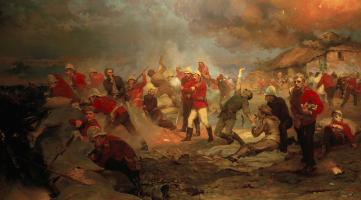
1880. Elizabeth Thompson Lady Butler [aged 33]. "The Defence of Rorke's Drift". Depicting the 1879 Battle of Rorke's Drift which took place during the Anglo-Zulu War of 1877 to 1879.
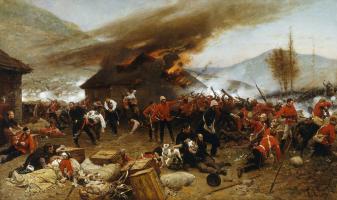
1880. Alphonse de Neuville [aged 44]. "The Defence of Rorke's Drift". Depicting the Battle of Rorke's Drift.
On 31st January 1880 HMS Atlanta, serving as a training ship, set sail from the Royal Naval Dockyard in Bermuda for Falmouth, England. It was presumed that she sank in a powerful storm which crossed her route a couple of weeks after she sailed. The search for evidence of her fate attracted worldwide attention, and the Admiralty received more than 150 telegrams and 200 personal calls from anxious friends and relatives after it was announced that the ship was missing, and possibly lost.
Philip Ernest Fisher [aged 22] was presumed drowned.
On 27th February 1881 was the final and decisive battle of the First Boer War that was a resounding victory for the Boers. General George Pomeroy aka Colley [aged 45], who commanded, and Captain Cornwallis Maude [aged 28] were killed.
The Deeds of the Dukes of Normandy
The Gesta Normannorum Ducum [The Deeds of the Dukes of Normandy] is a landmark medieval chronicle tracing the rise and fall of the Norman dynasty from its early roots through the pivotal events surrounding the Norman Conquest of England. Originally penned in Latin by the monk William of Jumièges shortly before 1060 and later expanded at the behest of William the Conqueror, the work chronicles the deeds, politics, battles, and leadership of the Norman dukes, especially William’s own claim to the English throne. The narrative combines earlier historical sources with firsthand information and oral testimony to present an authoritative account of Normandy’s transformation from a Viking settlement into one of medieval Europe’s most powerful realms. William’s history emphasizes the legitimacy, military prowess, and governance of the Norman line, framing their expansion, including the conquest of England, as both divinely sanctioned and noble in purpose. Later chroniclers such as Orderic Vitalis and Robert of Torigni continued the history, extending the coverage into the 12th century, providing broader context on ducal rule and its impact. Today this classic work remains a foundational source for understanding Norman identity, medieval statesmanship, and the historical forces that reshaped England and Western Europe between 800AD and 1100AD.
Available at Amazon in eBook and Paperback format.

On 13th March 1881 Tsar Alexander II of Russia [aged 62] was assassinated. He died at the Winter's Palace, St Petersburg. His son Alexander [aged 36] succeeded III Tsar Russia. Dagmar aka Maria Feodrovna Glücksburg [aged 33] by marriage Tsarina Russia.
As he was known to do every Sunday for many years, the emperor went to the Mikhailovsky Manège for the military roll call. A young member of the Narodnaya Volya ("People's Will") movement, Nikolai Rysakov, threw a bomb which explosion Alexander survived. A second young member of the Narodnaya Volya, Ignacy Hryniewiecki, threw a second bomb killing the Tsar.
On 19th January 1883 the first standardized incandescent electric lighting system employing overhead wires began service in Roselle, New Jersey. It had been built by Thomas Edison to demonstrate that an entire community could be illuminated by electricity.
On 30th April 1884 father and daughter, Prince Louis Hesse Darmstadt IV Grand Duke [aged 46] and Victoria Hesse Darmstadt Marchioness Milford Haven [aged 21], were both married on the same, or near, days, he taking advantage pf his relatives being in Darmstadt for his daughter's wedding. He, apparently, didn't approve of his daughter's choice of his first cousin Prince Louis of Battenburg 1st Marquess Milford Haven [aged 29] since they, Prince Louis of Battenburg 1st Marquess Milford Haven and Victoria Hesse Darmstadt Marchioness Milford Haven would live in Britain.
Prince Louis of Battenburg 1st Marquess Milford Haven and Victoria Hesse Darmstadt Marchioness Milford Haven were married. She the daughter of Prince Louis Hesse Darmstadt IV Grand Duke and Princess Alice Saxe Coburg Gotha. They were first cousin once removed. She a granddaughter of Queen Victoria of the United Kingdom.
In the evening Prince Louis Hesse Darmstadt IV Grand Duke and Alexandrina Hutten Czapska [aged 29] were married. She being his former mistress. Apparently, they separated within a week and the marriage was annulled within three months.


In February 1885 Russians occupied a post mi 5 km south of Sary Yazy. On 25 March, General Komarov arrived at Kazyl Tepe with 1,500 men. Two days later, they advanced. Charles Yate [aged 35] being the senior British officer unsuccessfully attempted to disuad the Russian officers from further advance. On 30th March 1885, Russians attacked the Afghans and defeated them, putting them to flight, the Russians got all the artillery, the convoy and they occupied Panjdeh. When news of the incident reached Britain preparations for war began. The crisis was partly averted by the initiative of Abdur Rahman Khan, the Amir of Afghanistan, who was then at Rawalpindi engaged in talks with the British. Having no desire to see two foreign armies fighting in his country, when told of Panjdeh, he pretended to regard it as a mere border skirmish.

On 29th December 1886 Margaret York aka Pole Countess of Salisbury was beatified as a martyr by Pope Leo XIII.
On Tuesday 3rd April 1888, around a quarter past midnigt, Emma Elizabeth Smith was last seen by fellow resident, 54-year-old Margaret Hayes, at 18 George Street, the day after the Easter Monday bank holiday. She is believed to have been attacked at the junction of Osborn Street and Brick Lane, Whitechapel, approximately an hour and a quarter later. Upon her return to her nearby lodging house, Smith told the deputy keeper, Mary Russell, that she had been attacked by two or three men, one of whom was a teenager. Russell and another lodger, Annie Lee, took her to the London Hospital, where she was treated by the house surgeon George Haslip. She fell into a coma and developed peritonitis; she died at 9 am the following day. The case was listed as the first of eleven Whitechapel murders in Metropolitan Police files.
On 17th April 1888 at a meeting at the since demolished Royal Hotel, Market Street, Liverpool, the 'Football League' was formed. The first season of the Football League began on the 8th September with twelve member clubs: Accrington, Aston Villa, Blackburn Rovers, Bolton Wanderers, Burnley, Derby County, Everton, Notts County, Preston North End, Stoke, West Bromwich Albion and Wolverhampton Wanderers.
On 23rd December 1888 Vincent van Gogh severed his left ear with a razor. He bandaged the wound, wrapped the ear in paper, and delivered the package to a woman at a brothel he and Gauguin both frequented.
The 1889 Cleveland Street Scandal was the discovery of a male brothel on Cleveland Street in London by the police. Those working at the brothel named a number of the nobility leading to accusations that the government were attempting a cover up...
On 21st December 1891 James Naismith, a Canadian-American professor of physical education and instructor at the International Young Men's Christian Association Training School (now Springfield College) in Springfield, Massachusetts, invented a new game in which players would pass a ball to teammates and try to score points by tossing the ball into a basket mounted on a wall. In 1892 Frank Mahan, one of the players from the original first game, approached Naismith after the Christmas break, in early 1892, asking him what he intended to call his new game, and suggested the name 'Basketball' to Naismith concurred.
On 14th December 1895 King George VI of the United Kingdom was born to King George V of the United Kingdom [aged 30] and Victoria Mary Teck Queen Consort England [aged 28] at York Cottage, Sandringham Estate. The second son at birth he became King when his elder brother King Edward VIII of the United Kingdom [aged 1] Abdicated. Coefficient of inbreeding 1.86%. He married 26th April 1923 Elizabeth Bowes-Lyon Queen Consort England, daughter of Claude Bowes-Lyon 14th Earl Strathmore and Kinghorne and Cecilia Nina Cavendish-Bentinck Countess of Strathmore and Kinghorne, and had issue.





The History of William Marshal was commissioned by his son shortly after William’s death in 1219 to celebrate the Marshal’s remarkable life; it is an authentic, contemporary voice. The manuscript was discovered in 1861 by French historian Paul Meyer. Meyer published the manuscript in its original Anglo-French in 1891 in two books. This book is a line by line translation of the first of Meyer’s books; lines 1-10152. Book 1 of the History begins in 1139 and ends in 1194. It describes the events of the Anarchy, the role of William’s father John, John’s marriages, William’s childhood, his role as a hostage at the siege of Newbury, his injury and imprisonment in Poitou where he met Eleanor of Aquitaine and his life as a knight errant. It continues with the accusation against him of an improper relationship with Margaret, wife of Henry the Young King, his exile, and return, the death of Henry the Young King, the rebellion of Richard, the future King Richard I, war with France, the death of King Henry II, and the capture of King Richard, and the rebellion of John, the future King John. It ends with the release of King Richard and the death of John Marshal.
Available at Amazon in eBook and Paperback format.
On 26th May 1897 Bram Stoker's [aged 49] novel "Dracula" was first published.

2nd July 1897. Henry Bullingham [aged 45]. Photograph of Adele Beach Grant Countess Essex [aged 30] at the Devonshire House Ball as Bernice Queen of Palestine.

2nd July 1897. Henry Bullingham [aged 45]. Photograph of Rachel Anne Gurney Countess Dudley [aged 29] at the Devonshire House Ball as Queen Esther.

2nd July 1897. Henry Bullingham [aged 45]. Photograph of Helena Gleichen [aged 24] at the Devonshire House Ball as Joan of Arc.
Helena Gleichen: On 1st February 1873 she was born to Prince Victor of Hohenlohe Langenburg Count Gleichen and Princess Laura Williamina Seymour. On 28th January 1947 she died.

2nd July 1897. Henry Bullingham [aged 45]. Photograph of Mary Venetia Cavendish-Bentinck [aged 36] at the Devonshire House Ball as Elizabeth Cavendish daughter of Bess of Hardwick.

2nd July 1897. Henry Bullingham [aged 45]. Photograph of Evelyn Henrietta Leigh Baroness Alington at the Devonshire House Ball as Duchesse de Nevers, Dame de la Cour de S.M. Marguérite de Valois.
Evelyn Henrietta Leigh Baroness Alington: she was born to Henry Blundell Leigh. On 10th February 1892 Henry Gerard Sturt 1st Baron Alington and she were married. She by marriage Baroness Alington. On 23rd January 1939 she died.

1897. James Lafayette [aged 44]. Photograph of Edith Amelia Ward Baroness Wolverton [aged 24] as "Brittania" at the 1897 Devonshire House Ball.
Edith Amelia Ward Baroness Wolverton: On 16th September 1872 she was born to William Ward 1st Earl of Dudley and Georgina Moncrieffe Countess Dudley. On 5th January 1895 Frederic Glyn 4th Baron Wolverton and she were married. She by marriage Baroness Wolverton. She the daughter of William Ward 1st Earl of Dudley and Georgina Moncrieffe Countess Dudley. On 6th June 1956 Edith Amelia Ward Baroness Wolverton died.

1897. Henry van der Weyde [aged 59]. Photograph of Ernest William Beckett 2nd Baron Grimthorpe [aged 40] as "Sir Walter Raeligh" at the 1897 Devonshire House Ball.

12th July 1897. James Lafayette [aged 44]. Photograph of Henry Chaplin 1st Viscount Chaplin [aged 56] as "Marshal Lefevre" at the 1897 Devonshire House Ball.
On 31st October 1899 Douglas Henry Marsham [aged 28] was killed.
Jean de Waurin's Chronicle of England Volume 6 Books 3-6: The Wars of the Roses
Jean de Waurin was a French Chronicler, from the Artois region, who was born around 1400, and died around 1474. Waurin’s Chronicle of England, Volume 6, covering the period 1450 to 1471, from which we have selected and translated Chapters relating to the Wars of the Roses, provides a vivid, original, contemporary description of key events some of which he witnessed first-hand, some of which he was told by the key people involved with whom Waurin had a personal relationship.
Available at Amazon in eBook and Paperback format.
On 15th December 1899 the Battle of Colenso was fought between British and Boer forces from the independent South African Republic and Orange Free State in and around Colenso, Natal, South Africa; the British were defeated.
John Spencer Cavendish [aged 24] took part.

The London Gazette 27157. From the General Commanding-in-Chief the Forces in South Africa to the Secretary of State for War. Chieveley Camp, SIB, December 16, 1899.
I have the honour to bring the following cases of Distinguished Service in the Field to your notice.
At [the Battle of] Colenso, on the 15th December, the detachments serving the guns of the 14th and 66th Batteries, Royal Field Artillery, had all been either killed, wounded, or driven from their guns by Infantry fire at close range, and the guns were deserted.
About 500 yards behind the guns was a donga, in which some of the few horses and drivers left alive were sheltered. The intervening space was swept with shell and rifle fire.
Captain Congreve, Rifle Brigade, who was in the donga, assisted to hook a team into a limber, went out and assisted to limber up a gun; being wounded he took shelter, but seeing Lieutenant Roberts [aged 27] fall badly wounded he went out again and brought him in. Some idea of the nature of the fire may be gathered from the fact that Captain Congreve was shot through the leg, through the toe of his boot, grazed on the elbow and the shoulder, and his horse shot in three places. Lieutenant the Honourable F. Roberts, King's Royal Rifles, assisted Captain Congreve. He was wounded in three places.
Corporal Nurse, Royal Field Artillery, 66th Battery, also assisted. I recommend the above three for the Victoria Cross.
The London Gazette 27160. War Office, February 2, 1900. The Queen has been graciously pleased to signify Her intention to confer the decoration of the Victoria Cross on the undermentioned Officers and Non-Commissioned Officer, whose claims have been submitted for Her Majesty's approval, for their conspicuous bravery at the battle of Colenso, as stated against their names:—
The Rifle Brigade (The Prince Consort's Own). Captain W. Congreve. At Colenso on the 15th December, 1899, the detachments serving the guus of the 14th and 66th Batteries, Royal Field Artillery, had all been either killed, wounded, or driven from their guns by Infantry fire at close range, and the guns were deserted.
About 500 yards behind the guns was a donga in which some of the few horses and drivers left alive were sheltered. The intervening space was swept with shell and rifle fire.
Captain Congreve, Rifle Brigade, who was in the donga, assisted to hook a team into a limber, went out; and assisted to limber up a gun. Being wounded, he took shelter; but, seeing Lieutenant Roberts fall, badly wounded, he went out again and brought him in. Captain Congreve was shot tbrough the leg, through the toe of his boot, grazed on the elbow and the shoulder, and his horse shot in three places.
The King's Royal Rifle Corps. Lieutenant the Honourable F. H. S. Roberts (since deceased). Lieutenant Roberts assisted Captain Congreve. He was wounded in three places.
66th Royal Battery, Field Artillery. Corporal G. E. Nurse. Corporal Nurse also assisted.
7th Royal Battery, Artillery Field. Captain H. L. Reed. Captain Reed, who had heard of the difficulty, shortly afterwards brought down three teams from liis battery to see if he could be of any use. He was wounded, as were five of the thirteen men who rode with him, one was killed; and thirteen out of twenty-one horses were killed before he got half-way to the guns, and he was obliged to retire
Become a Member via our Buy Me a Coffee page to read more.