

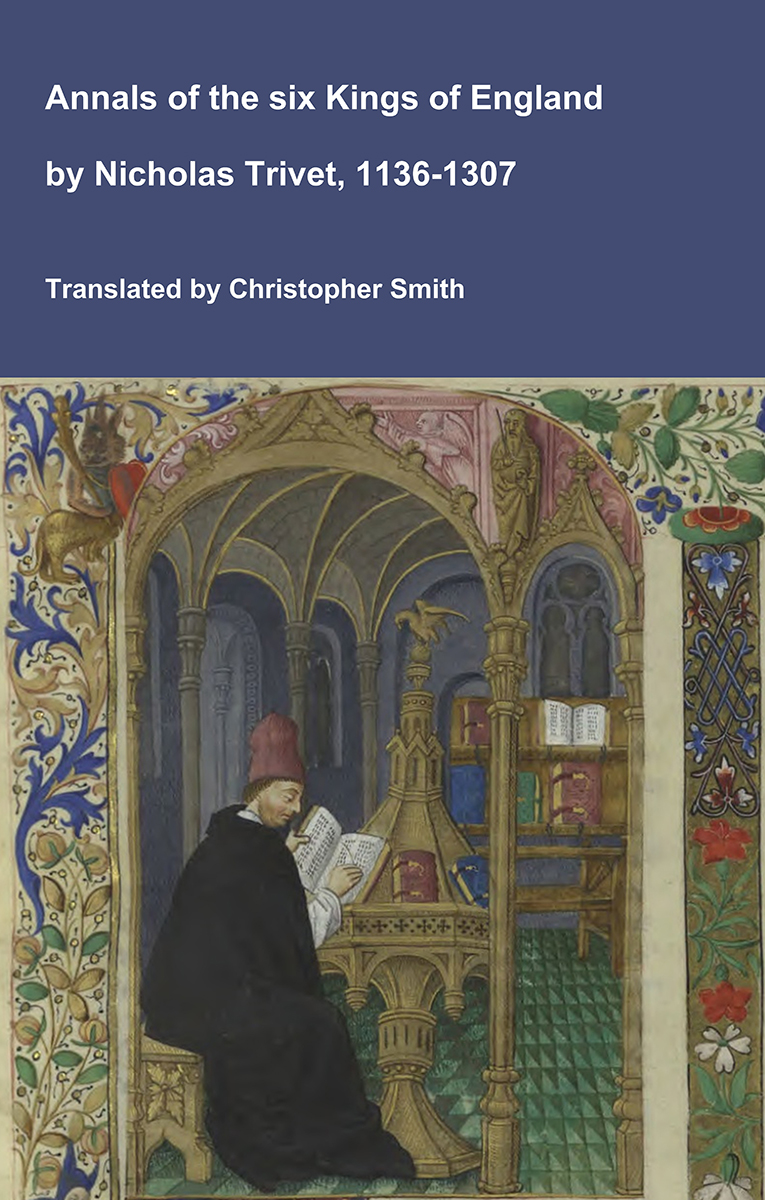
Annals of the six Kings of England by Nicholas Trivet
Translation of the Annals of the Six Kings of England by that traces the rise and rule of the Angevin aka Plantagenet dynasty from the mid-12th to early 14th century. Written by the Dominican scholar Nicholas Trivet, the work offers a vivid account of English history from the reign of King Stephen through to the death of King Edward I, blending political narrative with moral reflection. Covering the reigns of six monarchs—from Stephen to Edward I—the chronicle explores royal authority, rebellion, war, and the shifting balance between crown, church, and nobility. Trivet provides detailed insight into defining moments such as baronial conflicts, Anglo-French rivalry, and the consolidation of royal power under Edward I, whose reign he describes with particular immediacy. The Annals combines careful year-by-year reporting with thoughtful interpretation, presenting history not merely as a sequence of events but as a moral and political lesson. Ideal for readers interested in medieval history, kingship, and the origins of the English state, this chronicle remains a valuable and accessible window into the turbulent world of the Plantagenet kings.
Available at Amazon in eBook and Paperback format.
Battle of Ancrum Moor is in 1543-1547 Catherine Parr.
On 27th February 1545 a Scottish army defeated an English army at the Battle of Ancrum Moor at Jedburgh. The Scots Archibald Douglas 6th Earl Angus [aged 56], John Lindsay 5th Lord Lindsay of the Byres [aged 63] and James Hamilton 2nd Earl Arran [aged 29] fought.
Brian Leyton and Ralph Eure were killed.
The History of Scotland by George Buchanan. [27th February 1545] These exhortations added to their courage as much as the toil of the march abated their strength ; so that their two first battalions fell in amongst the Scots, who were prepared for the onset, as into an ambush ; yet trusting to their number, they stood to their arms and. fought stoutly. But two things, wisely foreseen, were a great help to the Scots; for the sun was almost at west, and darted with his full beams in the faces of the enemy, and also the wind, which was somewhat high, carried back the smoke of the gunpowder upon the battalions behind, insomuch that they could not see their way; and besides, whilst they were panting, by reason of their march, it mightily troubled them with its noisome smell. The first battalion of the English fell back upon the second, the second on the third; where, by their intermixtures one with another, and the pressing of the Scots upon them, they all broke their ranks and were driven back; so that they were so fullof fear and terror, that none knew his own colours or his captain. Thus, whilst every one provided for his own safety, no man remembered the public danger or disgrace. The Scots followed thick and close after them, so that now there was no more fighting, but slaying. At night the Scots were called back to their colours, and taking a view of the slain, they lost only two of their own; of the English, besides commanders, there died about 200 soldiers, most of them persons of quality. There were about 1000 prisoners taken, and of them above 80 gentlemen. This victory happening beyond all men's éxpectation, was so much the more accepetable; the fruit and profit of it all redounded to the regent, but almost all the honour to the Douglasses.
The History of Scotland by Robert Lindsay of Pitscottie. For the Englishmen, believing that the Scots fled, pursued them so fast, that they were all out of breath. The first battle, led by Sir Bryan Latoun and Sir Robert Bowis had, in the midst of the battle, a thousand spears; and, on their right wing, five hundred hagbutters, and on their left, five hundred bows. Sir Ralph Ivers led the great battle, containing a thousand spears, thousand hagbutters, and as many bows. The Scots, at the beginning, had only three hundred men with the governor, and two hundred with the earl of Angus. The English hasted them to preveen the flight of the Scots, thinking, by one encounter, to put an end to the war. But they, lighting on the ambush of the Scots, all wearied, and out of breath, albeit they were disicouraged, yet, contemning the fewness of their number, set upon them. The Scots had providently gotten the advantage both of the wind and sun (being both in the south-west) so that the sun-beams and smoke of the powder took all fight from the English, besides, the Scottish-mens spears were an ell longer than the English; whereby the English were born down before they could reach at the Scots; who, encountring them most violently, beat back the vanguard upon the great battle; and fo, disordering both, put them to flight, killing their two leaders, Sir Ralph Ivers and Sir Bryan Latoun, and a great number of gentlemen and common soldiers, to the number of five hundred; with the loss of two Scottishmen, slain rakelesly by their own artillery. There were taken a thousand, whereof eighty were gentlemen. The governor, at night, returning to his standard, kneeled down, and gave solemn thanks: to God for the unexpected victory; the like whereof hath scarcely been read of, that so small-a number discomfited so great a host, and so well appointed. The chief of the captives were, Mr. Howard [aged 20] the queen's uncle, Mr. Hutchinson mayor of York, the lord Bowis, Sir John Withrington, many of the Herons and Sellies, and other gentlemen of the borders, and knights of great esteem. This battle was foughten in Teviotdale, at Ancram-muir, the ninth of March, one thousand five hundred and forty-five2.
Note 1. George Howard, brother of Queen Catherine Howard of England.
Note 2. The battle was fought on 27th February 1545.
Letters and Papers Foreign and Domestic Henry VIII 1545. 1 March [1545]. Add. MS. 32,656, f. 170. B. M. Hamilton Papers, ii., No. 414. 285. Shrewsbury, Tunstall and Sadler to Henry VIII.
Have received a letter from the Warden of the East Marches and, immediately after it, anotherto the bp. of Duresme showing that the enterprise to Mewrehouse undertaken by the Warden of the Middle Marches ended in a miserable overthrow to him and his company. Suspect it has been through too much adventure, or some disorder, or else through trusting such Scots as, for fear only, entered the King's service. Knowing the forwardness of the man, had specially warned him to be wary. He being thus "piteously slain," who shall supply his office of wardenry and the keeping of Tyndale and Ryddesdale ? The garrisons and the countrymen of Northumberland being thus distressed, the power of the Bishopric which we set forward to attend the Wardens shall remain for defence of the Borders; and, to set the better face upon the matter, we will ourselves repair to Alnewyke, and will warn sundry gentlemen of Yorkshire to be ready at an hour's warning to come to the Borders to lie in garrison. If the pensioners and countrymen of Northumberland are distressed, as the letters import, it is the more requisite to have a greater number laid in garrison; and not only do we lack money but the country is utterly disfurnished of victuals, and so is Berwyke, as we have sundry times advertised. We send letters received from Lenoux and Wharton, with others from the Lord of the Isles to Lenoux, and have despatched to Court the messenger who came from the Lord of the Isles. Upon letters of the Council requiring us to travail with the inhabitants of Newcastell to set forth ships as those of Hull have done, we have done what we can and enclose their answer. Darneton, 1 March. Signed.
In Sadler's hand, pp. 3. Add. Endd.: 1544.
Letters and Papers Foreign and Domestic Henry VIII 1545. 3 March [1545]. Add.MS. 32,656 f 180. B.M. Hamilton Papers. ii., No.418. 301. Shrewsbury, Tunstall and Sadler to Henry VIII.
Send letters received from the Wardens of the East and West marches and Sir Cuthbert Ratclyff; and also a letter from Parson Ogle, the bringer of which related the words spoken by the Governor [Regent] [aged 29], of which the said Parson writes. It seems that Vicar Ogle, a friend of the said Parson's, being taken by one of Anguisshe's servants, was asked by the Governor [Regent], after the battle, if he knew the Warden [Ralph Eure]. On his answer that he did, the Governor [Regent] led him by the hand to where the dead bodies lay and he identified the Warden. "God have mercy on him (quod the Governor [Regent]) for he was a fell cruel man and over cruel, which many a man and fatherless bairn might rue; and, welaway (quod he) that ever such slaughter and bloodshedding should be amongst Christian men." And the tears trickled down his cheeks. Anguisshe then came up and asked the Governor [Regent] if he were merry, who answered. "My lord, I am much the merrier for you"; and took him about the neck and kissed him 20 times, saying he repented having ever mistrusted him, who had that day done so much for Scotland. Whereunto Anguisshe answered that God knew his loyalty to his native country.
Such as were at the conflict report that the overthrow proceeded of the treason of the assured Scots of Tyvydale, whose advice, and chiefly the laird of Bonjedwourth's, Sir Ralph Evres followed. They killed and took more Englishmen than did any of the enemies; and yet, but for disorder among our men at the joining of the battle, victory might have been ours, for the Scots were not so numerous as is said. Hear so many sundry tales that they cannot yet write the certainty. Newcastle, 3 March. Signed.
Ordnance Gazetteer of Scotland by Francis Groome Volume 1. One of them was a favourite retreat of the author of The Seasons, who was a frequent inmate of Ancrum Manse, and is known as 'Thomson's Cave,' his name being carved on its roof, it is said, by his own hand. Remains of a Caledonian stone circle existed within this century at Harestanes, near Mounteviot, but all its stones save one have been removed; and a Roman road skirts Ancrum Moor, 1¾ mile NW of the village, which moor was the scene of one of the last great conflicts in the international war between Scotland and England. An English army, 5000 strong, under Sir Ralph Evera and Sir Bryan Latoun, in 1544, overran and wasted the Scottish Border northward to Melrose. Returning with their booty, they were overtaken at Ancrum Moor and utterly routed by a Scottish force under the Earl of Angus and Scott of Buccleuch. Lilliard, a maid of Teviotdale, made desperate by the loss of her lover, fought in the Scottish ranks till she fell beneath many wounds; and she has bequeathed to part of the battlefield the name of Lilliard's Edge. A monument, now broken and defaced, stands on the spot, and bore this legend, —
'Fair Maiden Lilliard lies under this stane;
Little was her stature, but great was her fame;
Upon the English loons she laid mony thumps,
And when her legs were cuttid off, she fought upon her stumps.