

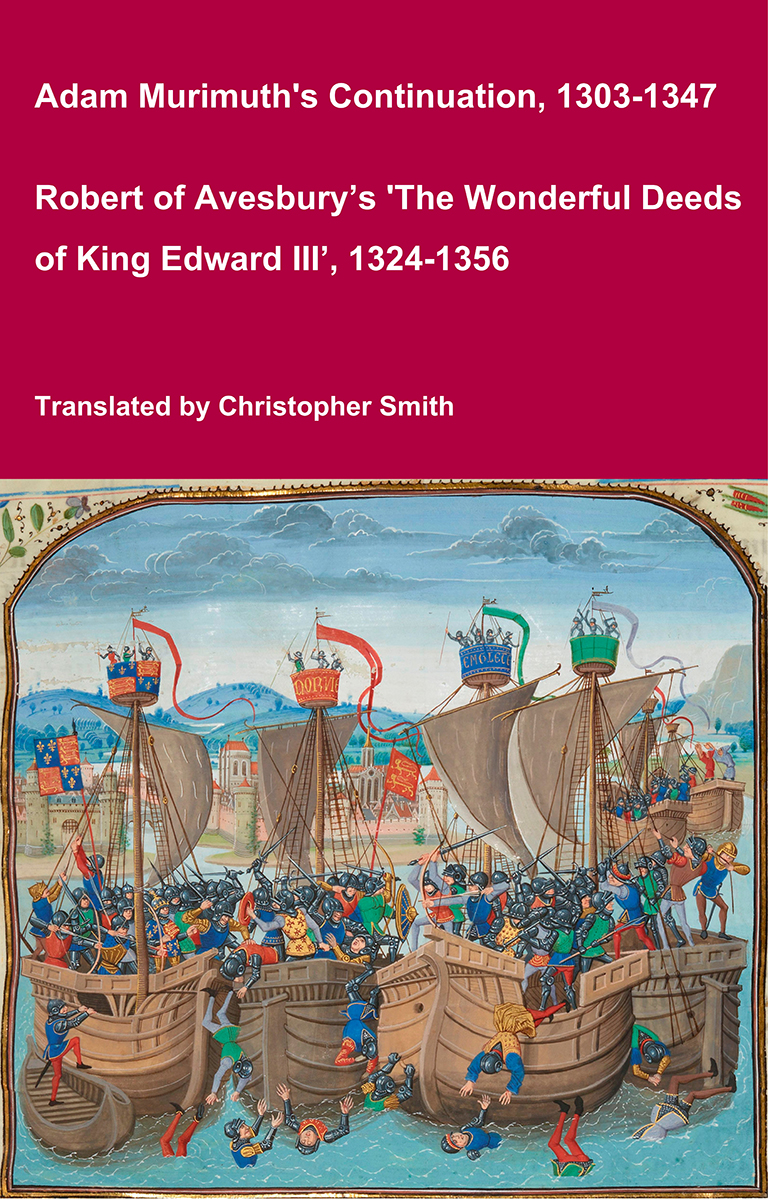
Adam Murimuth's Continuation and Robert of Avesbury’s 'The Wonderful Deeds of King Edward III'
This volume brings together two of the most important contemporary chronicles for the reign of Edward III and the opening phases of the Hundred Years’ War. Written in Latin by English clerical observers, these texts provide a vivid and authoritative window into the political, diplomatic, and military history of fourteenth-century England and its continental ambitions. Adam Murimuth Continuatio's Chronicarum continues an earlier chronicle into the mid-fourteenth century, offering concise but valuable notices on royal policy, foreign relations, and ecclesiastical affairs. Its annalistic structure makes it especially useful for establishing chronology and tracing the development of events year by year. Complementing it, Robert of Avesbury’s De gestis mirabilibus regis Edwardi tertii is a rich documentary chronicle preserving letters, treaties, and official records alongside narrative passages. It is an indispensable source for understanding Edward III’s claim to the French crown, the conduct of war, and the mechanisms of medieval diplomacy. Together, these works offer scholars, students, and enthusiasts a reliable and unembellished account of a transformative period in English and European history. Essential for anyone interested in medieval chronicles, the Hundred Years’ War, or the reign of Edward III.
Available at Amazon in eBook and Paperback format.
Coronation of Elizabeth I is in 1559-1579 Elizabeth I Accedes.

On 13th January 1559 two new peerages were created...
Henry Carey 1st Baron Hunsdon [aged 32] was created 1st Baron Hunsdon. Anne Morgan Baroness Hunsdon [aged 30] by marriage Baroness Hunsdon.
Oliver St John 1st Baron St John [aged 37] was created 1st Baron St John of Bletso. Agnes Fisher Baroness St John Bletso [aged 33] by marriage Baroness St John of Bletso.
On 15th January 1559 Queen Elizabeth I of England and Ireland [aged 25] was crowned I Queen of England by Bishop Owen Oglethorpe [aged 52] at Westminster Abbey [Map].
Margaret Audley Duchess Norfolk [aged 19] carried the train. Archbishop Nicholas Heath [aged 58] censed. Edward Dymoke [aged 51] attended as the Queen's Champion. Thomas Howard 4th Duke of Norfolk [aged 22], Francis Talbot 5th Earl of Shrewsbury [aged 59], Henry Fitzalan 12th or 19th Earl of Arundel [aged 46], Thomas Cecil 1st Earl Exeter [aged 16] and William Herbert 1st Earl Pembroke [aged 58] attended.
Henry Machyn's Diary. January 1559. The (blank) day in Crystynmas weyke they begane [to build] skayffold(s) in dyvers plasses in London for pa[geants] agaynst the crounassyon of quen Elesabetth, that [is to be the] xv day of January, and the condut nuw paynted.
Henry Machyn's Diary. 12th January 1559. The xij day the Qwen('s) [aged 25] grace toke her barge at Whytt-halle toward the Towre, and shott the bryge, and my lord mare [aged 50] and the althermen, and all the craftes, in barges with stremars and baners of ther armes.
Henry Machyn's Diary. 13th January 1559. The xiij day of January with-in the Towre the Quen mad Knyghtes of the Baythe x.
Note. P. 186. The Knights of the Bath made at the Coronation of queen Elizabeth were in number eleven, viz.:—
John lord Darcy of the North [aged 19],
John lord Sheffield [aged 21],
John lord Darcy of Chiche [aged 27],
Sir Robert Rich [aged 22],
Sir Roger North [aged 29],
Sir Nicholas Pointz [aged 31],
Sir John Berkeley,
Sir Edward Unton [aged 25],
Sir Henry Weston [aged 24],
Sir George Speke [aged 29],
See Anstis's History of the Order of the Bath, App. lxx.; and Nicolas, Appx. p. xiv.
Henry Machyn's Diary. 14th January 1559. [The xiv day of January the Queen [aged 25] came in a chariot from] the Towre [Map], with all the lordes and ladies [in crimson] velvet, and ther horses trapyd with the sam, and [trumpeters in] red gownes blohyng, and all the haroldes in ther cottes armur, and all the strettes stroyd with gravell; and at Grasyus strett [Map] a goodly pagantt of kyng [Henry] the viij and quen Ane ys wyff and of ther lenege, and in Cornelle [Map] a-nodur goodly pagantt of kyng Henry and kyng Edward the vjth; and be-syd Soper lane in [Cheap a]nodur goodly pagantt, and the condyth pentyd; [and] at the lytylle condutt a-nodur goodly pagant of a qwyke tre and a ded, and the quen had a boke gyffyn her ther; and ther the recorder of London and the chamburlayn [aged 38] delevered unto the quen a purse of gold fulle to the waluw of (blank); and so to the Flett strett to the condyt, and ther was a-nodur goodly pagantt of the ij chyrchys; and at Tempylle bare was ij grett gyanttes, the one name was Goott-magott [Gogmagog] a Albaon and the thodur Co(rineus.)


Henry Machyn's Diary. 15th January 1559. The xv day was the crounasyon of quen Elsabeth [aged 25] at Westmynster abbay [Map], and theyr all the trumpettes, and knyghtes, and lordes, and haroldes of armes in ther cotte armurs; and after all they in ther skarlett, and all the bysshopes in skarlett, and the Quen, and all the fottmen waytyng a-pone the quene, to Westmynster hall; ther mett all the byshoppes, and all the chapell with iij crosses, and in ther copes, the byshoppes mytered, and syngyng Salve festa dyes; and all the strett led with gravell, and bluw cloth unto the abbay, and raylled on evere syd, and so to the abbay to masse, and ther her grasse was crounyd; and evere offeser rede against she shuld go to dener to Westmynster hall [Map], and evere offeser to take ys offes at serves a-pone ther landes; and my lord mare [aged 50] and the althermen.
Archives of Venice. On Sunday, 15th January [1559], mass was sung for the coronation in Westminster Abbey, which was decorated with the handsomest and most precious tapestries that were ever seen, they having been purchased by Henry VIII., representing on one side the whole of Genesis, and on the other the Acts of the Apostles, from a design by Raffael d'Urbino; and the chambers were hung with the history of Cæsar and Pompey. At one of the sides the buffet was prepared with its raised steps, on which were seen 140 gold and silver drinking cups, besides others which were below for the service. The Queen was received under the canopy by the Archbishop [aged 58] and another Bishop, they having previously perfumed her with incense, giving her the holy water and the pax, the choristers singing; then the Earl of Rutland [aged 9] followed her Majesty with a plain naked sword without any point, signifying Ireland, which has never been conquered; then came the Earl of Exeter with the second sword; the third was borne by Viscount Montagu; the Earl of Arundel [aged 46], having been made Lord Steward and High Constable for that day, carried the fourth (sword) of royal justice, with its gilt scabbard loaded with pearls. The orb was carried by the Duke of Norfolk, Lord Marshal, and in advance were knights clad in the ducal fashion, carrying the three crowns, they being the three Kings-at-arms; they bore the three sceptres, with their three crowns of iron, of silver, and of gold on their heads, and in their hands three naked iron swords, signifying the three titles of England, France, and Ireland.
Henry Machyn's Diary. 16th January 1559. The xvj day of [January] was gret justes at the tylt-[yard], iiij chalengers, the duke of Northfoke [aged 22] and (unfinished)
William of Worcester's Chronicle of England
William of Worcester, born around 1415, and died around 1482 was secretary to John Fastolf, the renowned soldier of the Hundred Years War, during which time he collected documents, letters, and wrote a record of events. Following their return to England in 1440 William was witness to major events. Twice in his chronicle he uses the first person: 1. when writing about the murder of Thomas, 7th Baron Scales, in 1460, he writes '… and I saw him lying naked in the cemetery near the porch of the church of St. Mary Overie in Southwark …' and 2. describing King Edward IV's entry into London in 1461 he writes '… proclaimed that all the people themselves were to recognize and acknowledge Edward as king. I was present and heard this, and immediately went down with them into the city'. William’s Chronicle is rich in detail. It is the source of much information about the Wars of the Roses, including the term 'Diabolical Marriage' to describe the marriage of Queen Elizabeth Woodville’s brother John’s marriage to Katherine, Dowager Duchess of Norfolk, he aged twenty, she sixty-five or more, and the story about a paper crown being placed in mockery on the severed head of Richard, 3rd Duke of York.
Available at Amazon in eBook and Paperback format.
Henry Machyn's Diary. 17th January 1559. The xvij day of January was tornayhyng at the barears at Whythalle.