

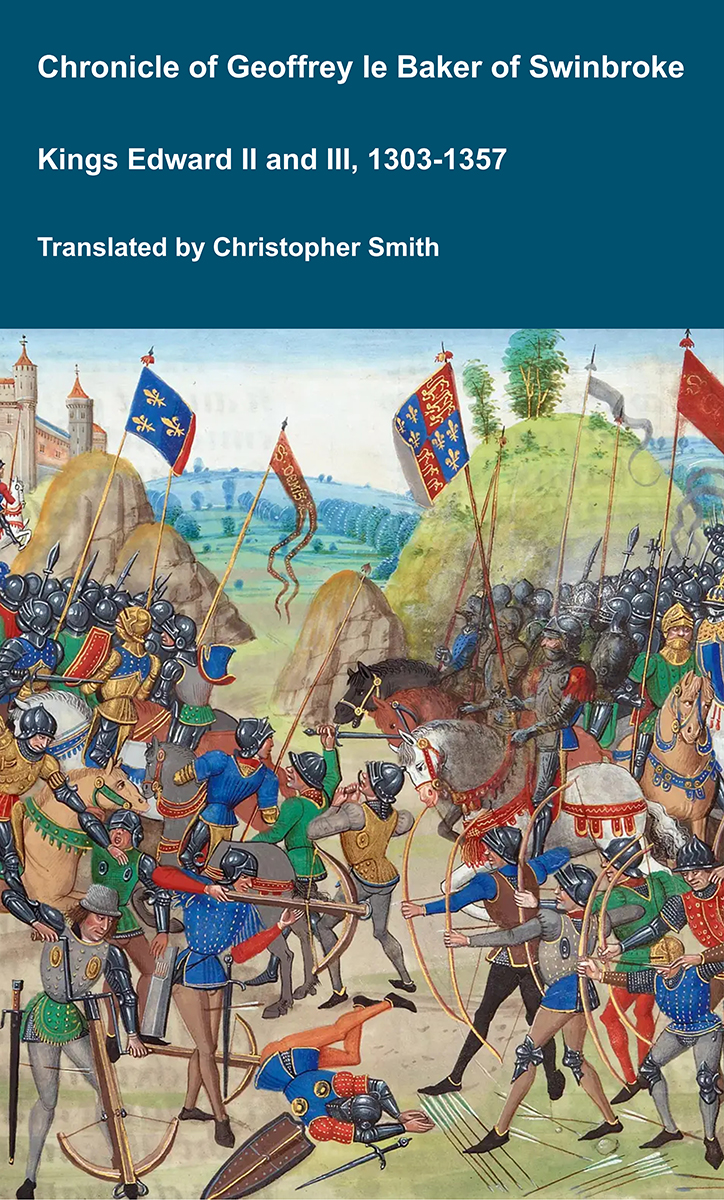
Chronicle of Geoffrey le Baker of Swinbroke
Baker was a secular clerk from Swinbroke, now Swinbrook, an Oxfordshire village two miles east of Burford. His Chronicle describes the events of the period 1303-1356: Gaveston, Bannockburn, Boroughbridge, the murder of King Edward II, the Scottish Wars, Sluys, Crécy, the Black Death, Winchelsea and Poitiers. To quote Herbert Bruce 'it possesses a vigorous and characteristic style, and its value for particular events between 1303 and 1356 has been recognised by its editor and by subsequent writers'. The book provides remarkable detail about the events it describes. Baker's text has been augmented with hundreds of notes, including extracts from other contemporary chronicles, such as the Annales Londonienses, Annales Paulini, Murimuth, Lanercost, Avesbury, Guisborough and Froissart to enrich the reader's understanding. The translation takes as its source the 'Chronicon Galfridi le Baker de Swynebroke' published in 1889, edited by Edward Maunde Thompson.
Available at Amazon in eBook and Paperback format.
Escallop is in Charges.
Escallop. A shell. The badge of a pilgrim, also a symbol of the Apostle S.James the Great, who is generally drawn in the garb of a pilgrim.
 Keppel Arms. Gules, three escallops argent. Source.
 Bayning Arms. Or two bars sable on each as many escallops of the first. Source.
 Littleton Arms. Argent, a chevron between three escallops sable. Source.
 Spencer Churchill Arms. Quartered 1&4
  Churchill Arms a canton of St George, 2&3
  Despencer Arms a bend sable three escallops, overall an escutcheon St George overall an escutcheon
  Capet Arms.
 Roger Lupton Arms. Argent, on a chevron between three wolf's heads and necks erased sable three lilies of the field on a chief gules between two escallops a Tau cross or. Arms granted to Roger Lupton by King Henry VII. The Tau cross was a symbol of Saint Anthony of Egypt and thus probably referred to his mastership of St Anthony's Hospital. The escallops were possibly bells, another symbol of Saint Anthony, of which two were often shown suspended from the cross member of a Tau cross. The wolves were canting references to his surname from the Latin Lupus, "a wolf", and Sable, three lilies argent, is the base part of the arms of Eton College [Map].
 Duff Arms. Vert, a fess dancetté ermine, between a buck's head caboshed in chief and two escallops in base or.
 Lyttleton Arms. Argent, a chevron between three escallops sable. Source.
 Freschville Arms. Azure, bend argent between six escallops.
 Maule Arms. Per pale, argent and gules, a bordure charged with eight escallops, all countercharged. Source.
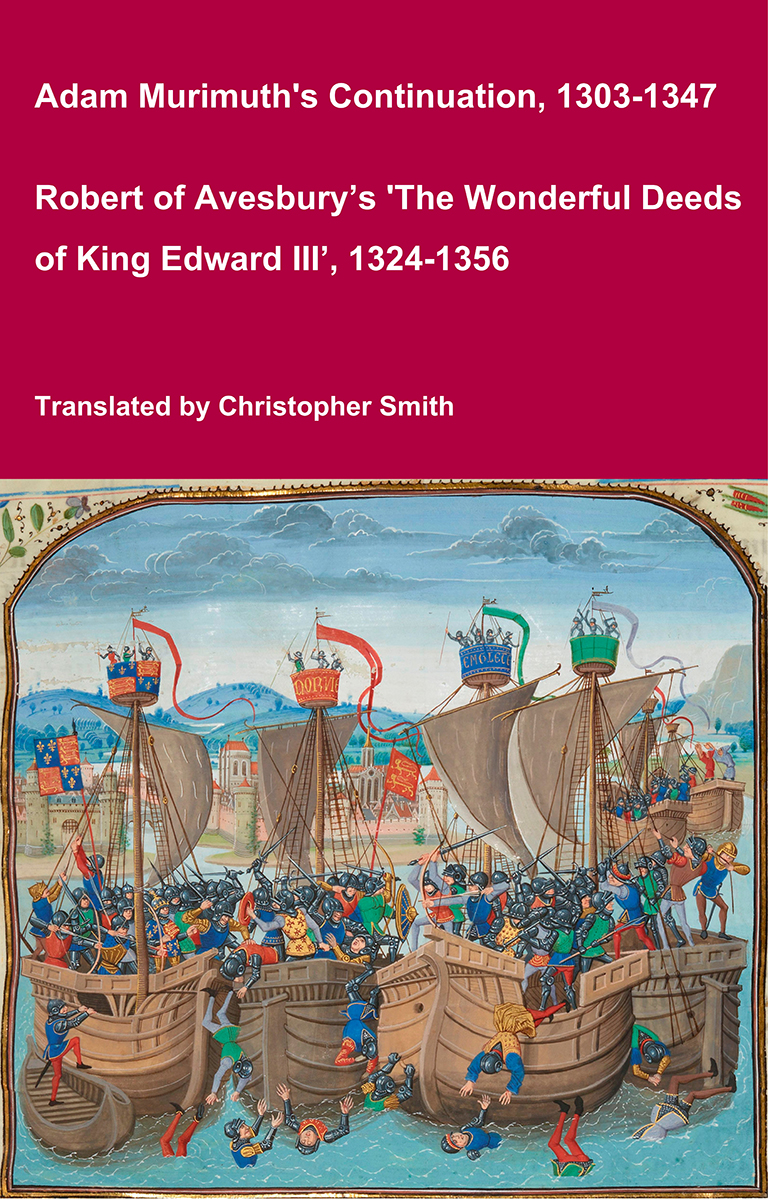
Adam Murimuth's Continuation and Robert of Avesbury’s 'The Wonderful Deeds of King Edward III'
This volume brings together two of the most important contemporary chronicles for the reign of Edward III and the opening phases of the Hundred Years’ War. Written in Latin by English clerical observers, these texts provide a vivid and authoritative window into the political, diplomatic, and military history of fourteenth-century England and its continental ambitions. Adam Murimuth Continuatio's Chronicarum continues an earlier chronicle into the mid-fourteenth century, offering concise but valuable notices on royal policy, foreign relations, and ecclesiastical affairs. Its annalistic structure makes it especially useful for establishing chronology and tracing the development of events year by year. Complementing it, Robert of Avesbury’s De gestis mirabilibus regis Edwardi tertii is a rich documentary chronicle preserving letters, treaties, and official records alongside narrative passages. It is an indispensable source for understanding Edward III’s claim to the French crown, the conduct of war, and the mechanisms of medieval diplomacy. Together, these works offer scholars, students, and enthusiasts a reliable and unembellished account of a transformative period in English and European history. Essential for anyone interested in medieval chronicles, the Hundred Years’ War, or the reign of Edward III.
Available at Amazon in eBook and Paperback format.
 Heveningham Arms. Quarterly or and gules on a bordure engrailed sable eight escallops argent. Source.
 Pollard Arms. Argent, a chevron sable between three escallops gules.
 Ingram Arms. Ermine on a fess gules three escallops or. Source.
 Strickland Arms. Sable three escallops argent. SSource.
 Graham Arms. Or an a chief sable three escallops argent. Source.
 Blackett Arms. Argent a chevron sable three escallops argent between three mullets sable. Source.
 Foljambe Arms. Sable a bend between six escallops or.
 Tailboys Arms. Argent, a saltire gules in chief gules three escallops argent. Source.
 Townshend Arms. Azure, a chevron ermine between three escallops argent. Source.
 Wendesley Arms. Ermine, on a bend gules three escallops argent. Source.
Chronicle of Geoffrey le Baker of Swinbroke
Baker was a secular clerk from Swinbroke, now Swinbrook, an Oxfordshire village two miles east of Burford. His Chronicle describes the events of the period 1303-1356: Gaveston, Bannockburn, Boroughbridge, the murder of King Edward II, the Scottish Wars, Sluys, Crécy, the Black Death, Winchelsea and Poitiers. To quote Herbert Bruce 'it possesses a vigorous and characteristic style, and its value for particular events between 1303 and 1356 has been recognised by its editor and by subsequent writers'. The book provides remarkable detail about the events it describes. Baker's text has been augmented with hundreds of notes, including extracts from other contemporary chronicles, such as the Annales Londonienses, Annales Paulini, Murimuth, Lanercost, Avesbury, Guisborough and Froissart to enrich the reader's understanding. The translation takes as its source the 'Chronicon Galfridi le Baker de Swynebroke' published in 1889, edited by Edward Maunde Thompson.
Available at Amazon in eBook and Paperback format.
 Dacre Arms. Gules three escallops argent. Source.


#/media/File:Strickland_of_Westmorland_arms.svg)
.svg)
#/media/File:Marquess_of_Downshire_COA.svg)
.svg)


