

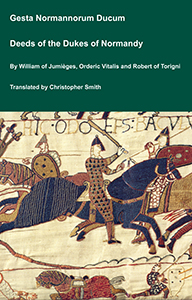
The Deeds of the Dukes of Normandy
The Gesta Normannorum Ducum [The Deeds of the Dukes of Normandy] is a landmark medieval chronicle tracing the rise and fall of the Norman dynasty from its early roots through the pivotal events surrounding the Norman Conquest of England. Originally penned in Latin by the monk William of Jumièges shortly before 1060 and later expanded at the behest of William the Conqueror, the work chronicles the deeds, politics, battles, and leadership of the Norman dukes, especially William’s own claim to the English throne. The narrative combines earlier historical sources with firsthand information and oral testimony to present an authoritative account of Normandy’s transformation from a Viking settlement into one of medieval Europe’s most powerful realms. William’s history emphasizes the legitimacy, military prowess, and governance of the Norman line, framing their expansion, including the conquest of England, as both divinely sanctioned and noble in purpose. Later chroniclers such as Orderic Vitalis and Robert of Torigni continued the history, extending the coverage into the 12th century, providing broader context on ducal rule and its impact. Today this classic work remains a foundational source for understanding Norman identity, medieval statesmanship, and the historical forces that reshaped England and Western Europe between 800AD and 1100AD.
Available at Amazon in eBook and Paperback format.
Munich is in Bavaria.
On 23rd December 1304 Matilda Habsburg Duchess Bavaria [aged 51] died at Munich.
On 14th December 1334 Otto Wittelsbach IV Duke Lower Bavaria [aged 27] died at Munich. His nephew John [aged 5] succeeded 1st Duke Lower Bavaria.
On 25th July 1336 Albert Wittelsbach I Duke Lower Bavaria was born to Louis Wittelsbach IV Holy Roman Emperor [aged 54] and Margaret Hainaut Holy Roman Empress [aged 24] at Munich. He a great x 4 grandson of King Henry "Curtmantle" II of England. He married (1) after 19th July 1353 Margaret of Silesia Duchesa Lowwer Bavaria and had issue (2) 1394 his half fourth cousin once removed Margaret de la Marck Duchess Bavaria, daughter of Adolph de la Marck and Margaret Jülich Countess Cleves and Mark.
In 1373 Ernest Wittelsbach I Duke Bavaria was born to John Wittelsbach II Duke Bavaria [aged 32] and Catherine Gorizia Duchess Bavaria at Munich. He married 26th January 1395 Elisabetta Visconti Duchess Bavaria and had issue.
In 1375 William Wittelsbach III Duke Bavaria was born to John Wittelsbach II Duke Bavaria [aged 34] and Catherine Gorizia Duchess Bavaria at Munich. He married 11th May 1433 his half second cousin once removed Margarethe of Cleves, daughter of Adolph de la Marck I Duke Cleves and Marie Valois Duchess Cleves, and had issue.
In 1376 Sofia Wittelsbach was born to John Wittelsbach II Duke Bavaria [aged 35] and Catherine Gorizia Duchess Bavaria at Munich.
On 7th January 1434 Adolf Wittelsbach was born to William Wittelsbach III Duke Bavaria [aged 59] and Margarethe of Cleves [aged 17] at Munich. He died aged seven in 1441.
In 1435 William Wittelsbach III Duke Bavaria [aged 60] died at Munich.
In 1435 William Wittelsbach was born to William Wittelsbach III Duke Bavaria [aged 60] and Margarethe of Cleves [aged 18] at Munich. He died aged less than one years old.
Jean de Waurin's Chronicle of England Volume 6 Books 3-6: The Wars of the Roses
Jean de Waurin was a French Chronicler, from the Artois region, who was born around 1400, and died around 1474. Waurin’s Chronicle of England, Volume 6, covering the period 1450 to 1471, from which we have selected and translated Chapters relating to the Wars of the Roses, provides a vivid, original, contemporary description of key events some of which he witnessed first-hand, some of which he was told by the key people involved with whom Waurin had a personal relationship.
Available at Amazon in eBook and Paperback format.
In 1435 William Wittelsbach died at Munich.
On 2nd July 1438 Ernest Wittelsbach I Duke Bavaria [aged 65] died at Munich. His son Albert [aged 37] succeeded III Duke Bavaria.
On 24th October 1441 Adolf Wittelsbach [aged 7] died at Munich.
On 9th June 1454 Barbara Wittelsbach was born to Albert Wittelsbach III Duke Bavaria [aged 53] and Anna Brunswick Grubenhagen Duchess Bavaria [aged 40] at Munich.

Around 1487 Nicholas Kratzer was born at Munich.
On 22nd February 1568 William Wittelsbach V Duke Bavaria [aged 19] and Renata Lorraine Duchess Bavaria [aged 23] were married at Munich. She by marriage Duchess Bavaria. She the daughter of Francis Lorraine I Duke Lorraine and Christina Oldenburg Duchess Lorraine [aged 46]. He the son of Albert V Wittelsbach V Duke Bavaria [aged 39] and Anna Habsburg Spain Duchess Bavaria [aged 39]. They were second cousins.

On 17th April 1573 Maximilian "The Great" Wittelsbach I Duke Bavaria I Elector Bavaria was born to William Wittelsbach V Duke Bavaria [aged 24] and Renata Lorraine Duchess Bavaria [aged 28] at Munich. Coefficient of inbreeding 2.86%. He married (1) 6th February 1595 his first cousin Elisabeth Renata Lorraine Duchess Bavaria, daughter of Charles "The Great" Lorraine III Duke Lorraine and Claude Valois Duchess Lorraine (2) 15th July 1635 his niece Maria Anna Habsburg Spain Duchess Bavaria, daughter of Ferdinand of Spain II Holy Roman Emperor and Maria Anna Wittelsbach Holy Roman Empress, and had issue.
On 8th December 1843 Christian Hubert von Pfeffel was born to Karl von Pfeffel [aged 32] and Karoline Adelheid Pauline Rottenburg [aged 38] at Munich. He a great x 4 grandson of King George II of Great Britain and Ireland.
On 8th November 1967 Marie Melita Hohenlohe Langenburg Duchess Schleswig Holstein Sonderburg Glücksburg [aged 68] died at Munich.