

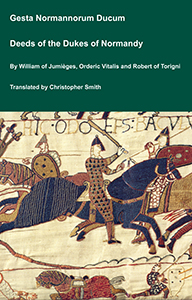
The Deeds of the Dukes of Normandy
The Gesta Normannorum Ducum [The Deeds of the Dukes of Normandy] is a landmark medieval chronicle tracing the rise and fall of the Norman dynasty from its early roots through the pivotal events surrounding the Norman Conquest of England. Originally penned in Latin by the monk William of Jumièges shortly before 1060 and later expanded at the behest of William the Conqueror, the work chronicles the deeds, politics, battles, and leadership of the Norman dukes, especially William’s own claim to the English throne. The narrative combines earlier historical sources with firsthand information and oral testimony to present an authoritative account of Normandy’s transformation from a Viking settlement into one of medieval Europe’s most powerful realms. William’s history emphasizes the legitimacy, military prowess, and governance of the Norman line, framing their expansion, including the conquest of England, as both divinely sanctioned and noble in purpose. Later chroniclers such as Orderic Vitalis and Robert of Torigni continued the history, extending the coverage into the 12th century, providing broader context on ducal rule and its impact. Today this classic work remains a foundational source for understanding Norman identity, medieval statesmanship, and the historical forces that reshaped England and Western Europe between 800AD and 1100AD.
Available at Amazon in eBook and Paperback format.
German Elector is in German Lords Temporal.

Maximilian "The Great" Wittelsbach I Duke Bavaria I Elector Bavaria was appointed Maximillian I Elector Bavaria.
Maximilian Wittelsbach II Elector Bavaria was appointed Maximillian II Elector Bavaria.
In 1415 Frederick I Elector Brandenburg [aged 43] was appointed Elector Brandenburg.
In 1471 Albert "Achilles" Elector Brandenburg [aged 56] was appointed Elector Brandenburg.
On 11th March 1486 Albert "Achilles" Elector Brandenburg [aged 71] died. His son John [aged 30] succeeded Elector Brandenburg. His son Frederick [aged 25] succeeded I Margrave Brandenburg-Ansbach. Sophia Jagiellon Margravine of Brandenburg-Ansbach [aged 21] by marriage Margravine Brandenburg-Ansbach.
On 1st December 1640 Frederick William "Great Elector" Hohenzollern Elector Brandenburg [aged 20] was appointed Elector Brandenburg.
Joachim "Nestor" Hohenzollern Elector Brandenburg was appointed Elector Brandenburg.
On 19th December 1692 Ernest Augustus Hanover Elector Brunswick-Lüneburg [aged 63] was elected Elector Brunswick Lüneburg.
In 1803 William Elector of Hesse [aged 59] was appointed Elector Hesse. Electress Wilhelmina Caroline Oldenburg [aged 55] by marriage Electress Hesse.


Chronicle of Walter of Guisborough
A canon regular of the Augustinian Guisborough Priory, Yorkshire, formerly known as The Chronicle of Walter of Hemingburgh, describes the period from 1066 to 1346. Before 1274 the Chronicle is based on other works. Thereafter, the Chronicle is original, and a remarkable source for the events of the time. This book provides a translation of the Chronicle from that date. The Latin source for our translation is the 1849 work edited by Hans Claude Hamilton. Hamilton, in his preface, says: 'In the present work we behold perhaps one of the finest samples of our early chronicles, both as regards the value of the events recorded, and the correctness with which they are detailed; Nor will the pleasing style of composition be lightly passed over by those capable of seeing reflected from it the tokens of a vigorous and cultivated mind, and a favourable specimen of the learning and taste of the age in which it was framed.'
Available at Amazon in eBook and Paperback format.
In 1410 Louis Wittelsbach III Elector Palatine [aged 31] was appointed III Elector Palatine.
Frederick Palatine III Elector Palatine succeeded III Elector Palatine.
On 19th March 1553 Alberta Palatinate Simmern [aged 14] died. Her brother Louis [aged 13] succeeded VI Elector Palatine Rhine.
On 22nd October 1583 Louis VI Elector Palatine [aged 44] died. His son Frederick [aged 9] succeeded IV Elector Palatine Rhine.
Before 16th July 1594 Frederick IV Elector Palatine [aged 20] and Electress Louise Juliana of the Palatine Rhine [aged 18] were married. She by marriage Electress Palatine Rhine. He the son of Louis VI Elector Palatine.
On 19th September 1610 Frederick Palatinate Simmern V Elector Palatine Rhine [aged 14] was elected V Elector Palatine Rhine.


On 28th August 1680 Charles Louis Palatinate Simmern [aged 62] died. His son Charles [aged 29] succeeded II Elector Palatine Rhine.
On 9th July 1553 Maurice Elector of Saxony [aged 32] died. His brother Augustus [aged 26] succeeded Elector Saxony.
On 11th February 1586 Augustus Wettin Elector of Saxony [aged 59] died. His son Christian [aged 25] succeeded Elector Saxony.
On 25th September 1591 Christian Wettin I Elector Saxony [aged 30] died. His son John [aged 6] succeeded Elector Saxony.
The History of William Marshal was commissioned by his son shortly after William’s death in 1219 to celebrate the Marshal’s remarkable life; it is an authentic, contemporary voice. The manuscript was discovered in 1861 by French historian Paul Meyer. Meyer published the manuscript in its original Anglo-French in 1891 in two books. This book is a line by line translation of the first of Meyer’s books; lines 1-10152. Book 1 of the History begins in 1139 and ends in 1194. It describes the events of the Anarchy, the role of William’s father John, John’s marriages, William’s childhood, his role as a hostage at the siege of Newbury, his injury and imprisonment in Poitou where he met Eleanor of Aquitaine and his life as a knight errant. It continues with the accusation against him of an improper relationship with Margaret, wife of Henry the Young King, his exile, and return, the death of Henry the Young King, the rebellion of Richard, the future King Richard I, war with France, the death of King Henry II, and the capture of King Richard, and the rebellion of John, the future King John. It ends with the release of King Richard and the death of John Marshal.
Available at Amazon in eBook and Paperback format.
On 8th October 1656 John George Elector Saxony [aged 71] died. His son John [aged 43] succeeded Elector Saxony.
On 22nd August 1680 John George Wettin Elector Saxony [aged 67] died. His son John [aged 33] succeeded Elector Saxony.
On 12th September 1691 John George Wettin III Elector Saxony [aged 44] died. His son John [aged 22] succeeded IV Elector Saxony.