

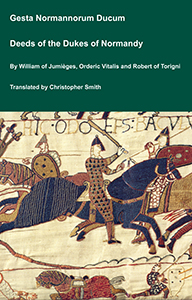
The Deeds of the Dukes of Normandy
The Gesta Normannorum Ducum [The Deeds of the Dukes of Normandy] is a landmark medieval chronicle tracing the rise and fall of the Norman dynasty from its early roots through the pivotal events surrounding the Norman Conquest of England. Originally penned in Latin by the monk William of Jumièges shortly before 1060 and later expanded at the behest of William the Conqueror, the work chronicles the deeds, politics, battles, and leadership of the Norman dukes, especially William’s own claim to the English throne. The narrative combines earlier historical sources with firsthand information and oral testimony to present an authoritative account of Normandy’s transformation from a Viking settlement into one of medieval Europe’s most powerful realms. William’s history emphasizes the legitimacy, military prowess, and governance of the Norman line, framing their expansion, including the conquest of England, as both divinely sanctioned and noble in purpose. Later chroniclers such as Orderic Vitalis and Robert of Torigni continued the history, extending the coverage into the 12th century, providing broader context on ducal rule and its impact. Today this classic work remains a foundational source for understanding Norman identity, medieval statesmanship, and the historical forces that reshaped England and Western Europe between 800AD and 1100AD.
Available at Amazon in eBook and Paperback format.
Paternal Family Tree: Fitzgerald
Around 1075 Gerald of Windsor was born to [his father] Walter FitzOther at Windsor Castle [Map].
After 1099 [his father] Walter FitzOther died.
In 1100 [his son] William Fitzgerald was born to Gerald of Windsor (age 25) and [his future wife] Nest ferch Rhys Dinefwr (age 15) at Carew Castle [Map]. He married Maria Montgomery and had issue.
In 1105 [his son] Maurice Fitzgerald was born to Gerald of Windsor (age 30) and [his future wife] Nest ferch Rhys Dinefwr (age 20) at Windsor Castle [Map].
Around 1106 [his son] David Fitzgerald was born to Gerald of Windsor (age 31) and [his future wife] Nest ferch Rhys Dinefwr (age 21).
Before 1135 Gerald of Windsor (age 59) and Nest ferch Rhys Dinefwr (age 49) were married. She the daughter of Rhys ap Tewdwr King Deheubarth and Gwladys ferch Rhiwallon Mathrafal Queen Consort Deheubarth (age 74).
In 1135 Gerald of Windsor (age 60) died.
Before 1136 [his former wife] Nest ferch Rhys Dinefwr (age 50) died.
The Itinerary of Archbishop Baldwin through Wales: Book 1 Chapter 12. The province of Penbroch adjoins the southern part of the territory of Ros, and is separated from it by an arm of the sea. Its principal city, and the metropolis of Demetia [Map], is situated on an oblong rocky eminence, extending with two branches from Milford Haven, from whence it derived the name of Penbroch [Map], which signifies the head of the aestuary. Arnulph de Montgomery,101 in the reign of king Henry I., erected here a slender fortress with stakes and turf, which, on returning to England, he consigned to the care of Giraldus de Windesor,102 his constable and lieutenant-general, a worthy and discreet man. Immediately on the death of Rhys son of Tewdwr, who a short time before had been slain by the treachery of his own troops at Brecheinoc, leaving his son, [his former brother-in-law] Gruffydd, a child, the inhabitants of South Wales besieged the castle. One night, when fifteen soldiers had deserted, and endeavoured to escape from the castle in a small boat, on the following morning Giraldus invested their armour bearers with the arms and estates of their masters, and decorated them with the military order. The garrison being, from the length of the siege, reduced to the utmost want of provisions, the constable, with great prudence and flattering hopes of success, caused four hogs, which yet remained, to be cut into small pieces and thrown down to the enemy from the fortifications. The next day, having again recourse to a more refined stratagem, he contrived that a letter, sealed with his own signet, should be found before the house of Wilfred,103 bishop of St. David's, who was then by chance in that neighbourhood, as if accidentally dropped, stating that there would be no necessity of soliciting the assistance of earl Arnulph for the next four months to come. The contents of these letters being made known to the army, the troops abandoned the siege of the castle, and retired to their own homes. Giraldus, in order to make himself and his dependants more secure, married [his former wife] Nest, the sister of Gruffydd, prince of South Wales, by whom he had an illustrious progeny of both sexes; and by whose means both the maritime parts of South Wales were retained by the English, and the walls of Ireland afterwards stormed, as our Vaticinal History declares.
Note 101. Arnulph, younger son of Roger de Montgomery, did his homage for Dyved, and is said, by our author, to have erected a slender fortress with stakes and turf at Pembroke, in the reign of king Henry I., which, however, appears to have been so strong as to have resisted the hostile attack of Cadwgan ap Bleddyn in 1092, and of several lords of North Wales, in 1094.
Note 102. Walter Fitz-Other, at the time of the general survey of England by William the Conqueror, was castellan of Windsor, warden of the forests in Berkshire, and possessed several lordships in the counties of Middlesex, Hampshire, and Buckinghamshire, which dominus Otherus is said to have held in the time of Edward the Confessor. William, the eldest son of Walter, took the surname of Windsor from his father's office, and was ancestor to the lords Windsor, who have since been created earls of Plymouth: and from Gerald, brother of William, the Geralds, Fitz-geralds, and many other families are lineally descended. The Gerald here mentioned by Giraldus is sometimes surnamed De Windsor, and also Fitz-Walter, i.e. the son of Walter; having slain Owen, son of Cadwgan ap Bleddyn, chief lord of Cardiganshire, he was made president of the county of Pembroke.
Note 103. Wilfred is mentioned by Browne Willis in his list of bishops of St. David's, as the forty-seventh, under the title of Wilfride, or Griffin: he died about the year 1116.
The Itinerary of Archbishop Baldwin through Wales: Introduction. Though his mother was half Saxon and his father probably fully Norman, Gerald, with a true instinct, described himself as a "Welshman." His frank vanity, so naive as to be void of offence, his easy acceptance of everything which Providence had bestowed on him, his incorrigible belief that all the world took as much interest in himself and all that appealed to him as he did himself, the readiness with which he adapted himself to all sorts of men and of circumstances, his credulity in matters of faith and his shrewd common sense in things of the world, his wit and lively fancy, his eloquence of tongue and pen, his acute rather than accurate observation, his scholarship elegant rather than profound, are all characteristic of a certain lovable type of South Walian. He was not blind to the defects of his countrymen any more than to others of his contemporaries, but the Welsh he chastised as one who loved them. His praise followed ever close upon the heels of his criticism. There was none of the rancour in his references to Wales which defaces his account of contemporary Ireland. He was acquainted with Welsh, though he does not seem to have preached it, and another archdeacon acted as the interpreter of Archbishop Baldwin's (age 62) Crusade sermon in Anglesea. But he could appreciate the charm of the Cynghanedd, the alliterative assonance which is still the most distinctive feature of Welsh poetry. He cannot conceal his sympathy with the imperishable determination of his countrymen to keep alive the language which is their differentia among the nations of the world. It is manifest in the story which he relates at the end of his "Description of Wales." Henry II. asked an old Welshman of Pencader in Carmarthenshire if the Welsh could resist his might. "This nation, O King," was the reply, "may often be weakened and in great part destroyed by the power of yourself and of others, but many a time, as it deserves, it will rise triumphant. But never will it be destroyed by the wrath of man, unless the wrath of God be added. Nor do I think that any other nation than this of Wales, or any other tongue, whatever may hereafter come to pass, shall on the day of the great reckoning before the Most High Judge, answer for this corner of the earth." Prone to discuss with his "Britannic frankness" the faults of his countrymen, he cannot bear that any one else should do so. In the "Description of Wales" he breaks off in the middle of a most unflattering passage concerning the character of the Welsh people to lecture Gildas for having abused his own countrymen. In the preface to his "Instruction of Princes," he makes a bitter reference to the prejudice of the English Court against everything Welsh - "Can any good thing come from Wales?" His fierce Welshmanship is perhaps responsible for the unsympathetic treatment which he has usually received at the hands of English historians. Even to one of the writers of Dr. Traill's "Social England," Gerald was little more than "a strong and passionate Welshman."
The Itinerary of Archbishop Baldwin through Wales: Introduction. Gerald was therefore born to romance and adventure. He was reared in the traditions of the House of Dinevor. He heard the brilliant and pitiful stories of Rhys ap Tewdwr, who, after having lost and won South Wales, died on the stricken field fighting against the Normans [Battle of Mynydd Carn], an old man of over fourscore years; and of his gallant son, [his former brother-in-law] Prince Rhys, who, after wrenching his patrimony from the invaders, died of a broken heart a few months after his wife, the Princess Gwenllian, had fallen in a skirmish at Kidwelly. No doubt he heard, though he makes but sparing allusion to them, of the loves and adventures of his grandmother, the [his former wife] Princess Nesta, the daughter and sister of a prince, the wife of an adventurer, the concubine of a king, and the paramour of every daring lover - a Welshwoman whose passions embroiled all Wales, and England too, in war, and the mother of heroes - Fitz-Geralds, Fitz-Stephens, and Fitz-Henries, and others - who, regardless of their mother's eccentricity in the choice of their fathers, united like brothers in the most adventurous undertaking of that age, the Conquest of Ireland.
[his daughter] Angharad FitzGerald was born to Gerald of Windsor and Nest ferch Rhys Dinefwr.
Philippa Lancaster Queen Consort Denmark [1]
King Richard III of England [2]
Anne Neville Queen Consort England [2]
Queen Anne Boleyn of England [4]
Catherine Parr Queen Consort England [2]
Queen Catherine Howard of England [3]
Jane Grey I Queen England and Ireland [5]
George Wharton [33]
President George Washington [2]
Brigadier-General Charles Fitz-Clarence [121]
Queen Elizabeth II of the United Kingdom [506]
Queen Consort Camilla Shand [170]
Diana Spencer Princess Wales [1492]