

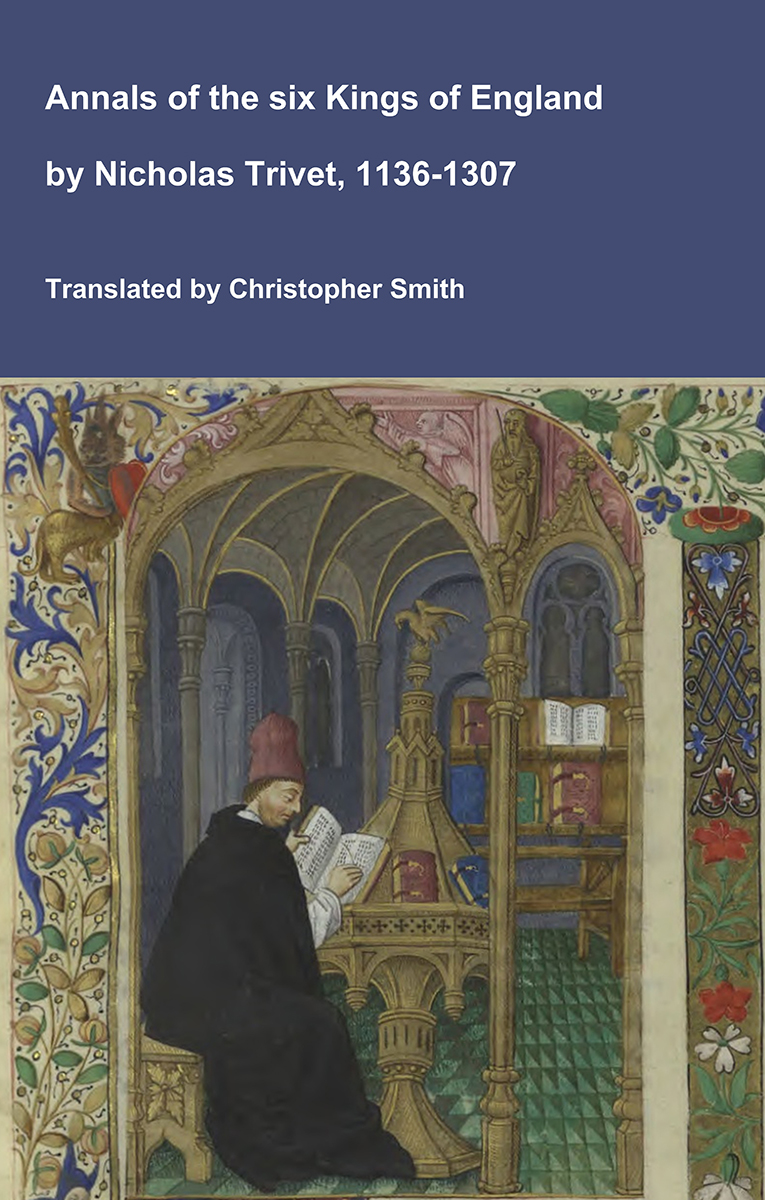
Annals of the six Kings of England by Nicholas Trivet
Translation of the Annals of the Six Kings of England by that traces the rise and rule of the Angevin aka Plantagenet dynasty from the mid-12th to early 14th century. Written by the Dominican scholar Nicholas Trivet, the work offers a vivid account of English history from the reign of King Stephen through to the death of King Edward I, blending political narrative with moral reflection. Covering the reigns of six monarchs—from Stephen to Edward I—the chronicle explores royal authority, rebellion, war, and the shifting balance between crown, church, and nobility. Trivet provides detailed insight into defining moments such as baronial conflicts, Anglo-French rivalry, and the consolidation of royal power under Edward I, whose reign he describes with particular immediacy. The Annals combines careful year-by-year reporting with thoughtful interpretation, presenting history not merely as a sequence of events but as a moral and political lesson. Ideal for readers interested in medieval history, kingship, and the origins of the English state, this chronicle remains a valuable and accessible window into the turbulent world of the Plantagenet kings.
Available at Amazon in eBook and Paperback format.
Holyrood Chronicle. 6th November 1153. Eo die8 apud9 Scotiam Sumerlede1 et nepotes sui, filii scilicet Malcolmi2, a[s]so[c]iatis3 sibi plurimis, insurrexerunt4 in regem Malcolm, et Scotiam in magna parte perturban[t]es inquietaverunt.
On that day [?], in Scotland, Somerled and his nephews, the sons of Malcolm [Macheth], allied with themselves very many men, and rebelled against king Malcolm, and disturbed and disquieted Scotland to a great extent.
Note 8. Eo die: In K and L, there is no mark of punctuation before eo. Perhaps Eo die is an error for Eodem anno.
Note 9. apud: L, apput.
Note 1. Sumerlede: Somerled, Gillebrigte's son, lord of Argyll. The Chronicle of Holyrood is the authority for his rebellion in 1153. The fact and date of the rebellion are to some extent confirmed by the Chronicle of Melrose, which describes him thus at his death in 1164: Sumerledus regulus Eregeithel, jam per annos duodecim contra regem Scotie Malcolmum dominum mum naturalem impie rebellans. But he seems to have been reconciled with king Malcolm for a time. A charter of king Malcolm, of 25 Dec. 1160, is dated on the Christmas after their reconciliation: apud Pert in natali domini proximo post concordiam Regis et Sumerledi (Registrum episcopatus Moraviensis, p. 453). Compare below, p. 137.
The foundation of the Cistercian abbey of Saddell, in Kintyre, appears to have been dated in 1160 in the Cistercian List (Journal of the British Archaeological Association, xxvi, p. 361), within this period of reconciliation.
Note 2. Malcolmi: Malcolm Macheth had apparently married a sister of Somerled. See below, 1156 and 115
Note 3. a[s]so[c]iatis: K, asotiatis; L, asociatis.
Note 4. insurrexerunt: L, insurexerunt.
Holyrood Chronicle. 1164. Sumerlede regis Scotie adversarius cum maxima classe apud Remfriu predaturus applicuit, et ipse ibi et films ejus cum innumerabili multitudine suorum interfectus est.6
Somerled, the opponent of the king of Scotland, landed with a great fleet at Renfrew, to plunder; and there he was killed with his son, and an innumerable host of his people.
Note 6. See 1153, note. For accounts of this affair, see Early Sources, ii, pp. 254-258. The Chronicle of Melrose says, under 1164: "And Somerled, regulus of Argyll, who had now been for twelve years in impious rebellion against Malcolm, king of the Scots, his natural lord, after landing at Renfrew, bringing with him a large army from Ireland and various places, was at last through divine vengeance killed there by a few fellow-provincials, and with him his son and innumerable people." The account given by Howden (Rolls Series 51, i, p. 224), briefer and with a few variations, is derived from the source of that passage (see above, p. 31).
Chronicle of Man and the Isles. 1164. In the year 1164, Somerled assembled a fleet of 160 ships and put in at Renfrew, with the intention of subduing the whole of Scotland. But through divine punishment he was overcome by a small number of foes, and there slain with his son and a vast number of his people.
Chronicle of Man and the Isles. 1192. In the year 1192, there was a contest between the sons of Somerled, Reginald, and Angus, in which many were wounded and fell, but Angus gained the victory. In the same year, the abbey of St. Many of Rushen was removed to Pouglas. After remaining there four years the monks returned to Rushen.
Chronicle of Man and the Isles. 1210. In the year 1210, Angus, son of Somerled, was killed, with his three sons. In the same year, John, King of Eng land, with a fleet of 50 ships, went to Ireland and subdued it. He sent a part of the army, with an earl of the name of Fulke, to Man. This force in fifteen days devastated nearly the whole island, and receiving hostages returned home. King Reginald, however, and his nobles were absent from Man at the time.
Time Team Series 2 Episode 1: Lord of the Isles was filmed between 24th June 1994 and 26th June 1994 was filmed. It was originally shown on 8th January 1995.
Location: Finlaggan, Islay [Map]
Category: Time Team Prehistory, Time Team Early Medieval.
The Time Team:
Tony Robinson (age 48), Presenter
Mick Aston (age 48), Bristol University Landscape Archaeologist
Carenza Lewis (age 31), Royal Commission on Historic Monuments
Phil Harding (age 44), Wessex Archaeological Trust Field Archaeologist
Robin Bush (age 51), Archivist
Victor Ambrus (age 59), Historical Illustrator
John Gator, Chris Gaffney, Geophysics
Stewart Ainsworth (age 43), Landscape Archaeologist
David Caldwell, Director of Excavations
Kate Bonner, Excavation Team
Sally Ann Chandler, Period Clothing Expert
Donald Macfadian, Finlaggan Trust
Simon Mears, GPS System
Historical Figures: King Somerled of Argyll
Sources: Chronicle of Man and the Isles, A Description of the Western Isles of Scotland by Martin Martin, A Description of the Western Isles of Scotland by Martin Martin.
Outcomes: Partly complete Glass Bead, Replica aketon, possible mesolithic site, possibly stone rows aligned to Paps of Jura.