

Abbot John Whethamstede’s Chronicle of the Abbey of St Albans
Abbot John Whethamstede's Register aka Chronicle of his second term at the Abbey of St Albans, 1451-1461, is a remarkable text that describes his first-hand experience of the beginning of the Wars of the Roses including the First and Second Battles of St Albans, 1455 and 1461, respectively, their cause, and their consequences, not least on the Abbey itself. His text also includes Loveday, Blore Heath, Northampton, the Act of Accord, Wakefield, and Towton, and ends with the Coronation of King Edward IV. In addition to the events of the Wars of the Roses, Abbot John, or his scribes who wrote the Chronicle, include details in the life of the Abbey such as charters, letters, land exchanges, visits by legates, and disputes, which provide a rich insight into the day-to-day life of the Abbey, and the challenges faced by its Abbot.
Available at Amazon in eBook and Paperback format.
Province of Ulster is in Ireland.
On 5th August 1599 Alexander Radclyffe of Ordsall Hall [aged 26] died of wounds and fever in Ulster while campaigning with the Robert Devereux 2nd Earl Essex [aged 33] during the unsuccessful attempt to bring Ireland under English control. The Queen [aged 65] herself informed his twin sister of her brother's death.
Gartnanoul Court Tomb is also in Prehistoric Ireland.
Gartnanoul Court Tomb [Map] is a dual-tomb because it has two tombs in line with each other, with each tomb having its own court. It is estimated that when it was built Gartnanoul was 28 metres long and 8 metres wide.
In 464 Conall Gulban King was murdered by the Masraige at Magh Slécht. He was buried by Saint Caillín at Fenagh. His descendants are known as the Cenél Conaill; geographically the western half of Donegal aka Tir Conaill. The Cenél Conaill is part of the Northern Uí Néill.
On 19th March 1824 William Allingham was born at Ballyshannon.
In 465 Eógan mac Néill died. He was buried at the Inishowen Peninsula. His ancestors form the Cenél nEógain; geographically eastern Donegal.
In 1620 William Fitzwilliam 1st Baron Fitzwilliam [aged 42] was created 1st Baron Fitzwilliam of Liffer in Donegal. Liffer being an alternative spelling of Lifford.
In September 1607 describes the leaving of Ireland by Hugh O'Neill 1st Earl of Tyrone [aged 57] and Rory O'Donnell 1st Earl of Tyrconnell [aged 32], and around ninety of their followers, from Ireland to Europe. The event was first named as a "flight" in a book by the Reverend C. P. Meehan that was published in 1868. The set sail from Rathmullan.
Goward Dolmen is also in Prehistoric Ireland.
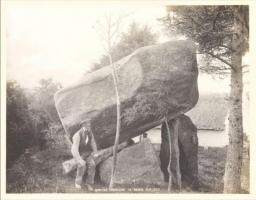
1898. Robert Welch [aged 38]. Goward Dolmen [Map].
Legananny Dolmen is also in Prehistoric Ireland.
Legananny Dolmen [Map]. Tripod dolmen has a capstone over 3m long and 1.8 m from the ground.
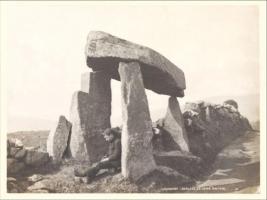
1898. Robert Welch [aged 38]. Legananny Dolmen [Map].
Chronicle of a Bourgeois of Valenciennes
Récits d’un bourgeois de Valenciennes aka The Chronicle of a Bourgeois of Valenciennes is a vivid 14th-century vernacular chronicle written by an anonymous urban chronicler from Valenciennes in the County of Hainaut. It survives in a manuscript that describes local and regional history from about 1253 to 1366, blending chronology, narrative episodes, and eyewitness-style accounts of political, military, and social events in medieval France, Flanders, and the Low Countries. The work begins with a chronological framework of events affecting Valenciennes and its region under rulers such as King Philip VI of France and the shifting allegiances of local nobility. It includes accounts of conflicts, sieges, diplomatic manoeuvres, and the impact of broader struggles like the Hundred Years’ War on urban life in Hainaut. Written from the perspective of a burgher (bourgeois) rather than a monastery or royal court, the chronicle offers a rare lay viewpoint on high politics and warfare, reflecting how merchants, townspeople, and civic institutions experienced the turbulence of the 13th and 14th centuries. Its narrative style combines straightforward reporting of events with moral and civic observations, making it a valuable source for readers interested in medieval urban society, regional politics, and the lived experience of war and governance in pre-modern Europe.
Available at Amazon in eBook and Paperback format.
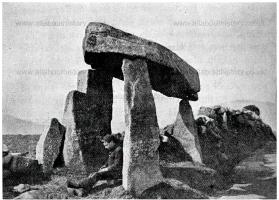
Handbook of Irish Antiquities by Wakeman Chapter 1. Legananny Cromlech [Map]. This cromlech is in the townland of Legananny, on the southern slope of Cratlieve mountain, in Co. Down, about six miles north-west of Castlewellan. The cap is a coffin-shaped granite block, 11 feet 4 inches long, 4 feet 9 inches wide at the south-east end, and 3 feet at the foot or north-west end. It rests upon three upright pillars, the two at the south-west measuring 7 feet and 6 feet 2 inches respectively, the third block at the foot being 4 feet 5 inches high. An urn was found in the chamber beneath. It has no sign of ever having been covered; and Fergusson has instanced it as an example of the free-standing62 cromlech in combating the theory that all cromlechs were originally covered by cairns or mounds.
On 13th August 1667 Bishop Jeremy Taylor [aged 54] died at Lisburn, Antrim. He was buried in Dromore Cathedral.
On 16th August 1312 Thomas Fitzgerald 2nd Earl of Kildare and Joan Burgh Countess Kildare [aged 12] were married at Greencastle, County Down. She by marriage Countess Kildare. She the daughter of Richard "Red Earl" Burgh 2nd Earl of Ulster [aged 53] and Margaret Burgh Countess Ulster. He the son of John Fitzgerald 1st Earl of Kildare [aged 62] and Blanche La Roche Countess Kildare [aged 57].
In 1591 Toby Caulfeild 1st Baron Caulfeild [aged 25] joined the Robert Devereux 2nd Earl Essex [aged 25] to Ireland, in command of a troop of horse, and was for a time stationed at Newry.
Ballymacdermot Court Tomb is also in Prehistoric Ireland.
Archaeologia Volume 15 Appendix. March 14th, 1804. The Rev. the Dean of Raphoe presented to the Society four original drawings of some caves [Ballymacdermot Court Tomb [Map]], which he had discovered on his glebe, in the parish of Killevy, in the county of Armagh in Ireland. Some account of these caves, with engravings, has been published by General Vallencey, in his Collectanea de Rebus Hibernicis; yet, for the satisfaction of such gentlemen as may not have seen that publication, the Dean accompanied his present with a short description, as follows:
On 3rd May 1987 Viola Maud Lyttelton Duchess Westminster [aged 74] died in a car accident at Dungannon, County Tyrone. She was returning to Ely Lodge, on the shore of Lough Erne. Her funeral was held at St Macartin's Cathedral, Enniskillen. She was buried at Monea, Fermanagh.
On 3rd May 1987 Viola Maud Lyttelton Duchess Westminster [aged 74] died in a car accident at Dungannon, County Tyrone. She was returning to Ely Lodge, on the shore of Lough Erne. Her funeral was held at St Macartin's Cathedral, Enniskillen. She was buried at Monea, Fermanagh.
In 1624 Ralph Bingley [aged 54] was elected Mayor of Derry aka Londonderry.
On 21st December 1679 Bishop Robert Mossum [aged 62] died at Derry aka Londonderry.
John Evelyn's Diary. 26th April 1689. There now came certain news that King James [aged 55] had not only landed in Ireland, but that he had surprised Derry aka Londonderry, and was become master of that kingdom, to the great shame of our government, who had been so often solicited to provide against it by timely succor, and which they might so easily have done. This is a terrible beginning of more troubles, especially should an army come thence into Scotland, people being generally disaffected here and everywhere else, so that the seamen and landmen would scarce serve without compulsion.


John Evelyn's Diary. 19th July 1689. The Marshal de Schomberg [aged 73] went now as General toward Ireland, to the relief of Derry aka Londonderry. Our fleet lay before Brest. The Confederates passing the Rhine, besiege Bonn and Mayence, to obtain a passage into France. A great victory gotten by the Muscovites, taking and burning Perecop. A new rebel against the Turks threatens the destruction of that tyranny. All Europe in arms against France, and hardly to be found in history so universal a face of war.
John Evelyn's Diary. 25th August 1689. Hitherto it has been a most seasonable summer. Derry aka Londonderry relieved after a brave and wonderful holding out.
On 25th January 1944 John Leslie 2nd Baronet [aged 86] died at Glaslough. His son John [aged 58] succeeded 3rd Baronet Leslie of Glaslough in County Monaghan.
Loughash Wedge Tomb is also in Prehistoric Ireland.
Abbot John Whethamstede’s Chronicle of the Abbey of St Albans
Abbot John Whethamstede's Register aka Chronicle of his second term at the Abbey of St Albans, 1451-1461, is a remarkable text that describes his first-hand experience of the beginning of the Wars of the Roses including the First and Second Battles of St Albans, 1455 and 1461, respectively, their cause, and their consequences, not least on the Abbey itself. His text also includes Loveday, Blore Heath, Northampton, the Act of Accord, Wakefield, and Towton, and ends with the Coronation of King Edward IV. In addition to the events of the Wars of the Roses, Abbot John, or his scribes who wrote the Chronicle, include details in the life of the Abbey such as charters, letters, land exchanges, visits by legates, and disputes, which provide a rich insight into the day-to-day life of the Abbey, and the challenges faced by its Abbot.
Available at Amazon in eBook and Paperback format.
Loughash Wedge Tomb [Map]. Known on the OS maps as 'Giants Grave', this burial tomb dates from around 4500 years ago. It is called a wedge tomb because it narrows in size from front to back and also decreases in height.
On 4th February 1653 Phelim Roe O'Neill of Kinard [aged 49] was captured by William Caulfeild 1st Viscount Charlemont [aged 29] on an island in Roughan Lough where he had taken refuge. William Caulfeild 1st Viscount Charlemont possibly considered Phelim Roe O'Neill of Kinard was responsible for the death of his father William Caulfeild 2nd Baron Caulfeild [aged 66] with whom Phelim had been dining when captured, imprisoned and, fifteen weeks later, shot.
In 1655 James Hamilton 3rd Baron Hamilton of Strabane [aged 22] drowned in the River Mourne near Strabane. His brother George [aged 21] succeeded 4th Baron Hamilton of Strabane.
In June 1701 Charles Hamilton 5th Earl Abercorn [aged 41] died in Strabane without issue. His second cousin James [aged 40] succeeded 6th Earl Abercorn.