

Chronicle of Walter of Guisborough
A canon regular of the Augustinian Guisborough Priory, Yorkshire, formerly known as The Chronicle of Walter of Hemingburgh, describes the period from 1066 to 1346. Before 1274 the Chronicle is based on other works. Thereafter, the Chronicle is original, and a remarkable source for the events of the time. This book provides a translation of the Chronicle from that date. The Latin source for our translation is the 1849 work edited by Hans Claude Hamilton. Hamilton, in his preface, says: 'In the present work we behold perhaps one of the finest samples of our early chronicles, both as regards the value of the events recorded, and the correctness with which they are detailed; Nor will the pleasing style of composition be lightly passed over by those capable of seeing reflected from it the tokens of a vigorous and cultivated mind, and a favourable specimen of the learning and taste of the age in which it was framed.'
Available at Amazon in eBook and Paperback format.
Peterborough Ware is in Pottery.
Peterborough Ware is one of three major groups of Neolithic pottery. Its makers seem usually to have lived in low-lying areas like the Thames valley, where one of the largest concentrations of the pottery in Britain occurs. In Middlesex the largest finds have come from the Heathrow site and, in lesser quantities, from the Thames at Mortlake and Hammersmith, while at least one sherd was recovered from Yeoveney.

In 1924 Alexander Keiller [aged 34] bought Windmill Hill Causewayed Enclosure [Map] and excavated between 1925 to 1929 with Harold St George Gray [aged 51]. Pottery was found in the bottom of the ditches - probably Windmill Hill Pottery. Upper layers contained Peterborough Ware. Later deposits contained Grooved Ware and Beaker Potsherds suggesting continuous occupation over an extended period.
Wiltshire Archaeological Magazine 1930 V45 Pages 300-335. THE POTTERY.
The quantity of pottery found is small, but fortunately more than from the holes at Woodhenge [Map]. At Woodhenge [Map] most of the pottery and other objects came from the ditch or from under the bank, but at the Sanctuary there is no bank or ditch.
About 200 sherds in all were found, some showing distinctive ornament but many are plain and of indefinite character.
With the exception of three small pieces from the surface of Early Iron Age or Romano-British date, the pottery all belongs to one group, composed of two distinct but overlapping types, The earlier of these is known as the West Kennet, or Peterborough long-barrow type, the later as "Beaker" pottery.
Pottery of the West Kennet type seems to be characteristic of the long-barrow people who inhabited southern Britain before the arrival of the "Beaker" people who buried their dead in round barrows.
Archaeologia Volume 84 1935 Section VI. The mixed silting proved to be an interesting deposit as far as fragments of pottery were concerned, for there were three definite archaeological types. In the upper third, and above a depth of 4.5 ft. from the surface, Norman and medieval pottery1 was found commonly, indicating not only that Avebury was overrun during those times, but also that since early Norman times about 4.5 ft. of silting had accumulated in this part of the fosse. Secondly, pottery of the Roman period was found at depths varying from 5 to 6 ft. in the middle of the mixed silting deposit; and thirdly, two fragments of pottery (no. 44), belonging to the Peterborough ware — Beaker horizon — were found in the lowest third of the mixed silting at a depth of 7 ft. from the surface. In the middle division of this area twenty-five fragments of pottery were collected, all of Romano-British type and unornamented. Some of the pieces were small, and it is possible that a few of them may be post-Roman, but all undoubtedly are pre-Norman. The pieces of Roman ware associated with the Romano-British pottery consisted of a very thin fragment, brick-red on the two surfaces, light grey inside (no. 80, depth 5 ft.); a handle of a vessel of similar character (no. 109, depth 6 ft.); a fragment of thin grey pottery (no. 116, depth 57 ft.); a large piece of the side and neck of painted New Forest grey pottery painted a dull black on both surfaces (no. 98, depth 5.8 ft.); and a piece of tile, tegulum (no. 24, depth 5.4 ft.).
Note 1. Among these sherds is a large proportion of pieces of rims and bottoms of vessels; less frequently handles of pots were found, and fragments bearing definite traces of glaze. This pottery bears a close resemblance, both in quality, form, and general character, to that found in my excavations in the large camp known as 'Castle Neroche', 7 miles SSE. of Taunton (Proc . Som. Arch. Soc. xlix, ii, 23-53).
Ebbsfleet Ware. Named from pottery found in the Ebbsfleet valley in north-east Kent. The fabric of Ebbsfleet pottery tends to be inferior to that of Windmill Hill Pottery, but the vessels are normally quite well made, in rather globular shapes with simple rims, distinct necks, rounded or occasionally sharp shoulders, and a moderate amount of decoration round the upper part of the pot, sometimes extending inside the rim. Decorative motifs include incised patterns, finger-nail and, more rarely, vertical cord impressions, and pits in the neck usually made with the finger-tips. Ebbsfleet pottery developed into Mortlake ware.
West Kennet Long Barrow [Map] is a Severn Cotswolds Tomb type tomb, probably constructed in the 3700s BC. Human bones of men, women and children were placed in the chambers between 3670 and 3635 BC. The site appears to be subsequently re-used between 3620 and 3240 BC. In the late Neolithic it was blocked up with the addition of large sarsen boulders. It is 100m in length, 20m wide, constructed from earth with ditches on both sides, oriented east-west. At the east end are multiple chambers formed off a passage that extends 12m into the barrow. The ceiling is between 1.7 and 2.2m high - sufficient to allow an adult to stand upright.
Finds included Grooved Ware, Beaker Ware, Ebbsfleet Ware, Mortlake Ware and Fengate Ware coming from more than two hundred and fifty vessels.
Around 3600BC. Combe Hill [Map] is a causewayed enclosure on the northern edge of the South Downs in Sussex. The enclosure has been excavated twice: in 1949, by Reginald Musson, and in 1962, by Veronica Seton-Williams. Musson found a large quantity of Ebbsfleet Ware pottery in one of the ditches.
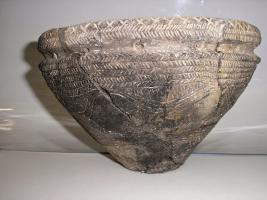
Fengate Ware. The bases and contours tend to become flattened and the rims to overhang the walls of the pot in a way that suggests the overhanging-rim urns of the Bronze Age.
Photo: Fengate Ware, Berkshire, 1990,1009.31, British Museum (order FI-000715026).
West Kennet Long Barrow [Map] is a Severn Cotswolds Tomb type tomb, probably constructed in the 3700s BC. Human bones of men, women and children were placed in the chambers between 3670 and 3635 BC. The site appears to be subsequently re-used between 3620 and 3240 BC. In the late Neolithic it was blocked up with the addition of large sarsen boulders. It is 100m in length, 20m wide, constructed from earth with ditches on both sides, oriented east-west. At the east end are multiple chambers formed off a passage that extends 12m into the barrow. The ceiling is between 1.7 and 2.2m high - sufficient to allow an adult to stand upright.
Finds included Grooved Ware, Beaker Ware, Ebbsfleet Ware, Mortlake Ware and Fengate Ware coming from more than two hundred and fifty vessels.
Mortlake Ware developed from Ebbsfleet Ware. Typified by a bowl (now in the British Museum) and other pottery from the Thames at Mortlake. Mortlake pottery is generally cruder and clumsier than Ebbsfleet ware and made of thicker, softer fabric.
The vessels usually have heavy projecting rims, deeply hollowed necks, sharp shoulders, and round bases, although flat bases are not unknown.
Close-set impressed decoration, often arranged herring-bone fashion, covers most of the exterior and sometimes the upper part of the interior. Some of the devices, like pits in the neck, resemble those on Ebbsfleet pottery, but cord impressions are much more common and new techniques, such as rustication (pinching the clay between two finger-nails), appear.
Abbot John Whethamstede’s Chronicle of the Abbey of St Albans
Abbot John Whethamstede's Register aka Chronicle of his second term at the Abbey of St Albans, 1451-1461, is a remarkable text that describes his first-hand experience of the beginning of the Wars of the Roses including the First and Second Battles of St Albans, 1455 and 1461, respectively, their cause, and their consequences, not least on the Abbey itself. His text also includes Loveday, Blore Heath, Northampton, the Act of Accord, Wakefield, and Towton, and ends with the Coronation of King Edward IV. In addition to the events of the Wars of the Roses, Abbot John, or his scribes who wrote the Chronicle, include details in the life of the Abbey such as charters, letters, land exchanges, visits by legates, and disputes, which provide a rich insight into the day-to-day life of the Abbey, and the challenges faced by its Abbot.
Available at Amazon in eBook and Paperback format.
West Kennet Long Barrow [Map] is a Severn Cotswolds Tomb type tomb, probably constructed in the 3700s BC. Human bones of men, women and children were placed in the chambers between 3670 and 3635 BC. The site appears to be subsequently re-used between 3620 and 3240 BC. In the late Neolithic it was blocked up with the addition of large sarsen boulders. It is 100m in length, 20m wide, constructed from earth with ditches on both sides, oriented east-west. At the east end are multiple chambers formed off a passage that extends 12m into the barrow. The ceiling is between 1.7 and 2.2m high - sufficient to allow an adult to stand upright.
Finds included Grooved Ware, Beaker Ware, Ebbsfleet Ware, Mortlake Ware and Fengate Ware coming from more than two hundred and fifty vessels.