

William of Worcester's Chronicle of England
William of Worcester, born around 1415, and died around 1482 was secretary to John Fastolf, the renowned soldier of the Hundred Years War, during which time he collected documents, letters, and wrote a record of events. Following their return to England in 1440 William was witness to major events. Twice in his chronicle he uses the first person: 1. when writing about the murder of Thomas, 7th Baron Scales, in 1460, he writes '… and I saw him lying naked in the cemetery near the porch of the church of St. Mary Overie in Southwark …' and 2. describing King Edward IV's entry into London in 1461 he writes '… proclaimed that all the people themselves were to recognize and acknowledge Edward as king. I was present and heard this, and immediately went down with them into the city'. William’s Chronicle is rich in detail. It is the source of much information about the Wars of the Roses, including the term 'Diabolical Marriage' to describe the marriage of Queen Elizabeth Woodville’s brother John’s marriage to Katherine, Dowager Duchess of Norfolk, he aged twenty, she sixty-five or more, and the story about a paper crown being placed in mockery on the severed head of Richard, 3rd Duke of York.
Available at Amazon in eBook and Paperback format.
Paternal Family Tree: Williams aka Cromwell
1643 Trial and Execution of the Hothams
1652 Indemnity and Oblivion Act
1653 Cromwell becomes Lord Protector
On 25th April 1599 Oliver Cromwell was born to [his father] Robert Cromwell [aged 36] and [his mother] Elizabeth Steward [aged 33] at Huntingdon [Map].
On 24th June 1617 [his father] Robert Cromwell [aged 54] died at Huntingdon [Map].

On 22nd August 1620 Oliver Cromwell [aged 21] and Elizabeth Bourchier [aged 22] were married.
In 1621 [his son] Robert Cromwell was born to Oliver Cromwell [aged 21] and [his wife] Elizabeth Bourchier [aged 23].
In 1622 [his daughter] Oliver Cromwell was born to Oliver Cromwell [aged 22] and [his wife] Elizabeth Bourchier [aged 24].

In 1624 [his daughter] Bridget Cromwell was born to Oliver Cromwell [aged 24] and [his wife] Elizabeth Bourchier [aged 26]. She married (1) 15th June 1646 Henry Ireton (2) 1652 Major General Charles Fleetwood.

On 4th October 1626 [his son] Richard Cromwell Lord Protector was born to Oliver Cromwell [aged 27] and [his wife] Elizabeth Bourchier [aged 28].
On 20th January 1628 [his son] Henry Cromwell was born to Oliver Cromwell [aged 28] and [his wife] Elizabeth Bourchier [aged 30] at Huntingdon [Map]. He married 10th May 1653 Elizabeth Russell, daughter of Francis Russell 2nd Baronet and Catherine Wheatley.

On 2nd July 1629 [his daughter] Elizabeth Cromwell was born to Oliver Cromwell [aged 30] and [his wife] Elizabeth Bourchier [aged 31]. She married 13th January 1646 John Claypole.
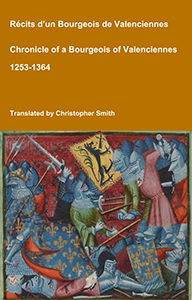
Chronicle of a Bourgeois of Valenciennes
Récits d’un bourgeois de Valenciennes aka The Chronicle of a Bourgeois of Valenciennes is a vivid 14th-century vernacular chronicle written by an anonymous urban chronicler from Valenciennes in the County of Hainaut. It survives in a manuscript that describes local and regional history from about 1253 to 1366, blending chronology, narrative episodes, and eyewitness-style accounts of political, military, and social events in medieval France, Flanders, and the Low Countries. The work begins with a chronological framework of events affecting Valenciennes and its region under rulers such as King Philip VI of France and the shifting allegiances of local nobility. It includes accounts of conflicts, sieges, diplomatic manoeuvres, and the impact of broader struggles like the Hundred Years’ War on urban life in Hainaut. Written from the perspective of a burgher (bourgeois) rather than a monastery or royal court, the chronicle offers a rare lay viewpoint on high politics and warfare, reflecting how merchants, townspeople, and civic institutions experienced the turbulence of the 13th and 14th centuries. Its narrative style combines straightforward reporting of events with moral and civic observations, making it a valuable source for readers interested in medieval urban society, regional politics, and the lived experience of war and governance in pre-modern Europe.
Available at Amazon in eBook and Paperback format.
In 1632 [his son] James Cromwell was born to Oliver Cromwell [aged 32] and [his wife] Elizabeth Bourchier [aged 34].

In 1637 [his daughter] Mary Cromwell Countess Fauconberg was born to Oliver Cromwell [aged 37] and [his wife] Elizabeth Bourchier [aged 39]. She married 18th November 1657 Thomas Belasyse 1st Earl Fauconberg.
In 1638 [his daughter] Frances Cromwell Baroness Russell was born to Oliver Cromwell [aged 38] and [his wife] Elizabeth Bourchier [aged 40]. She married (1) 11th November 1657 Robert Rich, son of Robert Rich 3rd Earl Warwick and Anne Cavendish Countess Warwick (2) 7th May 1663 John Russell 3rd Baronet, son of Francis Russell 2nd Baronet and Catherine Wheatley, and had issue.


In 1639 [his son] Robert Cromwell [aged 18] died.
In April 1643 John Hotham [aged 33] joined his troops with the Parliamentarian forces in Lincolnshire. The bad behaviour of Hotham's troops, coupled with what appeared to be attempts by Hotham to co-opt the Parliamentarian officers, raised suspicions with then Colonel Oliver Cromwell [aged 43] and John Hutchinson, the governor of Nottingham Castle. They denounced him to the Parliamentary Committee of Safety. In summer 1643 his arrest was ordered. He fled to Nottingham then attempted to travel to Hull. He was arrested with his father John Hotham 1st Baronet [aged 53].
On 28th July 1643 the Parliamentary arms commanded by Oliver Cromwell [aged 44] and the Royalist army commanded by Charles Cavendish [aged 23] fought at the Battle of Gainsborough at North Scarle.
Charles Cavendish was killed by James Berry. He was buried at Newark on Trent, Nottinghamshire [Map].
On 4th August 1643 the Royalist Newdigate Poyntz [aged 34] died probably from wounds received at the battle.
In 1644 [his daughter] Oliver Cromwell [aged 22] died of typhoid.
On 13th January 1646 [his son-in-law] John Claypole [aged 20] and Elizabeth Cromwell [aged 16] were married. She the daughter of Oliver Cromwell [aged 46] and Elizabeth Bourchier [aged 48].

On 15th June 1646 [his son-in-law] Henry Ireton [aged 35] and Bridget Cromwell [aged 22] were married. She the daughter of Oliver Cromwell [aged 47] and Elizabeth Bourchier [aged 48].
John Evelyn's Diary. 4th May 1648. Came up the Essex petitioners for an agreement between his Majesty and the rebels. The 16th, the Surrey men addressed the Parliament for the same; of which some of them were slain and murdered by Oliver Cromwell's [aged 49] guards, in the new palace yard [Map]. I now sold the impropriation of South Malling, near Lewes [Map], in Sussex, to Messrs. Kemp and Alcock, for £3,000.

Around 1649. Robert Walker [aged 50]. Oliver Cromwell [aged 49].
On 29th January 1649 King Charles I of England, Scotland and Ireland [aged 48] fifty-seven commissioners signed King Charles' Death Warrant at Westminster Hall [Map]. Two further names were added subsequently.
3 Oliver Cromwell
9 [his son-in-law] Henry Ireton
10 Thomas Maulever 1st Baronet
14 Major-General William Goffe
21 Admiral Richard Deane
42 John Jones
45 Major General Charles Fleetwood
55 John Downes
57 Thomas Scot
58 John Carew
The commissioners who sat at the trial but did not sign the Death Warrant included:
William Monson 1st Viscount Monson [aged 50]
James Harington 3rd Baronet [aged 41]
The Captain of the Guard was Daniel Axtell [aged 27]. The guards included Francis Hacker, Matthew Tomlinson [aged 31].
The Solicitor-General was John Cook [aged 41].


 Become a Member via our Buy Me a Coffee page to read more.
Between 3rd September 1649 and 11th September 1649, Drogheda [Map], under the command of the Royalist Arthur Aston [aged 59], was besieged by the Parliamentary army commanded by Oliver Cromwell [aged 50].
On 11th September 1649 Oliver Cromwell had a letter delivered to Sir Arthur Aston, which proposed his Aston's surrender; Aston refused.
At 5:00 PM Cromwell ordered simultaneous assaults on the southern and eastern breaches in the walls of Drogheda.
At the southern breach, the defenders counterattacked. The death of their commander, Colonel Wall, caused them to fall back, allowing further Parliamentary reinforcements to be funnelled into the breach. In the fighting at the walls some 150 Parliamentarian troops, including Colonel Castle, were killed.
After the death of Colonel Wall with more and more Parliamentary soldiers streaming into the breaches, the Royalist resistance at the walls collapsed.
In Cromwell's words, "In the heat of the action, I forbade them [his soldiers] to spare any that were in arms in the town...and, that night they put to the sword about two thousand men".
The execution of Royalists constinued as and when they were discovered.
Around one hundred Royalists were discovered in St Peter's Church - Cromwell ordered the church and those inside to be burned.
Arthur Aston was killed.
Become a Member via our Buy Me a Coffee page to read more.
Letters of Oliver Cromwell 106. Oliver Cromwell [aged 50]. For the Honourable William Lenthall [aged 58], Esquire, Speaker of the Parliament of England: These.
Dublin, 17th September, 1649.
Sir,
Your Army being safely arrived at Dublin: and the Enemy endeavouring to draw all his forces together about Trim and Tecroghan, as my intelligence gave me,-from whence endeavours were made by the Marquis of Ormond to draw Owen Roe O'Neil with his forces to his assistance, but with what success I cannot yet learn,-I resolved, after some refreshment taken for our weather-beaten men and horses, and accommodation for a march, to take the field. And accordingly, upon Friday, the 30th of August last, rendezvoused with eight regiments of foot, six of horse and some troops of dragoons, three miles on the north side of Dublin. The design was, To endeavour the regaining of Tredah; or tempting the Enemy, upon his hazard of the loss of that place, to fight.
On 3rd September 1651 at Worcester, Worcestershire [Map] the Battle of Worcester Oliver Cromwell [aged 52] commanded the Parliamentary army with Charles Howard 1st Earl Carlisle [aged 22]. In the Royalist army Francis Talbot 11th Earl of Shrewsbury [aged 28], Thomas Blagge [aged 38] and Archibald Campbell 9th Earl Argyll [aged 22] fought. Thomas Wentworth 1st Earl Cleveland [aged 60] was captured. Giles Strangeways [aged 36] provided 300 gold pieces to King Charles II of England Scotland and Ireland [aged 21] following his defeat to aid his escape.
Henry Lyttelton 2nd Baronet [aged 27] fought for the Royalists, was captured and spent 17 months imprisoned in the Tower of London [Map].
Philip Musgrave 2nd Baronet [aged 44] fought for th Royalists.


In 1652 [his son-in-law] Major General Charles Fleetwood [aged 34] and Bridget Cromwell [aged 28] were married. She the daughter of Oliver Cromwell [aged 52] and Elizabeth Bourchier [aged 54].

John Evelyn's Diary. 6th March 1652. Saw the magnificent funeral of that arch-rebel, [his former son-in-law] Ireton, carried in pomp from Somerset House [Map] to Westminster [Map], accompanied with divers regiments of soldiers, horse and foot; then marched the mourners, General Cromwell [aged 52] (his father-in-law), his mock-parliament-men, officers, and forty poor men in gowns, three led horses in housings of black cloth, two led in black velvet, and his charging horse, all covered over with embroidery and gold, on crimson velvet; then the guidons, ensigns, four heralds, carrying the arms of the State (as they called it), namely, the red cross and Ireland, with the casque, wreath, sword, spurs, etc.; next, a chariot canopied of black velvet, and six horses, in which was the corpse; the pall held up by the mourners on foot; the mace and sword, with other marks of his charge in Ireland (where he died of the plague), carried before in black scarfs. Thus, in a grave pace, drums covered with cloth, soldiers reversing their arms, they proceeded through the streets in a very solemn manner. This Ireton was a stout rebel, and had been very bloody to the King's [aged 21] party, witness his severity at Colchester, when in cold blood he put to death those gallant gentlemen, Sir Charles Lucas [aged 39] and Sir George Lisle. My cousin, R. Fanshawe [aged 43], came to visit me, and informed me of many considerable affairs. Sir Henry Herbert [aged 57] presented me with his brother, my Lord Cherbury's book, "De Veritate"..
John Evelyn's Diary. 15th March 1652. I saw the "Diamond" and "Ruby" launched in the Dock at Deptford [Map], carrying forty-eight brass cannon each; Cromwell [aged 52] and his grandees present, with great acclamations.
John Evelyn's Diary. 5th April 1652. My brother George [aged 34] brought to Sayes Court [Map] Cromwell's [aged 52] Act of Oblivion to all that would submit to the Government.
Chronicle of Walter of Guisborough
A canon regular of the Augustinian Guisborough Priory, Yorkshire, formerly known as The Chronicle of Walter of Hemingburgh, describes the period from 1066 to 1346. Before 1274 the Chronicle is based on other works. Thereafter, the Chronicle is original, and a remarkable source for the events of the time. This book provides a translation of the Chronicle from that date. The Latin source for our translation is the 1849 work edited by Hans Claude Hamilton. Hamilton, in his preface, says: 'In the present work we behold perhaps one of the finest samples of our early chronicles, both as regards the value of the events recorded, and the correctness with which they are detailed; Nor will the pleasing style of composition be lightly passed over by those capable of seeing reflected from it the tokens of a vigorous and cultivated mind, and a favourable specimen of the learning and taste of the age in which it was framed.'
Available at Amazon in eBook and Paperback format.
Proceedings of the Somerset Archaeological and Natural History Society Volume 3 Pages 114-124. Sir, — I am very sorrye my occacion will not permit mee to returne ( i.e. to reply) to you as I would. I have not yett fully spoken with the gentlemen I sent to waite upon you? When I shall doe it, I shall be enabled to bee more particular, beinge unwillinge to detaine your servante any longer. With my service to your lady and family, I take leave, and rest
Your affectionate servante.
O. Cromwell [aged 53].
July 30, 1652.
For my honoured friend, Mr. Hungerford, the elder, at his house, These.
On 10th May 1653 Henry Cromwell [aged 25] and Elizabeth Russell were married. He the son of Oliver Cromwell [aged 54] and Elizabeth Bourchier [aged 55].
On 16th December 1653 Oliver Cromwell [aged 54] was appointed Lord Protector.
In 1654 William Lockhart of Lee [aged 33] and Robina Sewster [aged 24] were married. She being a niece of Oliver Cromwell [aged 54].
John Evelyn's Diary. 8th February 1654. Ash Wednesday. In contradiction to all custom and decency, the usurper, Cromwell [aged 54], feasted at the Lord Mayor's, riding in triumph through the city.
On 30th May 1654 Hugh Wyndham Baron of the Exchequer [aged 52] was appointed Justice of the Common Pleas by Oliver Cromwell [aged 55].
On 18th November 1654 [his mother] Elizabeth Steward [aged 89] died.
John Evelyn's Diary. 9th April 1655. I went to see the great ship newly built by the usurper, Oliver [aged 55], carrying ninety-six brass guns, and 1,000 tons burden. In the prow was Oliver on horseback, trampling six nations under foot, a Scot, Irishman, Dutchman, Frenchman, Spaniard, and English, as was easily made out by their several habits. A Fame held a laurel over his insulting head; the word, God with us.
On 6th June 1655 Geoffrey Palmer 1st Baronet [aged 57] was imprisoned in the Tower of London [Map] on suspicion of raising forces against Oliver Cromwell [aged 56].
John Evelyn's Diary. 27th November 1655. This day, came forth the Protector's [aged 56] Edict, or Proclamation, prohibiting all ministers of the Church of England from preaching or teaching any schools, in which he imitated the apostate, Julian; with the decimation of all the royal party's revenues throughout England.
John Evelyn's Diary. 25th December 1655. I went to London, where Dr. Wild preached the funeral sermon of Preaching, this being the last day; after which Cromwell's [aged 56] proclamation was to take place, that none of the Church of England should dare either to preach, or administer Sacraments, teach schools, etc., on pain of imprisonment, or exile. So this was the most mournful day that in my life I had seen, or the Church of England herself, since the Reformation; to the great rejoicing of both Papist and Presbyter.54 So pathetic was his discourse, that it drew many tears from the auditory. Myself, wife [aged 20], and some of our family, received the Communion, God make me thankful, who hath hitherto provided for us the food of our souls as well as bodies! The Lord Jesus pity our distressed Church, and bring back the captivity of Zion!
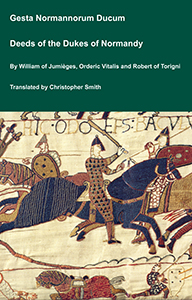
The Deeds of the Dukes of Normandy
The Gesta Normannorum Ducum [The Deeds of the Dukes of Normandy] is a landmark medieval chronicle tracing the rise and fall of the Norman dynasty from its early roots through the pivotal events surrounding the Norman Conquest of England. Originally penned in Latin by the monk William of Jumièges shortly before 1060 and later expanded at the behest of William the Conqueror, the work chronicles the deeds, politics, battles, and leadership of the Norman dukes, especially William’s own claim to the English throne. The narrative combines earlier historical sources with firsthand information and oral testimony to present an authoritative account of Normandy’s transformation from a Viking settlement into one of medieval Europe’s most powerful realms. William’s history emphasizes the legitimacy, military prowess, and governance of the Norman line, framing their expansion, including the conquest of England, as both divinely sanctioned and noble in purpose. Later chroniclers such as Orderic Vitalis and Robert of Torigni continued the history, extending the coverage into the 12th century, providing broader context on ducal rule and its impact. Today this classic work remains a foundational source for understanding Norman identity, medieval statesmanship, and the historical forces that reshaped England and Western Europe between 800AD and 1100AD.
Available at Amazon in eBook and Paperback format.
John Evelyn's Diary. 10th February 1656. I heard Dr. Wilkins [aged 41] preach before the Lord Mayor in St. Paul's [Map], showing how obedience was preferable to sacrifice. He was a most obliging person, who had married the Protector's [aged 56] sister, and took great pains to preserve the Universities from the ignorant, sacrilegious commanders and soldiers, who would fain have demolished all places and persons that pretended to learning.
John Evelyn's Diary. 10th July 1656. I returned homeward, passing again through Colchester, Essex [Map]; and, by the way, near the ancient town of Chelmsford, Essex [Map], saw New Hall, built in a park by Henry VII. and VIII., and given by Queen Elizabeth to the Earl of Sussex, who sold it to the late great Duke of Buckingham, and since seized on by Oliver Cromwell [aged 57] (pretended Protector). It is a fair old house, built with brick, low, being only of two stories, as the manner then was; the gate-house better; the court, large and pretty; the staircase, of extraordinary wideness, with a piece representing Sir Francis Drake's action in the year 1580, an excellent sea-piece; the galleries are trifling; the hall is noble; the garden a fair plot, and the whole seat well accommodated with water; but, above all, I admired the fair avenue planted with stately lime trees, in four rows, for near a mile in length. It has three descents, which is the only fault, and may be reformed. There is another fair walk of the same at the mall and wilderness, with a tennis-court, and pleasant terrace toward the park, which was well stored with deer and ponds.


John Evelyn's Diary. 20th August 1656. Was a confused election of Parliament called by the Usurper [aged 57].

John Evelyn's Diary. 14th September 1656. Now was old Sir Henry Vane [aged 43] sent to Carisbrook Castle, in Wight, for a foolish book he published; the pretended Protector [aged 57] fortifying himself exceedingly, and sending many to prison.
On 15th September 1656 John Dethick was knighted by Oliver Cromwell [aged 57].
After 1657 Colonel Silius Titus [aged 34] was appointed Groom of the Bedchamber by King Charles II of England Scotland and Ireland [aged 26] for having published a pamphlet "Killing No Murder" advocating the assassination of Oliver Cromwell [aged 57].
John Evelyn's Diary. 10th February 1657. I went to visit the governor of Havannah, a brave, sober, valiant Spanish gentleman, taken by Captain Young, of Deptford, when, after twenty years being in the Indies, and amassing great wealth, his lady and whole family, except two sons, were burned, destroyed, and taken within sight of Spain, his eldest son, daughter, and wife, perishing with immense treasure. One son, of about seventeen years old, with his brother of one year old, were the only ones saved. The young gentleman, about seventeen, was a well-complexioned youth, not olive-colored; he spoke Latin handsomely, was extremely well-bred, and born in the Caraccas, 1,000 miles south of the equinoctial, near the mountains of Potosi; he had never been in Europe before. The Governor was an ancient gentleman of great courage, of the order of St. Jago, sorely wounded in his arm, and his ribs broken; he lost for his own share £100,000 sterling, which he seemed to bear with exceeding indifference, and nothing dejected. After some discourse, I went with them to Arundel House [Map], where they dined. They were now going back into Spain, having obtained their liberty from Cromwell [aged 57]. An example of human vicissitude!
John Evelyn's Diary. 25th March 1657. The Protector Oliver [aged 57], now affecting kingship, is petitioned to take the title on him by all his newly-made sycophant lords, etc.; but dares not, for fear of the fanatics, not thoroughly purged out of his rebel army.
On 11th November 1657 [his son-in-law] Robert Rich [aged 23] and Frances Cromwell Baroness Russell [aged 19] were married. He died three months later. She the daughter of Oliver Cromwell [aged 58] and Elizabeth Bourchier [aged 59]. He the son of Robert Rich 3rd Earl Warwick [aged 46] and Anne Cavendish Countess Warwick.

On 18th November 1657 [his son-in-law] Thomas Belasyse 1st Earl Fauconberg [aged 30] and Mary Cromwell Countess Fauconberg [aged 20] were married. She by marriage Viscountess Faunconberg. She the daughter of Oliver Cromwell [aged 58] and Elizabeth Bourchier [aged 59].
In 1658 John Marlay [aged 68] offered to sell the Royalists' plans for the restoration of Charles II to Oliver Cromwell [aged 58] for £100 and permission to return home. His reputation never recovered from this act of treason.
On 2nd August 1658 [his daughter] Elizabeth Cromwell [aged 29] died.
John Evelyn's Diary. Death and Funeral of Oliver Cromwell3rd September 1658. Died that arch-rebel, Oliver Cromwell [aged 59], called Protector.
The History of William Marshal was commissioned by his son shortly after William’s death in 1219 to celebrate the Marshal’s remarkable life; it is an authentic, contemporary voice. The manuscript was discovered in 1861 by French historian Paul Meyer. Meyer published the manuscript in its original Anglo-French in 1891 in two books. This book is a line by line translation of the first of Meyer’s books; lines 1-10152. Book 1 of the History begins in 1139 and ends in 1194. It describes the events of the Anarchy, the role of William’s father John, John’s marriages, William’s childhood, his role as a hostage at the siege of Newbury, his injury and imprisonment in Poitou where he met Eleanor of Aquitaine and his life as a knight errant. It continues with the accusation against him of an improper relationship with Margaret, wife of Henry the Young King, his exile, and return, the death of Henry the Young King, the rebellion of Richard, the future King Richard I, war with France, the death of King Henry II, and the capture of King Richard, and the rebellion of John, the future King John. It ends with the release of King Richard and the death of John Marshal.
Available at Amazon in eBook and Paperback format.
On 3rd September 1658 Oliver Cromwell [aged 59] died at Whitehall Palace [Map]. His son Richard [aged 31] succeeded Lord Protector.
John Evelyn's Diary. 22nd October 1658. Saw the superb funeral of the protector [deceased]. He was carried from Somerset House [Map] in a velvet bed of state, drawn by six horses, housed with the same; the pall held by his new lords; Oliver lying in effigy, in royal robes, and crowned with a crown, sceptre, and globe, like a king. The pendants and guidons were carried by the officers of the army; the imperial banners, achievements, etc., by the heralds in their coats; a rich caparisoned horse, embroidered all over with gold; a knight of honor, armed cap-a-pie, and, after all, his guards, soldiers, and innumerable mourners. In this equipage, they proceeded to Westminster: but it was the most joyful funeral I ever saw; for there were none that cried but dogs, which the soldiers hooted away with a barbarous noise, drinking and taking tobacco in the streets as they went.
Samuel Pepys' Diary. 19th September 1660. Office Day. I put on my mourning and went to the office. At noon thinking to have found my wife in hers, I found that the tailor had failed her, at which I was vexed because of an invitation that we have to a dinner this day, but after having waited till past one o'clock I went, and left her to put on some other clothes and come after me to the Mitre tavern in Wood-street (a house of the greatest note in London), where I met W. Symons, and D. Scobell, and their wives, Mr. Samford, Luellin, Chetwind, one Mr. Vivion, and Mr. White1, formerly chaplin to the Lady Protectresse [aged 62]2 (and still so, and one they say that is likely to get my Lady Francess [aged 22] for his wife). Here we were very merry and had a very good dinner, my wife coming after me hither to us.
Note 1. According to Noble, Jeremiah White married Lady Frances Cromwell's waiting-woman, in Oliver's lifetime, and they lived together fifty years. Lady Frances had two husbands, Mr. Robert Rich and Sir John Russell of Chippenham [aged 20], the last of whom she survived fifty-two years dying 1721-22 The story is, that Oliver found White on his knees to Frances Cromwell, and that, to save himself, he pretended to have been soliciting her interest with her waiting-woman, whom Oliver compelled him to marry. (Noble's "Life of Cromwell", vol. ii. pp. 151, 152.) White was born in 1629 and died 1707.
Note 2. Elizabeth, wife of Oliver Cromwell.
Samuel Pepys' Diary. 4th December 1660. From thence I to my Lord's, and dined with him and told him what we had done to-day. Sir Tho. Crew [aged 36] dined with my Lord to-day, and we were very merry with Mrs. Borfett, who dined there still as she has always done lately. After dinner Sir Tho. and my Lady to the Playhouse [Map] to see "The Silent Woman". I home by water, and with Mr. Hater in my chamber all alone he and I did put this morning's design into order, which being done I did carry it to Sir W. Batten [aged 59], where I found some gentlemen with him (Sir W. Pen [aged 39] among the rest pretty merry with drink) playing at cards, and there I staid looking upon them till one o'clock in the morning, and so Sir W. Pen and I went away, and I to bed. This day the Parliament voted that the bodies of Oliver, [his former son-in-law] Ireton, Bradshaw, &c., should be taken up out of their graves in the Abbey, and drawn to the gallows, and there hanged and buried under it: which (methinks) do trouble me that a man of so great courage as he was, should have that dishonour, though otherwise he might deserve it enough.


On 28th January 1661 the remains of Oliver Cromwell, [his former son-in-law] Henry Ireton and John Bradshaw were exhumed and mutilated in a posthumous execution.
John Evelyn's Diary. 30th January 1661. This day (Oh, the stupendous and inscrutable judgments of God!) were the carcasses of those arch-rebels, Cromwell, Bradshawe (the judge who condemned his Majesty), and [his former son-in-law] Ireton (son-in-law to the Usurper), dragged out of their superb tombs in Westminster [Map] among the Kings, to Tyburn [Map], and hanged on the gallows there from nine in the morning till six at night, and then buried under that fatal and ignominious monument in a deep pit; thousands of people who had seen them in all their pride being spectators. Look back at October 22 1658, and be astonished! and fear God and honour the King [aged 30]; but meddle not with them who are given to change!
John Evelyn's Diary. 9th August 1661. I first saw the famous Queen Pine brought from Barbadoes, and presented to his Majesty [aged 31]; but the first that were ever seen in England were those sent to Cromwell four years since.
Note. An excellent print in the line manner, 13 inches by 12, was engraved, in 1823, by Robert Grave, from the picture at Strawberry-Hill, of King Charles II., receiving this species of fruit from Rose, his gardener, who is presenting it on his knees, at Dawney Court, Buckinghamshire, the seat of the celebrated Duchess of Cleveland, See hereafter, under 1668, August.

Samuel Pepys' Diary. 3rd September 1662. In our discourse in the boat Mr. Coventry [aged 34] told us how the Fanatiques and the Presbyters, that did intend to rise about this time, did choose this day as the most auspicious to them in their endeavours against monarchy: it being fatal twice to the King [aged 32], and the day of Oliver's death1. But, blessed be God! all is likely to be quiet, I hope.
Note 1. Cromwell had considered the 3rd of September as the most fortunate day of his life, on account of his victories at Dunbar and Worcester. It was also remarkable for the great storm that occurred at the time of his death; and as being the day on which the Fire of London, in 1666, burnt with the greatest fury. B.
In 1665 [his former wife] Elizabeth Bourchier [aged 67] died.
Grammont. This man, whose ambition had opened him a way to sovereign power by the greatest crimes, maintained himself in it by accomplishments which seemed to render him worthy of it by their lustre. The nation, of all Europe the least submissive, patiently bore a yoke which did not even leave her the shadow of that liberty of which she is so jealous; and Cromwell, master of the Commonwealth, under the title of Lord Protector, feared at home, but yet more dreaded abroad, was at his highest pitch of glory when he was seen by the Chevalier de Grammont; but the Chevalier did not see any appearance of a court. One part of the nobility proscribed, the other removed from employments; an affectation of purity of manners, instead of the luxury which the pomp of courts displays all taken together, presented nothing but sad and serious objects in the finest city in the world; and therefore the Chevalier acquired nothing by this voyage but the idea of some merit in a profligate man, and the admiration of some concealed beauties he had found means to discover.
[his father] Robert Cromwell and [his mother] Elizabeth Steward were married.
Grammont. Curiosity to see a man equally famous for his crimes and his elevation, had once before induced the Chevalier de Grammont to visit England. Reasons of state assume great privileges. Whatever appears advantageous is lawful, and every thing that is necessary is honourable in politics. While the King of England sought the protection of Spain in the Low Countries, and that of the States-General in Holland, other powers sent splendid embassies to Cromwell.
Kings Wessex: Great x 23 Grand Son of King Edward "Elder" of the Anglo Saxons
Kings England: Great x 17 Grand Son of King Henry I "Beauclerc" England
Kings Franks: Great x 26 Grand Son of Charles "Charlemagne aka Great" King of the Franks King Lombardy Holy Roman Emperor
Kings France: Great x 21 Grand Son of Hugh I King of the Franks
Kings Duke Aquitaine: Great x 25 Grand Son of Ranulf I Duke Aquitaine
Great x 2 Grandfather: Morgan Williams
Great x 1 Grandfather: Richard Cromwell aka Williams  14 x Great Grand Son of King Henry I "Beauclerc" England
Great x 4 Grandfather: John Cromwell 11 x Great Grand Son of King Henry I "Beauclerc" England
Great x 3 Grandfather: Walter Cromwell 12 x Great Grand Son of King Henry I "Beauclerc" England
Great x 2 Grandmother: Katherine Cromwell 13 x Great Grand Daughter of King Henry I "Beauclerc" England
Great x 3 Grandmother: Katherine Glossop
GrandFather: Henry Cromwell aka Williams 15 x Great Grand Son of King Henry I "Beauclerc" England
Great x 2 Grandfather: Thomas Murfyn
Great x 1 Grandmother: Frances Mirfyn
Father: Robert Cromwell 16 x Great Grand Son of King Henry I "Beauclerc" England
Great x 2 Grandfather: Thomas Warren of Feering in Essex
Great x 1 Grandfather: Ralph Warren
GrandMother: Joan Warren
Great x 2 Grandfather: John Lake alias Davy of Cornwall 
Great x 1 Grandmother: Joan Trelake
Oliver Cromwell 17 x Great Grand Son of King Henry I "Beauclerc" England
GrandFather: William Steward
Mother: Elizabeth Steward