The History of William Marshal was commissioned by his son shortly after William’s death in 1219 to celebrate the Marshal’s remarkable life; it is an authentic, contemporary voice. The manuscript was discovered in 1861 by French historian Paul Meyer. Meyer published the manuscript in its original Anglo-French in 1891 in two books. This book is a line by line translation of the first of Meyer’s books; lines 1-10152. Book 1 of the History begins in 1139 and ends in 1194. It describes the events of the Anarchy, the role of William’s father John, John’s marriages, William’s childhood, his role as a hostage at the siege of Newbury, his injury and imprisonment in Poitou where he met Eleanor of Aquitaine and his life as a knight errant. It continues with the accusation against him of an improper relationship with Margaret, wife of Henry the Young King, his exile, and return, the death of Henry the Young King, the rebellion of Richard, the future King Richard I, war with France, the death of King Henry II, and the capture of King Richard, and the rebellion of John, the future King John. It ends with the release of King Richard and the death of John Marshal.
Available at Amazon in eBook and Paperback format.
St Lythans Burial Chamber is in St Lythans, Glamorganshire, Prehistoric Wales Neolithic Burials.
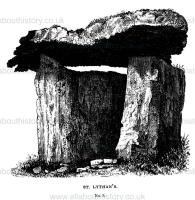
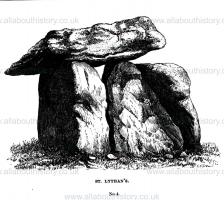
St Lythans Burial Chamber [Map] is a tall Neolithic tomb chamber with large capstone which would originally have been covered in earth and stone. The massive capstone is supported by three unusually tall uprights.
Archaeologia Cambrensis 1874 Pages 59-. The St. Lythan's Cromlech [Map] is certainly a fine one, and, with the exception of the eastern end, presents a perfect chamber. Not a vestige remains of the tumulus, as might have been expected, as it was probably composed of earth. It stands east and west, and presents a chamber 7 ft. 10 ins. by 5 ft. The south wall is formed of a stone measuring 11 ft. 4 ins., while the north one is only 10 ft. 1 inch; so that it seems to have lost a stone which would have made the two side- walls of equal length, a necessary consideration if it were desirable that the eastern slab should fit as closely as possible, so as to leave few interstices to be filled up with small stones. It is generally thought that the three sides of a chamber were first erected, and the capstone placed thereon; then the interment took place, and the fourth side placed last, and the tumulus completed. That such was the practice there can be little question, if it is conceded that the proper course would be to complete the chamber as far as possible before the interment took place. To erect the four sides, then inter, and finally place in position the capstone, would be more inconvenient; and in the case of large capstones, risk to the remains interred would be incurred in case any accident happened in the moving of the capstone into place. As arrangements, moreover, for future interments were necessary, one side must be capable of being removed,which must, therefore, have not supported the capstone; so that it was far more convenient to build up only three sides on capstones, and complete the fourth after the interment. Hence it is that this part of a chamber is almost universally wanting, the other parts generally owing their preservation as contributing to support the capstone.
Cut No. 3 is from a drawing of Mrs. Traherne of Coed-riglan, who has kindly placed it at the disposal of the Society.
Cut No. 4 presents the western view, or back of the cromlech, and is copied from a stereoscope of the Eev. Walter Evans, by Arthur Gore, Esq., to whose ready pencil the Association has been on so many occasions indebted. The general view of this cromlech is exceedingly fine, presenting a grand, massive appearance which any engraving must fail to reproduce.