

Earl Southesk is in Earl.
On 22nd June 1633 David Carnegie 1st Earl Southesk [aged 58] was created 1st Earl Southesk.
In February 1658 David Carnegie 1st Earl Southesk [aged 83] died. His son James [aged 44] succeeded 2nd Earl Southesk.
In January 1669 James Carnegie 2nd Earl Southesk [aged 55] died. His son Robert [aged 20] succeeded 2nd Earl Southesk.
In 1688 Robert Carnegie 3rd Earl Southesk [aged 39] died. His son Charles [aged 26] succeeded 4th Earl Southesk.
On 9th August 1699 Charles Carnegie 4th Earl Southesk [aged 38] died. His son James [aged 7] succeeded 5th Earl Southesk.
In 1716 James Carnegie 5th Earl Southesk [aged 24] attainted by which he lost his Earldom.
In 1730 James Carnegie 5th Earl Southesk [aged 38] died. His third cousin James [aged 14] de jure 6th Earl Southesk.
On 30th April 1765 James Carnegie 3rd Baronet [aged 49] died. His son David [aged 11] de jure 7th Earl Southesk, 3rd Baronet Carnegie of Pittarrow in Kincardine.
On 25th May 1805 David Carnegie 4th Baronet [aged 51] died. His son James [aged 6] de jure 8th Earl Southesk, 4th Baronet Carnegie of Pittarrow in Kincardine.
On 30th January 1849 James Carnegie 5th Baronet [aged 50] died. His son James [aged 21] de jure9th Earl Southesk, 5th Baronet Carnegie of Pittarrow in Kincardine.
On 2nd July 1855 James Carnegie 9th Earl Southesk [aged 27] was restored 9th Earl Southesk, 9th Lord Carnegie of Kinnaird, and the 9th Lord Carnegie of Kinnaird and Leuchars.
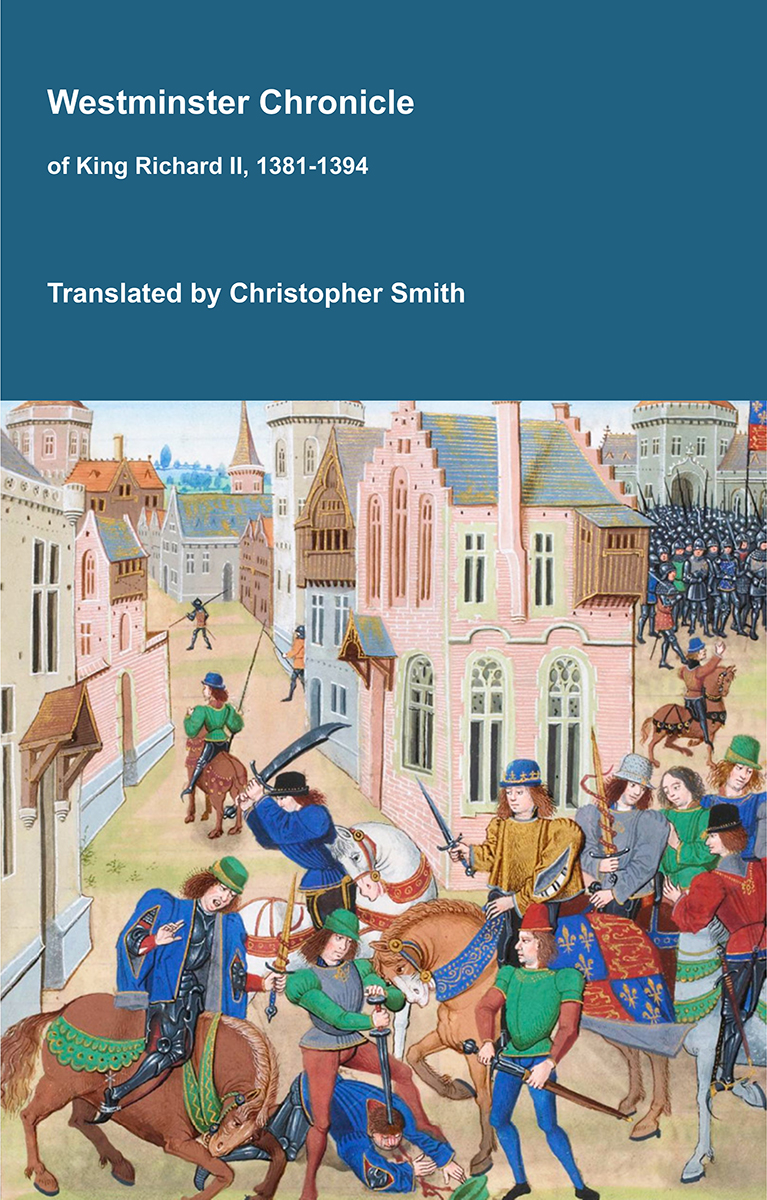
Westminster Chronicle of King Richard II, 1381-1394
The Westminster Chronicle is one of the most vivid and important narrative sources for the reign of Richard II. Written by an anonymous chronicler closely connected with Westminster Abbey, it covers the years 1381 to 1394, from the Peasants’ Revolt to the political tensions, court ceremonies, diplomatic negotiations, royal progresses, and public crises of Richard’s later reign. Rich in detail the chronicle records major events such as the conflicts between the King and Lords Appellant, King and the City of London, negotiations with France and Scotland, the death and funeral of Queen Anne of Bohemia, the illness of Charles VI of France, and the changing fortunes of leading nobles including John of Gaunt, Thomas of Gloucester, Robert de Vere, and the Earl of Arundel. The Chronicle offers readers a remarkable window into late fourteenth-century England, combining political observation, courtly spectacle, urban drama, ecclesiastical affairs, and moral judgement. It is an essential source for anyone interested in medieval monarchy, London, Westminster, and the troubled reign of Richard II.
Available at Amazon in eBook and Paperback format.
In 1860 James Carnegie 9th Earl Southesk [aged 32] and Susan Catherine Mary Murray Countess Southesk [aged 22] were married. She by marriage Countess Southesk. She the daughter of Alexander Murray 6th Earl Dunmore and Catherine Herbert Countess Dunmore [aged 45]. He the son of James Carnegie 5th Baronet.
On 21st February 1905 James Carnegie 9th Earl Southesk [aged 77] died. His son Charles [aged 50] succeeded 10th Earl Southesk, 6th Baronet Carnegie of Pittarrow in Kincardine.
On 10th November 1941 Charles Noel Carnegie 10th Earl of Southesk [aged 87] died. His son Charles [aged 48] succeeded 11th Earl Southesk, 7th Baronet Carnegie of Pittarrow in Kincardine. Princess Maud Duff Countess Southesk [aged 48] by marriage Countess Southesk.


Grammont. The next day the news was made public, and the whole court was eager to pay her that respect, from a sense of duty, which in the end became very sincere.
The petits-maîtres who had spoken against her, seeing their intentions disappointed, were not a little embarrassed. Women are seldom accustomed to forgive injuries of this nature; and, if they promise themselves the pleasure of revenge, when they gain the power, they seldom forget it: in the present case, however, the fears of these petits-maîtres were their only punishment.
The Duchess of York, being fully informed of all that was said in the cabinet concerning her, instead of shewing the least resentment, studied to distinguish, by all manner of kindness and good offices, those who had attacked her in so sensible a part; nor did she ever mention it to them, but in order to praise their zeal, and to tell them, "that nothing was a greater proof of the attachment of a man of honour, than his being more solicitous for the interest of his friend, or master, than for his own reputation:" a remarkable example of prudence and moderation, not only for the fair sex, but even for those who value themselves most upon their philosophy among the men.
The Duke of York, having quieted his conscience by the declaration of his marriage, thought that he was entitled, by this generous effort, to give way a little to his inconstancy: he therefore immediately seized upon whatever he could first lay his hands upon: this was Lady Carnegy, had been in several other hands. She was still tolerably handsome, and her disposition, naturally inclined to tenderness, did not oblige her new lover long to languish. Every thing coincided with their wishes for some time: Lord Carnegy, her husband, was in Scotland; but his father dying suddenly, he as suddenly returned with the title of Southesk, which his wife detested; but which she took more patiently than she received the news of his return. Some private intimation had been given him of the honour that was done him in his absence; nevertheless, he did not shew his jealousy at first; but, as he was desirous to be satisfied of the reality of the fact, he kept a strict watch over his wife's actions. The Duke of York and her ladyship had, for some time, been upon such terms of intimacy, as not to pass their time in frivolous amusements; however, the husband's return obliged them to maintain some decorum: he therefore never went to her house, but in form, that is to say, always accompanied by some friend or other, to give his amours at least the appearance of a visit.


