

In 1505 [her father] Thomas More [aged 26] and [her mother] Jane Colt were married.


In 1505 Margaret More was born to Thomas More [aged 26] and Jane Colt.
In 1511 [her mother] Jane Colt died.
Around 1519 William Roper [aged 23] and Margaret More [aged 14] were married.

Around 1523 [her daughter] Mary Roper was born to [her husband] William Roper [aged 27] and Margaret More [aged 18]. She married before June 1556 James Bassett, son of John Bassett of Tehidy and Umberleigh and Honor Grenville Viscountess Lisle, and had issue.
In 1532 [her son] Thomas Roper was born to [her husband] William Roper [aged 36] and Margaret More [aged 27]. He married in or before 1557 Lucy Browne and had issue.
On 6th July 1535 [her father] Thomas More [aged 57] was beheaded on Tower Hill [Map]. He was buried at St Peter ad Vincula Church, Tower of London [Map].
Letters and Papers Foreign and Domestic Henry VIII 1535. 3rd June 1535. 815. Sir [her father] Thomas More [aged 57] to Margaret Roper [aged 30].
Writes, as it is likely she has heard that he was before the Council this day. Perceives little difference between this time and the last. As far as he can see, the whole purpose is to drive him to say precisely one way or the other. My lord of Canterbury [aged 45], my Lord Chancellor [aged 47], lords Suffolk [aged 51] and Wiltshire [aged 58], and Mr. Secretary [aged 50], were here. Mr. Secretary said he had told the King about More's answer, and he was not content, but thought More had been the occasion of much grudge in the realm, and had an obstinate mind and an evil towards him, and he had sent them to command him to make a determinate answer whether he thought the statute lawful or no, and that he should either confess it lawful that the King should be Supreme Head of the Church of England, or else utter plainly his malignity. Answered that he had no malignity, and therefore could none utter, aud could make no answer but what he had made before. Is sorry that the King had such an opinion of him, but comforts himself, knowing that the time shall come when God shall declare his truth towards the King. His case is such that he can have no harm, though he may have pain, "for a man may in such a case lose his head, and have no harm." Has always truly used himself, looking first upon God and next upon the King, according to the lesson his Highness taught him at first coming to his service. Can go no further and make no other answer. To this the Lord Chancellor and Secretary said that the King might by his laws compel him to give an answer. Said this scemed hard, if his conscience were against it, to compel him to speak either to the loss of his soul or the destruction of his body. Mr. Secretary referred to More's having compelled heretics to answer whether they believed the Pope to be Head of the Church or not, and asked why the King should not similarly compel him? Replied that there was a difference between what was taken for an undoubted thing throughout Christendom, and a thing that was merely agreed in this realm, and the contrary taken for truth elsewhere. Mr. Secretary answered that they were as well burned for denying that, as they were beheaded for denying this, and therefore as good reason to compel men to answer one us the other. Answered that a man is not so bound in conscience by a law of one realm as by a law of Christendom; the reasonableness or unreasonableness of binding a man to answer stands not in the difference between heading and burning, but in the difference between heading and hell. In conclusion they offered him an oath to answer truly what wus asked him on the King's behalf concerning his person. Said he never purposed to swear any book oath while he lived. They said he was very obstinate to refuse that, for every man does it in the Star Chamber and elsewhere. Replied that he could well conjecture what would be part of his interrogatories, and it was as well to refuse them at first as afterward. The interrogatories were then shown him, and they were two:—whether he had seen the statute, and whether he thought it a lawful made statute or not. Refused the oath, and said he had already confessed the first and would not answer the second. Was thereupon sent away. In the communication before, it was said that it was marvel that he stuck so much in his conscience while he was not sure therein. Said he was sure that his own conscience might very well stand with his own salvation. It was also said to him that if he had as soon be out of the world as in it, why did he not speak plain out against the statute; it was clear that he was not content to die, though he said so. Answered that he has not been a man of such holy living that he might be bold to offer himself for death, lest God, for his presumption, might suffer him to fall. In conclusion, Mr. Secretary said he liked him worse than the last time, for then he pitied him, but now he thought he meant not well. God knows he means well. Wishes his friends to be of good cheer and pray for him.
Headed: Another letter written and sent by Sir Thos. More to his daughter Mistress Rooper, written A.D. 1535, 27 Hen. VIII.


Around 1536 Hans Holbein The Younger [aged 39]. Drawing of Margaret More [aged 31] known by her married name of "Margaret Roper".
In 1544 Margaret More [aged 39] died.
On 4th January 1578 [her former husband] William Roper [aged 82] died.
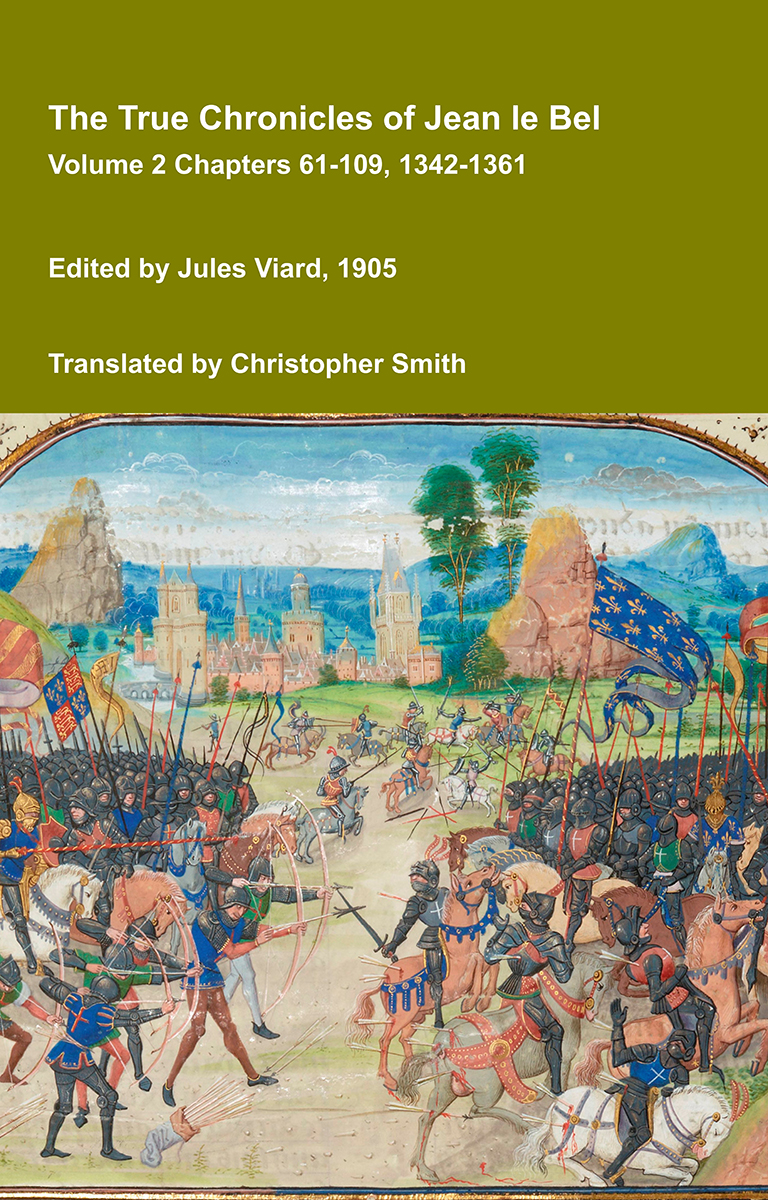
The True Chronicles of Jean le Bel Volume 2 Chapters 61-109 1342-1361
The Chronicle of Jean le Bel, Volume 2 continues one of the most important fourteenth-century accounts of the early Hundred Years’ War. Written by the Liège chronicler Jean le Bel, this vivid narrative follows the fortunes of Edward III, Jean II of France, the Black Prince, the great nobles of France and England, and the soldiers, captains and companies who shaped the conflict. This volume covers some of the most dramatic events of the period, including the battles of Crécy and Poitiers, the siege and capture of Calais, the captivity of King John, the rise of the Jacquerie, the turmoil in Paris under Étienne Marcel and Charles of Navarre, the devastation caused by the free companies, Edward III’s great campaign of 1359–1360, and the negotiations leading to the Treaty of Brétigny. Jean le Bel’s chronicle is especially valuable for its lively detail, its interest in chivalry, warfare, politics and reputation, and its influence on later chroniclers, most famously Froissart. This English translation presents the text in clear, readable British English while preserving the force and character of the original narrative. The translation includes extensive notes to help the reader better understand Jean le Bel's text. Volume 2 also includes translated appendices drawn from royal and administrative records, many from the English Record Office, which illuminate Edward III’s campaigns in Brittany, the siege and occupation of Calais, naval preparations, military finance, appointments, safe conducts and related affairs.
Available at Amazon in eBook and Paperback format.
1872. Emma Lucy Madox Brown [aged 28]. "Margaret Roper Receiving the Head of her [her father] Father".
Grandfather: John More
father: Thomas More
Great x 1 Grandfather: Alderman Thomas Graunger
Grandmother: Agnes Graunger
mother: Jane Colt